Australia seeks to expand its influence over the Pacific by incorporating Pacific peoples into its colonial project. Brunhilda writes on the ‘Pukpuk treaty’ between Australia and Papua New Guinea, and its implications for Papuans that will inevitably wind up in the Australian Defence Force. Originally published in Temokalati.
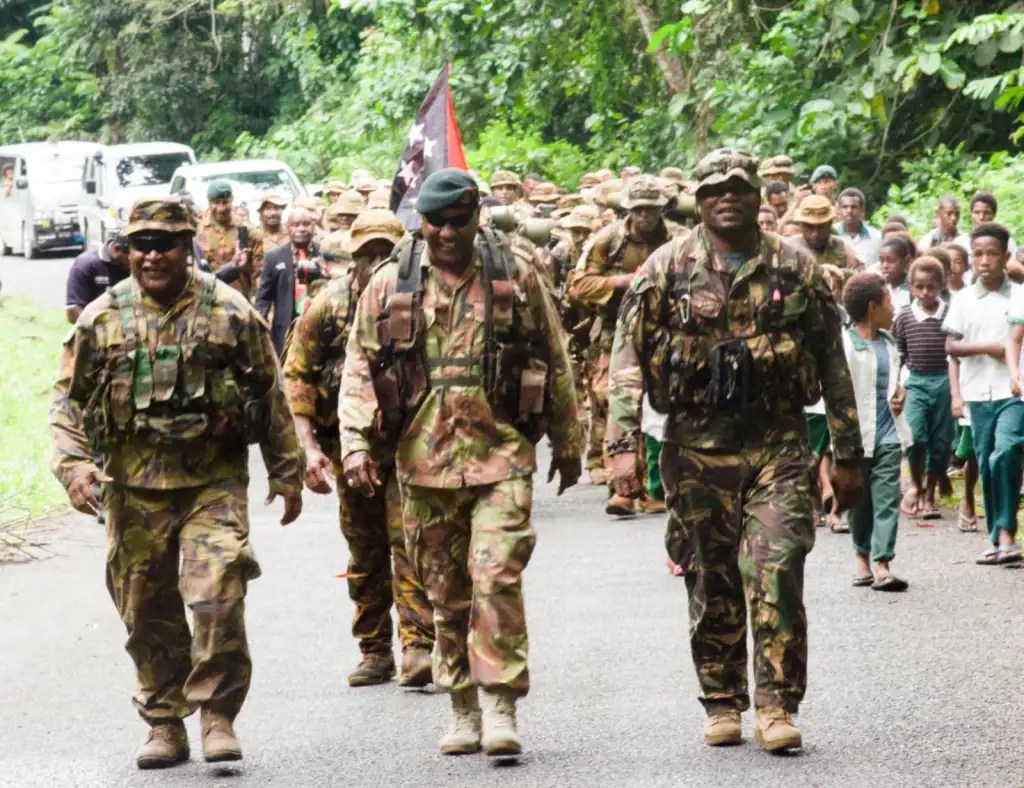
Australia’s foreign policy in the Pacific has taken a worrying trend, with the recent signing of the PNG-Australia Mutual Defence Treaty (the so-called “Pukpuk treaty”) in late 2025. The treaty grants Australian Defence Force (ADF) members extraterritorial legal rights while in PNG (Article 8, Clause 3), and passes the buck on building ADF bases onto the Port Moresby government (Annex C. Article 1, Clause 2). The more noteworthy section of the treaty establishes ADF enlistment for PNG citizens as a pathway to Australian citizenship (Article 5, clause 2, subsection J).
This treaty between Australia and PNG is the first of most likely many such treaties to be signed between imperialist powers and peripheral nations, which does little more than tie these post-colonial countries to their former colonial overlords. As of writing, Australia is negotiating similar treaties with the governments of Fiji (led by coup-master Sitiveni Rabuka) and Napat’s government in Vanuatu. This is part of Australia’s endeavours to “step up their [Australia’s] engagement with their pacific family”, ongoing since 2019.
The Logic of ANZAC Imperialism
This move is far from new. It comes from the fundamental logic of the Australian state, viewing itself as a sub-imperial force in the South Pacific. Australia has never been an independent imperialist power in its own right, only serving as a sub-imperial gendarme of first British, and not American, imperialism in the region. This has allowed the Australian state to build its own little imperialist machine in alliance with that of a greater power. Australia’s sub-imperial nature can be seen in its interactions with South Pacific nations, and more closely, with neighbouring Papua New Guinea. Australia exerted an almost total economic domination over the region, alongside its junior partner New Zealand.
Rather than outright economic gain, these imperialist moves were justified through appeals to national defence and strategic depth. That is to say, Australia aims to use Pacific countries as a kind of human shield against rival powers such as China. Consider the lopsided nature of Australia’s economic relationship with the Pacific region. 24% of PNG’s trade as of 2024 was with Australia; at around $2.19 Billion USD worth of exports, of which in 2024, 92.6% was gold. In contrast, PNG makes up 1.4% of Australian imports, and 0.62% of Australian exports. The Pacific’s main export to Australia is labour, and providing an expansion for military defence via hosting the ADF.
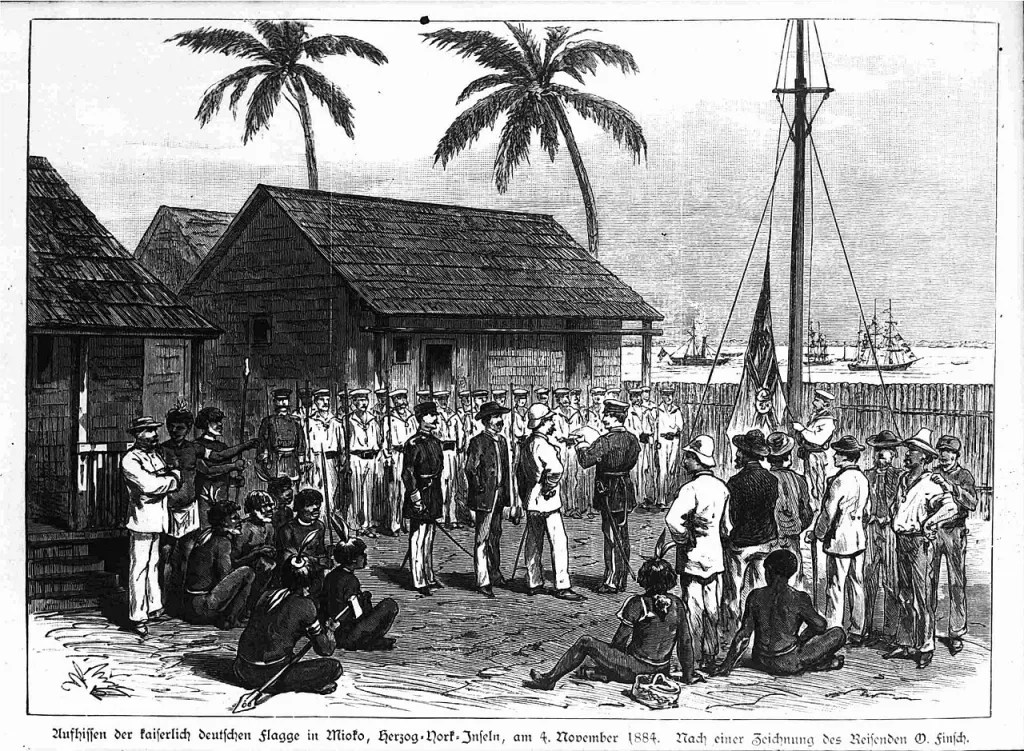
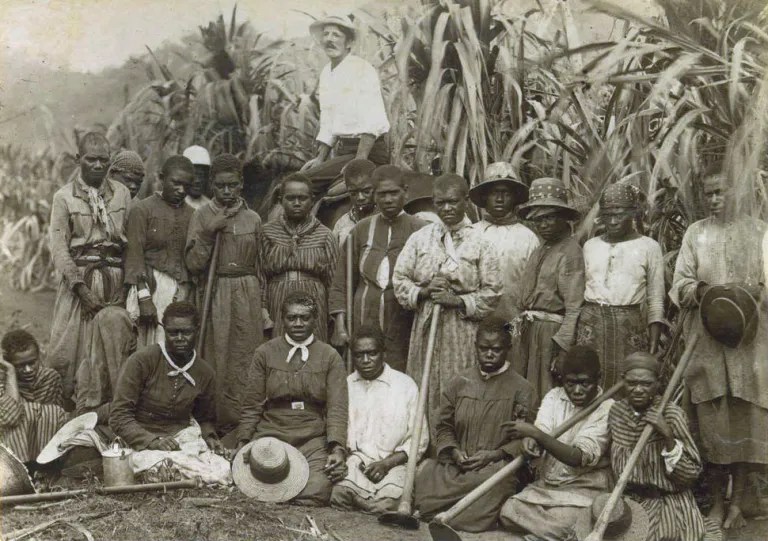
Papua New Guinea is the platonic ideal of Australian imperialism in the Pacific. The initial push by Queensland to illegally (by British standards!) colonise the southern half of the country rationalised itself on the basis that “…the prospect of a major foreign power moving into a region so close to Australia, and consequently threatening the security of the continent and its trade route through Torres Strait to East Asia, was as important as the alleged economic potential” (Roger C. Thompson. Australian Imperialism in the Pacific: The expansionist era 1820-1920 (Melbourne University Press, Melbourne, 1980), 39.). This economic potential, of course, involved the practice of “blackbirding”. In other terms, legally distinct slavery. Thousands of Papuans would be dragged from their villages and spirited away to sugar plantations in North Queensland. The decisive political factor, much as it was in the British colonisation of Fiji in the late 19th century, was the fear of rival colonial powers securing military access to the region, which would put them in a good position to potentially attack Australia. Such powers included France and Germany. Rumours of German colonisation in Papua helped justify efforts by Queensland to launch their own colonisation project.
The lesson of both world wars, the second of which Australia was threatened directly by a rival power (Japan), only reinforced the necessity of maintaining a military alliance with the dominant imperial power in the minds of Australian military planners. This required a continued military hegemony over the Pacific. Tensions between China and the US have given credence to this military vision, and the consensus within Australia’s defence circles is that a war with China is both necessary and inevitable.
Michael Wesley, writing in the occasionally insightful, if fundamentally liberal, Australian Foreign Affairs journal described this tendency as “our pervasive anxiety about the dynamism, difference and poverty of our Asian neighbours”. Australia’s military logic is simple: Australia is simply too big, and has too few people in it. Events such as the infamous Brisbane Lane scandal show that for Australia’s politicians and military planners, the task of defending this giant continent from a potential amphibious invasion is nigh impossible with sacrificing a vast amount of territory to any hypothetical invader. Everywhere outside of the urbanised south-east coast was considered more or less expendable.
The perspective overall is “defence via distance”. This is a strategy that relies on maintaining Australia’s strategic depth through ensuring that no rival power is able to secure a military control over the Pacific. This has been based on the historical division in the Pacific based on Australia and New Zealand’s territorial influence. This division traditionally was between “New Zealand [..] Polynesia, especially Samoa and the Cook Islands, and Australia in Melanesia” (Thompson, R. C., 1980).
Military Blackbirding?
The 2026 Australian National Defence Strategy was met with little to no comment by the socialist left in this country. All anti-imperialists, revolutionists, and socialists in Australia should be concerned with this document, as it heads Australia’s war drive in the Pacific. The document outlines that “the Government remains committed to a permanent ADF of 69,000 by the early 2030s, with continual growth to achieve a permanent ADF and Australian Public Service (APS) combined workforce of around 100,000 by 2040.”
The ADF has had notorious issues with recruitment, and the Australian state aims to fill enlistment gaps with Pacific auxiliary enlistees, predominantly from PNG. What we are seeing in the Pacific is a soft return of “blackbirding”, but this time for the ADF. First, there was the signing of the “Pukpuk treaty”. The treaty allows for up to 10,000 Papuans to be recruited to the ADF, which PM James Marape is more than eager to provide. By providing a pathway to Australian citizenship, and thus an on-paper escape from the poverty and destitution of life in PNG, the ADF becomes an attractive option for Papuans, especially youth.
Serena Sasingan for the Lowy Institute writes that “this defence cooperation presents an opportunity to build shared capability while creating thousands of structured opportunities for PNG’s youth – training, income, and discipline that translate into employability and upward social mobility.” What this fails to discuss however is what this ‘opportunity’ will seriously represent.
As the recruits will only receive Australian citizenship at the end of their service, it is unclear if they will fall under the current ADF industrial award/pay system. Considering the history of the Pacific Australia Labour Mobility (PALM) Scheme, a healthy sense of cynicism should be warranted when looking at the potential for pay equality between PNG recruits, and Australian born members. Neither has there been any news on the potential for these recruits to be trained as officers. Whilst it’s likely that a layer of these recruits will be trained as officers, it is likely to be a particularly narrow one. Those that are integrated into command ranks will be trained with the strategic view of providing a core of politically reliable military officers able to serve in both the ADG and PNGDF (Papua New Guinean Defence Force).
The majority of the recruits most likely will serve as grunts within the broader ADF. It is unlikely that they will serve in a separate regiment; moreso, these recruits will train under white Australian officers, serve under white Australian officers, and be expected to die under the command of white Australian officers.
The strategic hopes of the ADF are clearly that the enlistment of up to ten thousand Papuans will fill gaps in ADF recruiting. Less overtly, the hope is that by dangling yams on a stick, the ADF can ‘dupe’ the destitute peoples of the Pacific into signing their lives away to fight for Australia’s imperial control over the region. This treaty most likely will grant the ADF the strategic bolstering that it hopes for. For the youth of PNG, however, it offers a much grimmer likelihood.
Those accepted into the ADF will be disconnected from their home, taken to another country, and forced to learn a new language; trained to fight and die under the orders of an uncaring officer class that is totally disconnected from them. If a serious war doesn’t come, large amounts of their pay will return home in remittances for their family. Those who choose to return home will face a country defined by severe poverty, a deeply incoherent state apparatus, and only deeper under the grip of imperialism.
If a war does come, they almost certainly will form part of the first wave of Australian forces deployed. The promises of opportunity offered to them will reveal themselves to be the opportunity to be the first shredded apart by a drone, or the first to die choking on their own blood attempting to force a landing. This is to say, black people will once again form an expendable line of human shields.
Beyond Papua
The treaty is likely to be only the first of its kind, as the growing Chinese investment in the South Pacific rallies Australian imperialism, and military expansion. At the time of writing, the new Solomon Islands PM Matthew Wale has announced his intention to sign a new treaty with the Australian government. Little is confirmed, but Wale seemingly hopes to strike a faustian bargain with Canberra for developmental aid. Australia will doubtlessly use their treaty with PNG as the model for securing military control over Pacific nations.
The ongoing war between the US, Israel and Iran has sent ripples across the world economy. The Pacific will see a further implementation of austerity regimes, as Pacific countries with developing economies continue to struggle. It was only twenty years ago when the workers of Tonga took to the streets of the capital in an escalation for the battle for democracy. Of course, as the workers and toilers fought for democracy, it was the 1st Battalion, Royal Australian Regiment (1 RAR) that flew over to crack Tongan skulls.
It is a question of where and when, not if, the revolution will emerge again in the Pacific. When it does, it will undoubtedly be Australian and New Zealander jackboots deployed to smash the workers and toilers. The epoch of peaceful liberalism is over. Albanese can prattle all he wants about the “Pacific family”, but of course, his vision of the “Pacific Family” is one in which Australia and New Zealand hold all the power. Chances are, as ANZAC forces are deployed to reinforce the rule of capital, representatives of the Department of Foreign Affairs and Trade (DFAT) will come rolling in after them with shiny localised treaties, seemingly offering an escape valve for the parasitic ruling class of the Pacific.
The tasks facing us
“Today the imperialist bourgeoisie militarises the youth as well as the adults; tomorrow it may begin militarising the women. Our attitude should be: All the better! Full speed ahead! For the faster we move, the nearer shall we be to the armed uprising against capitalism.” – Vladimir Lenin, On the Disarmament Slogan
As communists, we cannot simply sit back and watch as imperialism raises the threat of generalised war, where the masses of the Pacific will be thrown into the meat grinder under the careless oversight of Australian officers. But to simply try and turn back time or push for a more isolated Pacific would be counterproductive, and politically negligent.
Communists in Australia and in New Zealand have the fundamental duty of fighting against the imperialist actions of their own state. This must include tearing up the Pukpuk treaty, forgiving of all debts from Pacific nations to Australia, and a crash ecological transition. However, we must also be realistic; the chances of a revolution in the heart of ANZAC imperialism at the current moment are non-existent.
As such, our current strategic task must be oriented towards regroupment and cohering a revolutionary program for the Pacific. This must reject the schema of socialism in one country, and instead look towards ensuring a revolutionary wave that overthrows imperialism, not only in the Pacific, but at home as well.
A socialist Polynesia and Melanesia, in fraternal alliance with a revolutionary Australia and New Zealand, would ensure a rapid uplift in the standards of living, as the resources of the entire region are poured into sweeping the legacy of imperialism into the dustbin of history.
But for this to happen, Pasifika workers must see that the workers of Australia and New Zealand stand with them in their fight for democracy and national liberation. As Australia turns its attention to the Pacific once more, communists must be in the forefront of the fight against the militarisation and exploitation of the region. We must fight for the dissolution of the ADF, and the death of Australia’s Foreign Legion before it is born.


 PARTISAN!
You must be logged in to post a comment.