What is a sect? What historical processes have given rise to this organisational form? How can we overcome it? Ewan Tilley addresses the questions for State & Confusion. We republish it here with permission.
I. The crisis of the British left is not a crisis of organisation. It is a crisis of class analysis. The misidentification is not incidental. A left that cannot account for what the class has become cannot build forms adequate to it. It can only build forms adequate to the class it remembers. This is what it has done. The organisational question, posed without the prior question of class composition, does not produce answers. It produces new organisations.
II. Every formation on the British left is organisationally adequate to a working class that has not existed for forty years. The deindustrialisation of the 1970s and 1980s did not merely reduce the size of a class. It destroyed the specific technical composition on which the existing left’s organisational assumptions rest. The mass factory, the union branch, the stable occupational community; these were not incidental backdrops to a politics that could be abstracted from them. They were its conditions of possibility. Those conditions are gone. The organisations remain.
III. The existing left did not develop its organisational forms. It inherited them. Inheritance is not the same as possession. What was received from a previous cycle of struggle has been administered, not developed, preserved in the form in which it arrived, defended against revision, passed on intact. Administration is not politics. The caretaker of a form is not its master.
IV. Class fragmentation has not produced new theory on the British left. It has produced new reasons not to theorise. Movementism substitutes the network for the class. The turn to identity mistakes a real feature of class experience for a replacement of class as analytical category. Social reproduction theory, in its weaker variants, defers the composition question by expanding the terrain on which it must eventually be posed. These are not answers to the harder problem. They are its displacement.
V. The sect is not a failed party. It is a distinct organisational form with its own logic, its own conditions of reproduction, and its own relationship to politics. Analysing it as a party that has not yet succeeded produces only the demand for better leadership, clearer programme, more democratic procedure. The form remains. The sect was produced by defeat and is sustained by the social relations internal to it. Understanding it requires beginning there, not with the party-form it nominally aspires to become.
VI. Programme on the British left is not crystallised from class struggle. It is negotiated among existing tendencies. The document that results is a balance-sheet of internal factional forces at the moment of its drafting. It records what could be agreed. It does not record what the class requires. These are not the same thing and cannot be made the same thing by procedural means.
VII. Theoretical inheritance without theoretical labour is not Marxism. It is genealogy. The reproduction of a lineage is not the development of a science. Most of what the British left calls theory is the restatement of received conclusions in the idiom of their original formulation. The conclusions are defended not because they have been tested against present conditions but because they are constitutive of the tendency’s identity. A tradition that cannot revise its conclusions is not a tradition of thought. It is a tradition of observance.
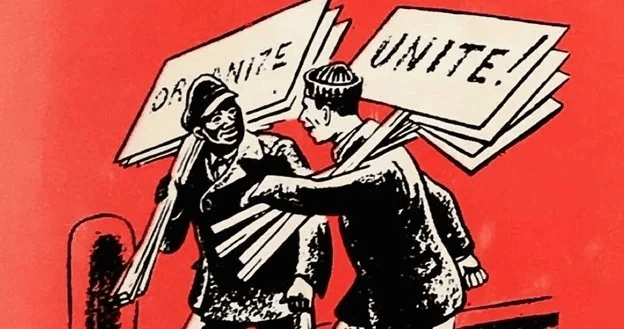
VIII. The unity call is not a strategic proposal. It is the procedural suppression of political difference. It does not produce the conditions for unity. It defers the analysis of why unity is impossible — which is the only analysis from which genuine political convergence could eventually follow. The call for unity is issued most loudly by those with the least interest in that analysis being conducted.
IX. The sect-form does not defer politics. It substitutes for it. The internal life of the sect — the faction fight, the doctrinal dispute, the management of splits and expulsions, the recruitment cycle — is experienced by its members as political activity. It is not. It is the administration of an institution whose relationship to the class it claims to represent has become entirely notional. The sect produces politics as internal event, insulated from the class, answerable only to its own inherited criteria of correctness. This is not an incidental feature. A form whose reproduction depends on doctrinal distinctness cannot afford genuine political engagement with a class that does not recognise its distinctions.
X. The sect-form reproduces itself through the social and psychological needs it meets for its members. This is not an accusation. It is an analytical observation that must precede any serious discussion of supersession. The sect provides identity, community, a sense of historical purpose, and an explanation of the world that is internally consistent and resistant to falsification. These are not trivial things. Any proposal for the supersession of the sect-form that does not account for what it provides will fail to understand why it persists.
XI. The Trotskyist groupuscules are organisationally frozen at the moment of their founding split. Each is the permanent institutional expression of a historical dispute whose political stakes have long since dissolved. The dispute is preserved not because it remains live but because it is constitutive of the organisation’s existence. To abandon it would be to abandon the reason for being a distinct organisation. The groupuscule therefore does not engage with history. It curates a fragment of it.
XII. The Communist Party formations retain the theoretical vocabulary of an international communist movement that no longer exists as an organisational or political reality. The vocabulary functions as identity, not as analysis. Of these formations, the CPGB-PCC is the most theoretically energetic and the most illustrative of the limit. It pursues rigour with genuine seriousness. What it cannot produce is a politics adequate to the present, because the subject to which its rigour might be applied — a recomposed working class with its own political expression — does not yet exist, and the CPGB-PCC has no method for addressing that absence except to continue.
XIII. The electoral left has consistently mistaken a tactical opening for a strategic transformation. The parliamentary conjuncture of 2015 to 2019 was real. What the left built inside it was not adequate to what the conjuncture demanded, and the formations that have followed have not drawn the necessary conclusions. The electoral party reproduces the structural tendency of the electoral form: power concentrated among those who manage the interface with parliamentary politics, programme subordinated to electability, organisational democracy as procedure rather than substance.
XIV. The movementist periphery has not transcended the sect-form. It has inverted it. The substitution of horizontal procedure for vertical doctrine leaves the foundational evasion intact: the refusal to pose the question of the class. The network, the coalition, the campaign are not answers to the party question. They are ways of not asking it. The movementist formation is the sect-form with its internal hierarchy externalised into the relation between paid organisers and a membership that mistakes activism for politics.
XV. What these formations share is not bad leadership or wrong decisions. They share a structural condition. Some are adequate to a politics of a previous moment. Each is sustained by inertia, by the institutional interests of those whose political identity is vested in it, and by the absence of any force capable of posing the alternative with sufficient clarity and weight. Their failures are not contingent, they are produced.
XVI. The British left in aggregate is not a movement in difficulty. It is a set of institutions whose primary function has become self-reproduction. This is a fact, not a polemic. An institution whose resources are directed primarily toward its own continuation has undergone a transformation of purpose regardless of what its founding documents say. The British left has undergone that transformation. Recognising it is the precondition for any serious politics.
XVII. The sect-form cannot be reformed from within its own logic. The demand for better leadership, clearer programme, or more democratic procedure leaves the form intact. It reproduces the conditions it claims to address. This is because the sect’s problems are not procedural failures. They are structural features. A form that substitutes internal life for politics, that negotiates programme among tendencies rather than crystallising it from struggle, that mistakes genealogy for theory does not produce better results when its procedures are improved. It produces the same results more efficiently.
XVIII. The Marxists the sects contain are not identical with the sects. The theoretical and political tendency within each formation is more significant than the organisational shell that houses it. In most cases the shell has become the primary obstacle to that tendency’s development, the condition that limits what can be thought, what can be proposed, what alliances can be made, what conclusions can be stated plainly. The sect protects its Marxists from the consequences of their own analysis. This protection is indistinguishable from suppression.
XIX. The proposal is not unity of organisations. It is unity of persons. Marxists inside and outside the existing formations, organised around theoretical and political positions rather than organisational genealogy or institutional loyalty. The sect-form abolishes itself when those it contains cease to identify their politics with its reproduction, when the cost of remaining inside exceeds the cost of the break. That calculation is not made in the abstract. It is made when an alternative exists that is serious enough to make the cost of the break legible as a cost worth paying.
XX. What that alternative looks like — the organisational forms adequate to the class as it currently exists, the programme that would mean something in this conjuncture, the international dimension without which no national formation can be theoretically serious — has been set out elsewhere in this publication. This is not an evasion. The theses form is diagnostic. The diagnosis has to precede the prescription, and the prescription has to be earned by the quality of the diagnosis. The reader who wants the positive content knows where to find it. The reader who disputes the diagnosis should say so. That is what this publication is for.

 PARTISAN!
You must be logged in to post a comment.