Pauline Hanson’s latest creative project has shocked and mortified liberal Australia. James Eisen reviews the film and reports that Hanson’s animated adventures are not nearly as transgressive as Hanson or her critics would have you believe.

The reaction to A Super Progressive Movie (2026, dir. Sebastian Peart), from both supporters and opponents of Pauline Hanson, is significantly more interesting than the film itself. While this does not bode well for Pauline Hanson’s future at the Oscars, some lessons can be gleaned about the state of Australia in 2026. Writing for Crikey, Alex Zucco and Emily Grace described the film as “a needlessly mean, outwardly racist, nonsensical and ultimately tired One Nation propaganda cartoon”. Watching the film however, the feeling is less of menace than of mediocrity.
A lot is packed into its only one hour and twenty-six minute runtime, but suffice to say, every assorted bugbear of your favourite anti-woke Facebook group is given its time to shine. This is a surreal animated film which gives us an insight into the fantasy land that One Nation and its supporters live in. To give an extremely brief overview, the film follows Pete, a cisgender, heterosexual white man who lives in the dystopian city of Naarm (formerly Melbourne), decolonised through treaty with the use of AI, or “Aboriginal Intelligence”. After being sentenced to death by a feelings-based court (featuring a grotesque David Pocock), he is saved by the intervention of prophecy, when the “Virtue Signal” (a giant Rainbow that protects Naarm by generating a literal bubble) is threatened. Uncle Murray, a “1/16th Aboriginal” man, along with Prime Minister Albanese’s daughter Stacy (depicted as a hairy, bearded man in a princess dress), a non-binary prison-guard and Pete must venture out of the Naarm Bubble and into The Real Australia, ruled by Prime Minister Pauline Hanson, in order to find the ancient “Victimhood”, which can power the Virtue Signal into perpetuity.

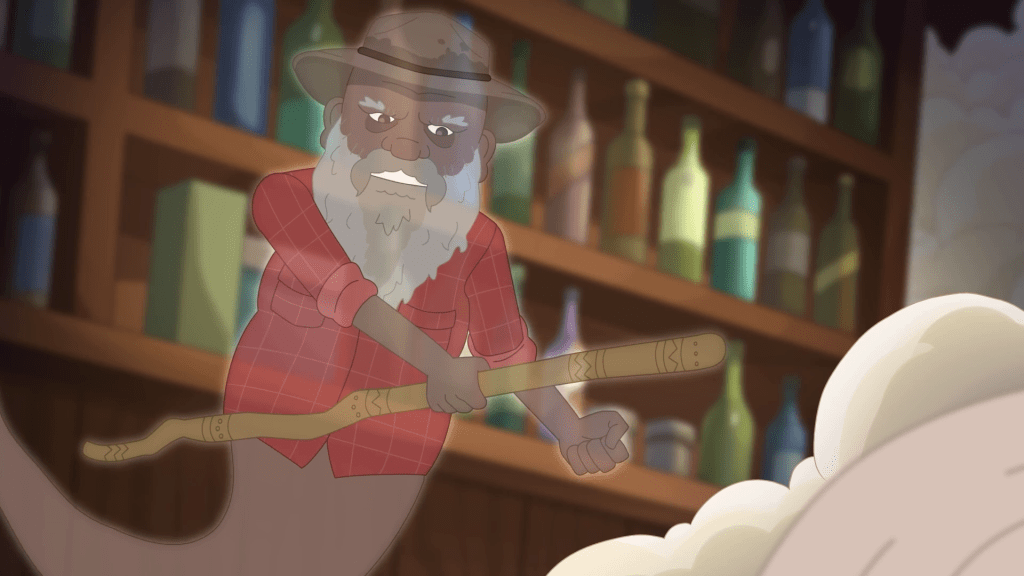
Along the way, Pete begins to discover that maybe The Real Australia isn’t so bad after all. After a great many assorted hijinks, Uncle Murray goes rogue and attempts to steal the Victimhood for himself, but ultimately loses both of his legs as Uluru explodes due to an oil spill. Left for dead, Pete discovers the real Victimhood (after covering his face in the soot from a sixteen-wheeler to look black), and is seduced by its power, returning to Naarm and turning himself into its superpowered dictator. After a meeting with Pauline Hanson, where she explains that her policies have turned Alice Springs into the financial capital of Australia, and a brush with death whereby his Aboriginal great-great grandfather endorses a classic conservative “bootstraps” mentality, Murray returns to Naarm and together with Hanson, frees Pete from the grasp of the Victimhood and imprisons Albo for his crimes.
Unfortunately, there isn’t much to comment on about the artistic expression of the film. It was clearly produced in the cheapest way possible, where all characters were only drawn from two or three angles. Even the climactic invasion of Naarm is animated in the same boring and flat style, which can be assumed to be inspired by South Park or Rick and Morty, but at least Rick and Morty do try and give each season a few set-pieces.
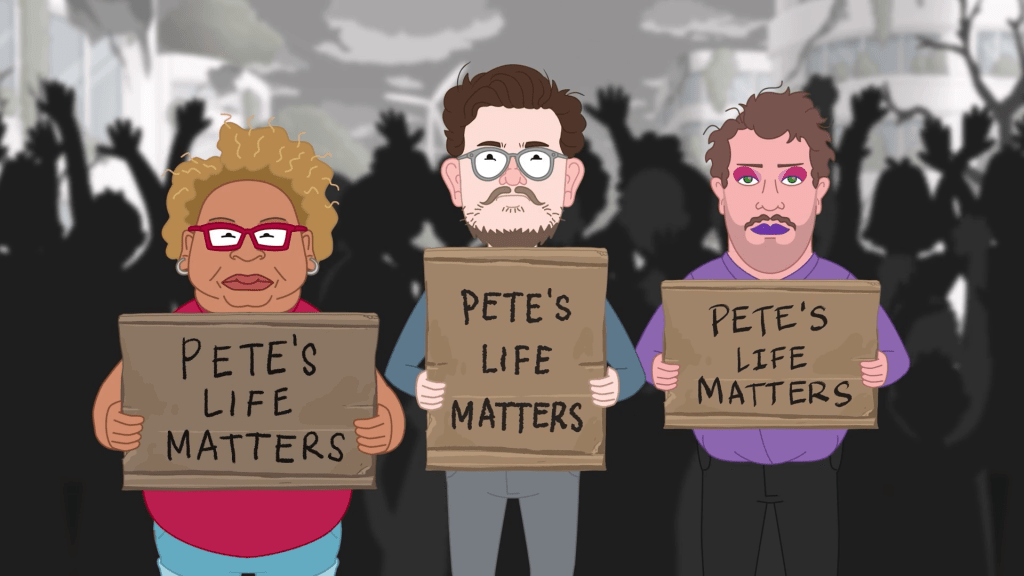
The ideology of the film is far more interesting, not exactly for what it says, but what it doesn’t say. A Super Progressive Movie is a rather ham-fisted way of delivering a classic moderate conservative message. The problem in society is that normal people, who are largely non-racist and willing to get on with their lives, are being ruled over by a tiny elite who wish to make everything about history and making up for past mistakes, and if we could simply agree to stop arguing about Australia Day every year, and instead pull ourselves up by our bootstraps and stop being victims, we would be all the better for it. Pete’s final turn can even be seen as a warning against Hanson’s far-right critics. White men would do well to remember the consequences of wearing the Victimhood. Children, please don’t join the National Socialist Network! If you were watching Jordan Peterson videos in 2015, you’ve heard it all before.
As for the film’s racism, sexism, transphobia, etc? Well, it’s quite mild. The transphobic jokes are very juvenile (reminiscent more of mid 2010s, schoolyard humour), and the titular transgender woman that so much of the marketing of the film was centered upon gives birth at the end of the film, so perhaps they were a cisgender woman all along? There’s a bizarre love-story between Albo’s daughter, Stacy, and the non-binary prison guard, where the prison guard gradually becomes more and more masculine as they are left without their hormones, culminating in a scene where the prison guard explains to Stacy the virtues of “staying in the kitchen”. This is presented as a point of conflict between Stacy and the prison guard, but the merits or lack thereof of the prison guard’s comment go completely unaddressed once the scene is over. They end the film having given birth to two children, and the division of household labour in this couple is left as a mystery to the audience.

For a woman who was thrust onto the national stage by her railing against immigration, the film is noticeably sparse in its riffs on the subject. The only real “anti-immigrant” joke is an Indian gas station employee talking on the phone loudly, and frankly, Hamish and Andy was more risque in its humour. In another scene, a typical “true blue” bogan is revealed to have a Filipino wife, who he loves very much. The message is clear: we love immigrants, as long as they assimilate, and there aren’t too many.
The one minority group where the film’s humour does seem to genuinely go beyond light riffs is Aboriginal Australians. In the world outside of the Naarm bubble, his victim mentality quickly gets him in trouble; he becomes a drunk within five minutes of entering a bar (another character is killed off and ascends to heaven, shown as a “great big RSL in the sky”), he kidnaps a group of Aboriginal children, convincing them of the evils of colonisation, in the process turning them against their policeman father, and getting them hooked on cigarettes. If you were to get your opinions on Indigenous affairs from this movie, which you shouldn’t, you’d come to the conclusion that Alice Springs’s crime problem stems from the bad influence of 1/16th “fake” Aboriginals on the “real” Aboriginals, who would be more than happy to embrace Hanson’s “sensible policies” if it weren’t for the influence of the inner-city educated faux-elite. A distasteful just-so story, nonetheless, it’s basically a repackaging of how American conservatives talk about African Americans, much more “God’s not Dead” than “Triumph of the Will”.
If you have a tolerance for more “edgy” humour, the film may even make you laugh. You can always see when a funny joke is coming, but they still manage to deliver it, such as the previously mentioned salt-of-the-earth bogan having an Asian wife, or in the climax of the movie, where Pauline Hanson saves the day by disguising herself with a Burqa. Unfortunately, these are the few highlights, and most of the jokes are amusing, but not funny. Watch with friends while drunk, and you’ll probably have a good time.
From this review, you may be slightly confused by the disproportionate reaction to the film from the bourgeois press and activists. The film’s politics are ultimately far less radical than it or its critics would like to believe. Beneath the film’s anti-woke aesthetic lies a familiar Australian consensus; social conflict is to be managed, immigration is to be controlled, and we need to all stop thinking of ourselves as victims.
Controlling the movement of labour is part and parcel for capitalist politics. We seem to have spent thirty years proclaiming Hanson to be simply outrageous, without consideration of what part we have played in making her appealing to so many, including many workers. In the absence of the international movement for socialism, protectionism, of both capital and labour, becomes an enticing offer. Is Pauline Hanson any different?


 PARTISAN!
You must be logged in to post a comment.