Rodrigo Paz may go down in Bolivian history as one of the country’s shortest presidencies, after that of Bolivar and Soto. Brunhilda explains that the mass protest movement spreading across the country represents an important juncture in the struggle against capitalism and imperialism in Latin America.
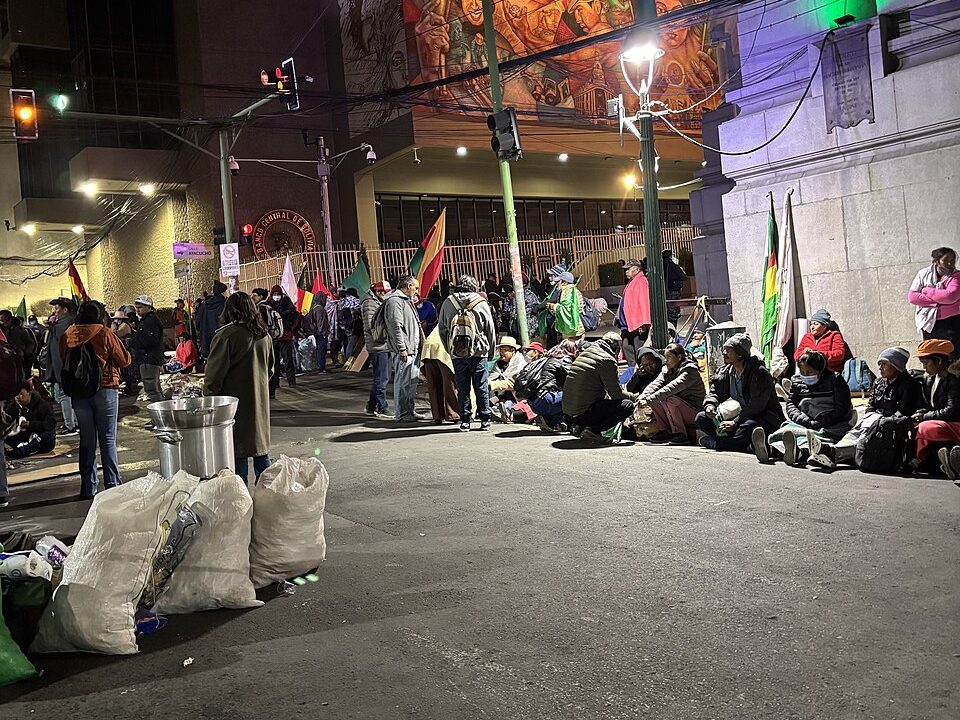
Bolivian President Rodrigo Paz’s six month tenure has been defined by his government’s unending assault against the gains of the 2010s Pink Tide movement, alongside the gains of previous presidents Morales and Acre. Paz was elected on the promise of “Capitalism for All” as a reaction to the foreign exchange crisis that had brought down the previous Movimiento al Socialismo (MAS) government. The electoral victory of the liberal Paz signals the beginning of the end for the “new pink wave” in Latin America, followed by the United State’s criminal attack on Venezuela and the abduction of the former president Nicolas Maduro and his wife Cilia Flores.
The initial wave of protests across the country were triggered by the Paz government’s removal of crucial fuel subsidies, amidst a ‘foreign exchange crisis’ – meaning that there is a severe shortage of US dollars in the government’s treasury. Internationally, the US and Israel continue their assault against Iran, which has sent waves across the world economy. There comes a need for the Paz government to cut spending in the middle of this crisis, which is rubbing up against the interests of Bolivian workers and peasants. It is hard to imagine that a MAS government would have acted any differently. It falls on Paz and his government to break the organised movement of workers and peasants in Bolivia, in order to successfully impose an austerity regime.
Paz’s government issued an arrest warrant for former president Evo Morales on May 11th, after his refusal to attend court to stand trial for accusations of statutory rape which took place during his presidency. Morales has denied all charges and allegations, which were first levied against him in 2024. The attempted arrest was met by mass protests by workers and peasants, concurrent to strikes by the Bolivian Workers Centre (Central Obrera Boliviana, Bolivia’s ACTU equivalent).
The protest movement managed to thwart the attempted arresting of Morales. Further protests and strikes in direct struggle with the Paz government appear to be spreading across the country. Many are demanding Paz’s resignation. Roads and highways have been blockaded by Indigenous Bolivians who form the bulk of Morales’s support base. These protests are demonstrating the overwhelming power of mass action against a government in stasis.
In an attempt to placate protesters, Paz has halved the salaries of himself and his cabinet. However, at the same time, he has repealed Bolivia’s State of Exception law, allowing him to declare an unlimited state of emergency. This legal move allows the government to deploy soldiers against protesters, raising the possibility of military retaliation against protests.
As the struggle deepens in Bolivia, the socialist movement must recognise the importance of Bolivia’s struggle for Latin America as a whole. A potentially successful ousting of Paz by the protest movement would demonstrate a weakness in the liberal and capitalist order, throwing an egg in the face of US imperialism and potentially paving a way forward for revolutionary forces.

 PARTISAN!
You must be logged in to post a comment.