The following theses were written by Edith Fischer and presented to the Fourth General Conference of Communist Unity, January 2026.
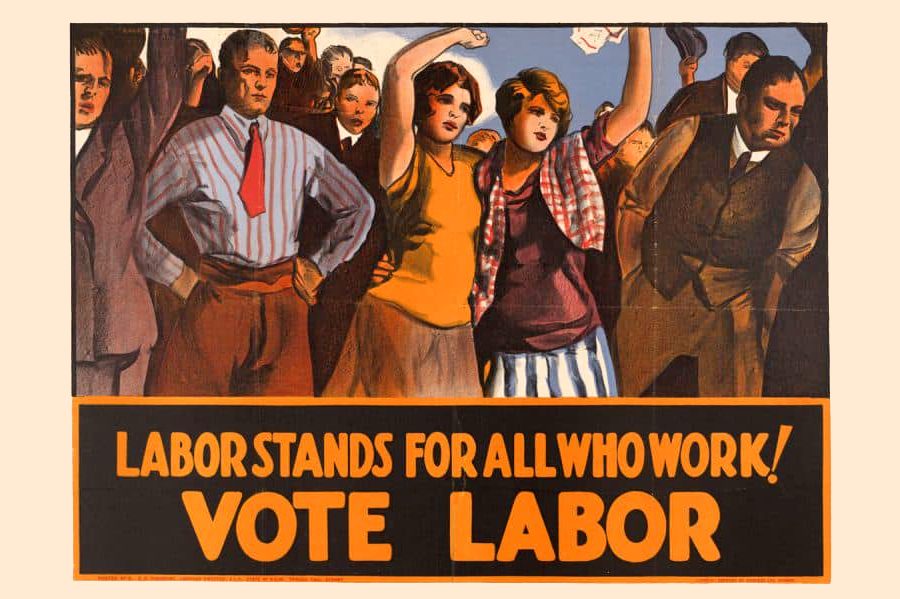
- The Australian Labor Party is central to the political form of the Australian national and political experiment. The Labor Party emerged as an expression of the reformist, petit-bourgeois character of the Australian workers movement in the 19th Century. From the outset, Labor was a corporatist, nationalist, and reformist organisation, representing the interests of the trade union bureaucracy — which in every country is the most conservative and appeasing layer of the organised workers movement. This has given the Labor Party a central role in shaping the development of Australian capitalism. At each historical turning point, the Labor Party has been called into government in order to win the consent of the Australian proletariat and manage Australian capitalism. We reject any notion of a golden age of Laborism.
- The ideology of Laborism is the dominant ideology of the Australian workers movement. As a form of reformism, it is an expression of bourgeois ideology within the working-class.
- Historically – in terms of membership, finances and electoral base – the Labor Party has largely relied on the working-class. Politically, however, the Labor leadership acts in the spirit of the bourgeoisie and the interests of capital. Something ensured in no small measure by the intermediate social position occupied by the trade union bureaucracy, which has a material interest in the continuation of the system of capital. Lenin correctly characterised the Labor Party as a “bourgeois workers’ party”. That is, it is a bourgeois liberal party with a base in the workers movement, which represents the interests of the trade union bureaucracy.
- Throughout its existence the Labor Party has been rent by left-right divisions. In part this reflects the contradiction between the working-class base and the pro-capitalist leadership. In part there is a symbiotic relationship. Right reformism needs working-class votes, but gains coherence through the serious business of trying to secure a parliamentary majority and forming a government. The trade union bureaucracy certainly wants a sympathetic government or one that is at least not overtly hostile. However, the capitalist state, legal system, media, money and corruption set the parameters of what is considered reliable, responsible and, in normal circumstances, electable.
- The right wing of the ALP has been able to use its position as a bourgeoisie worker’s party to more effectively corral working-class opposition to its policies. This can be seen most clearly in the introduction of the Accords and more recently the administration of the CFMEU. This role is key to understanding their attempts to become the allegedly natural choice to govern.
- By contrast, left reformist figureheads are constantly drawn to the right, crucially because they too look towards forming a government, but this time, at least in verbal terms, in order to get hold of the existing capitalist state machine. Left reformists claim this is crucial if their version of bureaucratic socialism is to be realised. The emphasis on the centrality of forming a bourgeois government unites Left and Right Reformism.
- Left reformists tend to compromise with the right in the name of getting elected and are thereby doomed never to secure any lasting or meaningful control over the Labor Party machine, let alone the commanding heights of the parliamentary Labor Party. When left reformists are elected to the leadership, they have little or no impact.
- Overcoming Laborism is a central strategic task for communists in Australia. Toadying as loyal lieutenants to left Laborites, keeping one’s ‘true’ politics under wraps, burying oneself in the bowels of the Labor Party and subordinating everything to staying in there till the glorious day when the class struggle transforms it into an instrument of socialism is naive at best. At worst it is downright treachery. On the other hand, to stand aloof from the Labor Party and its internal disputes and conflicts is as good as useless: a typical left sectarian pose.
- The overthrow of capitalism and the transition to communism requires that the working-class organises independently of the labour bureaucracy. However, a mass Communist Party in Australia is impossible without the communist vanguard closely cooperating with and changing the outlook of the broadest sections of the working-class, not least the membership and base of the Labor Party. There is no contradiction between the fight for a mass Communist Party and the fight to transform the Labor Party, trade unions and cooperatives.
- It is not possible to transform the Labor Party into a communist party, nor is it possible to turn the Labor Party into a vehicle for socialist revolution. We see the Labor Party, like the trade unions and other all-class organisations, as a site of struggle between bourgeois and proletarian trends in the working-class movement (that is, between reformism and communism).
- Historically, communists have effectively contested for influence within the Labor Party, both through the trade unions and through the application of the united front tactic. This reached its apogee in the 1950s, forcing a split within the Labor Party which kept the ALP out of office for decades. Even as its influence declined, the Communist Party of Australia influenced the Labor Party. However, by taking an increasingly reformist orientation under the influence of the Popular Front and Eurocommunism, the CPA functioned to strengthen reformism rather than combat it.
- The organisation that is the Australian Labor party, its core organisational components, personnel and closely linked institutions are dominated by the reformists of both the left and right variety. This is most obvious in the Parliamentary Labor Party (PLP), where Caucus Solidarity, effectively the whims of the Cabinet, overrides the platform put forward at Conference. As demonstrated by the case of Corbyn in the UK’s Labour Party, these forces will viciously resist attempts to democratise what they see as “their Party” and may sacrifice short term electoral gains. They have considerable power and will not hesitate to utilise it to crush threats to their powerful class interests. This does not change the importance of the struggle called for in these theses, however the ALP has built an exceptionally strict whip for a modern political party, which prevents the creation of such a figure, see Fatima Payman. This is an additional challenge Marxists organising in the Labor party must face.
- We reject any strategy of “entryism sui generis” which sacrifices the political and organisation independence of the Communist movement in order to undertake a reform movement inside the Labor Party. We also reject any common front that requires a “non-aggression pact” with the leadership of the Labor Party, including the leadership of the Labor Left.
- Communists urge Labor Party members to organise on the basis of explicitly Marxist – as opposed to left-Laborist, social democratic, Stalinite or Third Worldist – politics. Marxists in the Labor Party should openly advocate extreme democracy in society and throughout the labor movement, working-class rule, and international socialism. Marxists must develop clear proposals to overturn the current, reformist platform of Labor and replace it with a revolutionary program.
- Communists must struggle to establish the Labor Party as a united front for all pro-working class partisans and organisations. Undemocratic bans and proscriptions should be rescinded and all communist, revolutionary socialists, and left groups encouraged to affiliate. This struggle will depend on driving a wedge between Labor’s working-class base and its pro-capitalist tops, exploding the contradictions of this rotten entity. Today, this means standing in resolute opposition to Labor’s union-busting and genocide-backing Albanese government. It means taking up the defence of the CFMEU and those in the crosshairs of the witch-hunting administration; defending the oppressed against the increased repression following the Bondi killings; waging the struggle to break the US alliance and tear up AUKIS. There can be no democratisation of Labor so long as it remains the toady of US imperialism.
- Taking any steps towards democratising Labor will depend on driving a political wedge between Labor’s working class base and its pro-capitalist tops, exploding the contradictions of this rotten entity. Today this means standing in resolute opposition to Labor’s union-busting, genocide-backing Albanese government. It means taking up the defence of the CFMEU and those in the crosshairs of the witch-hunting administration; defending the oppressed against the increasing repression following the Bondi killings; waging the struggle to break the US alliance and tear up AUKUS. There can be no democratisation of Labor so long as it remains the toady of US imperialism. By that we communists mean establishing the Labor Party as a united front for all pro-working class partisans and organisations. Undemocratic bans and proscriptions should be rescinded and all communist, revolutionary socialist, and left groups encouraged to affiliate.
- The fight to democratise the Labor Party cannot be separated from the fight to democratise the trade unions. Trade union votes at Labor Party conferences should be cast not by general secretaries, but proportionately according to the political balance in each delegation.
- The Labor Party must be reorganised from top to bottom. The parliamentary whip must be brought under democratic control. The position of Labor leader should be abolished. Chairs of the parliamentary faction, shadow ministers, etc, should be elected by and accountable to the national executive committee. The national policy forums should be abolished, and the national executive should be unambiguously responsible for drafting Labor Party policy. The national executive should be elected and accountable to the annual Labor Party conference.
- Annual conference must be made into the supreme body of the Labor Party. Instead of a tame rally there must be democratic debate and binding votes, make Labor Party officials and shadow ministers report to the labour movement as servants. Elected representatives must be recallable by the constituency or other body that selected them. That includes Labor MPs, councillors, etc. Without exception elected representatives should take only the average wage of a skilled worker, the balance being donated to furthering the interests of the labour movement.
- Winning the Labor Party for democracy, the working-class and Marxism necessarily involves a protracted struggle against the right wing. These careerists have no legitimate place in the labour movement. The pro-capitalist, pro-imperialist right must be driven out. This includes the current gang of imperialists in the national leadership of both the “Left” and “Right” factions.
- Our goal is not to build a better, more left, more democratic “cleaned up” Labor Party, rather, this struggle would expose those “left” Laborites who from Palestine to AUKUS preach nice-sounding demands but ultimately prioritise unity with the right wing above all else. This struggle would demonstrate the impotence of the left Laborites’ liberal, pacifist program and their inability to carry out their demands.
- In the immediate term, Communist Unity is concerned with developing a nucleus for Marxist activity in the Labor Party. As such, members of CU inside the ALP are expected to form cells and organise on that basis. In particular, we will engage with the Labour Tribune group on the basis of these theses and seek to establish fraternal relations with them. Efforts should be made to enter the Labor Youth movement and seek to establish a communist nucleus within it on the basis of open political struggle and agitation. Along with the Labour Tribune group, CU should seek to fight for a common platform of maximal democracy, workers power, and international socialism within the Labor Party.



 PARTISAN!
You must be logged in to post a comment.