Labor MP and Minister for Health & Ageing and the National Disability Insurance Scheme Mark Butler has announced sweeping cuts to the funding scheme. Max J reports.
Are you an NDIS recipient or support worker? Get in touch with Partisan to share your thoughts: partisanmagazine@proton.me.
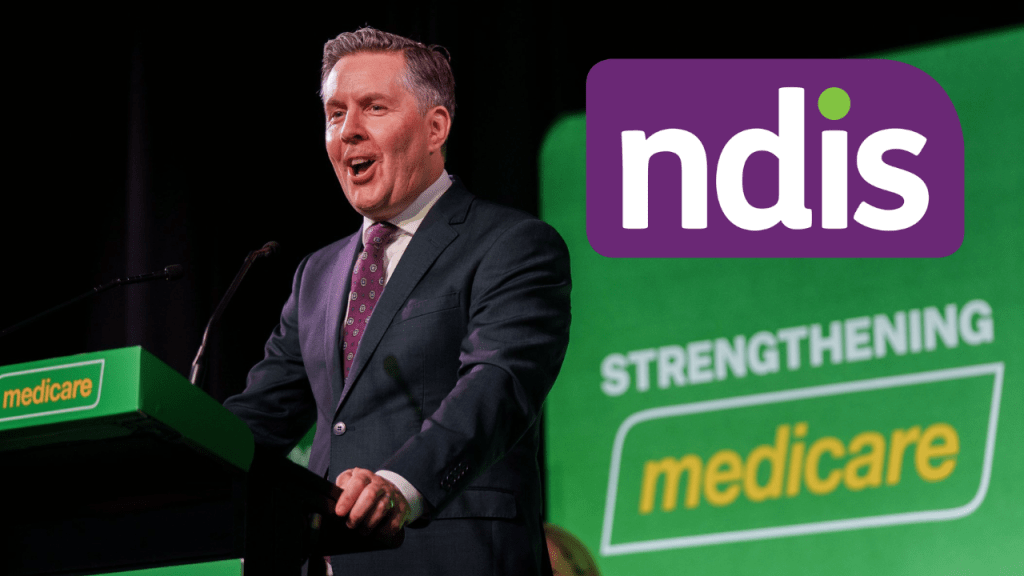
Albanese’s Labor government is set to announce their 2026-2027 budget on May 12th. It has been revealed that part of this budget will involve sweeping cuts to the National Disability Insurance Scheme (NDIS), a funding scheme designed to support people with disabilities.
The NDIS was established in 2012 as a trial scheme by the Gillard government, before being implemented fully. Under the NDIS, recipients would be provided funding for support based on a plan tailored to their needs. This funding is then used to access support services provided by NDIS providers, such as mobility aids, carers, and support workers.
While the NDIS is touted as a disability support scheme, and it by all means does support some disabled people, its primary function is to operate as a financial stimulus for small to medium enterprises (SMEs) which act as “providers” in the NDIS system. While recipients are free to use their funding as they wish via their NDIS plan, the scheme overall is the state paying to support recipients via intermediaries (providers).
The NDIS is also a means of inflating the Australian gross domestic product (GDP). GDP broadly is measured by the transfer of currency, or transactions. As the state pumps billions of dollars into the NDIS, recipients spend this money on providers, and this cash cycles through the economy, inflating GDP reporting.
As a private scheme, the NDIS is rife with fraudulent providers that rort the system. The exact number of fraudulent providers is unclear, but the opaque nature of NDIS funding has created pretext for the Albanese government to cut funding in an attempt to make the scheme sustainable, with a crackdown on providers being rolled out alongside future cuts.
NDIS funding cuts come after skyrocketing costs, far exceeding the expectations laid out by the Abbott government’s 2015 budget. Cuts will include an updated, stricter eligibility process which aims to filter out people with “lower support needs” or “higher functionality” (Mark Butler). While Butler assures recipients that they will be taken off the NDIS and put on “more appropriate” support systems, many report that these systems don’t yet exist, leaving recipients out in the cold.
In a 2025 opinion piece, Butler writes that in order to maintain the NDIS’s “social license”, the scheme’s growth needs to be curtailed. Butler writes:
Taxpayers deserve to know that the big investment made in the NDIS is paying for supports that are actually going to make a difference. The NDIS was established to support people with significant and permanent disability.
And since the scheme’s creation, the number of people with disability entering the system has generally stabilised around initial projections. Except in one area: children with developmental delay or autism.
Just under half of NDIS participants are children under 15, a share that rose again in this month’s latest quarterly report. Tens of thousands of young children with mild to moderate developmental delay or autism are on a scheme set up for permanent disability.
It’s not their parents’ fault. They are desperate to get their children diagnosed because we’ve made it the only way they can get help.
And, too often, they have to wait for ages and pay thousands of dollars just to get that diagnosis.
Families looking for additional supports in mainstream services can’t find them because they largely don’t exist any more.
The NDIS model just doesn’t fit their needs.
Mark Butler, “To keep social license, NDIS growth must be slowed“, 21 August 2025.
In abstract, a support system tailored to the needs of these children would be more effective than a blanket funding scheme such as the NDIS, which can only direct recipients and their families toward a series of private providers. However, as reported, alternative support schemes tailored to children with autism do not exist.
The campaign to cut the NDIS, crackdown on providers and to tighten eligibility criteria is a clear cut case of austerity: the ALP government under Albanese intends to cut social services to balance the budget. For all the flaws of the NDIS system, cuts and restrictions are the least productive way to solve the problem, and will only result in mass destitution for people with disabilities who will be forced into inhumane living conditions. Many will die without access to NDIS support. Since the announcement of the cuts, Butler has assembled a razor gang of ministers and department heads from across the country to implement them.
Many support workers for the NDIS oppose the cuts. An NDIS recipient told the World Socialist Website that “the disability community has already been through a Royal Commission that exposed widespread neglect, discrimination and systemic failures. These proposed cuts risk taking us backwards to those conditions—something no one in our community wants to see repeated.”
Graham Matthews reports in Green Left that “the $50 billion a year spent on NDIS ranks well below the military, which is due to come in at $63.4 billion in 2026–27, rising to $112 billion in 2035–36.” Socialist Alliance calls for a flat 25% tax on gas exports, as well as a 2% tax on individuals with incomes over $5M. This would, in their view, raise ample funds to continue funding the NDIS as is, regardless of the scheme’s future growth.
This recent row proves that the NDIS, while a vital avenue of support for people with disabilities, is not fit for purpose. Instead of a corporate system requiring recipients to interact with private, often for-profit businesses providing services at inflated prices, there should be a nationalised, government-run disability support service. A nationalised system would be far more efficient, as it would reduce the waste produced by prolific SMEs in the disability sector. It would be able to provide the same services to recipients for less cost. Most importantly, it would be democratically accountable, and subject to state oversight by elected governments as well as by people with disabilities who are in the system.


 PARTISAN!
You must be logged in to post a comment.