Antonio Garcia presents a history of the Volga Famine of 1921-22, and argues that it played an underappreciated role in the degeneration of the Russian Revolution.
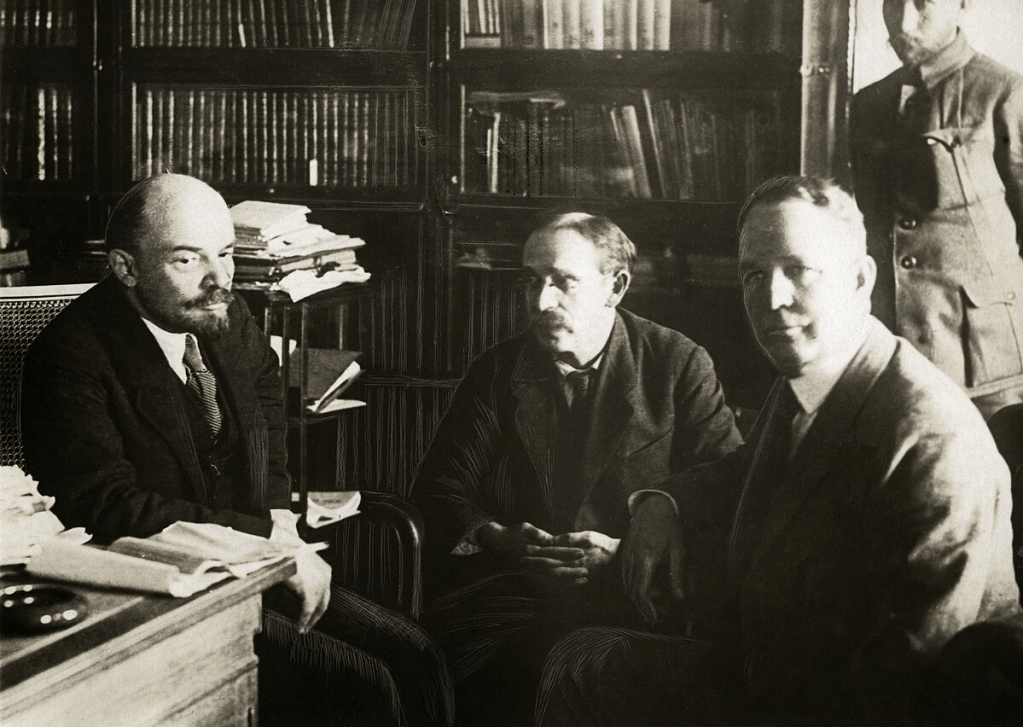
Behold, a Black Horse
In 1917, the workers of the Russian Empire did something extraordinary. After years of declining Tsarist rule, Black Hundreds pogroms, and wars that ravaged the proletariat, they overturned the systems which had sent millions to the slaughter. Rejecting both the feudal autocrats and bourgeois republicans, they charted a new path under the guidance of workers’ councils and a workers’ party. For the first time in Russian history, and arguably, world history, a proletarian dictatorship in the truest sense existed- a state governed entirely by the workers.
Of course, Russia’s ruling classes and those of ‘foreign’ states could not tolerate this. Proletarian dictatorships are incompatible with capitalism, rejecting the market, commodity production, and imperialism, whilst actively seeking to export their revolution worldwide. Thus, every tool of the bourgeoisie was used to stifle the October Revolution. In Siberia, Ukraine, Finland, and the Baltic states, armies mobilised to crush the workers’ revolution by force. ‘Foreign’ armies terrorised the countryside to abort the revolution and secure imperial concessions. Propaganda waxed poetic about the fictional misdeeds of the workers, claiming that babies were being eaten, women were being forced into state-managed prostitution, and that the Bolsheviks were waging war with every country on the planet, from Britain, to Japan, to India1. During this epoch, where class antagonisms between workers and capitalists were most acute and most bloody, it is typical to exclusively examine the overt conflicts taking place. It is easy to solely focus on the military matters of the Russian Civil War and Brest-Litovsk, it is simple to point at foreign legionaries and Red Scare propaganda as the sole source of foreign intervention. These matters, whilst certainly critical to understand the workers’ revolution in Russia, were not the sole ways in which the bourgeoisie assaulted the proletarian state. Indeed, each of these attempts failed- the White, Green, and Black armies were defeated, the legionaries were eventually forced out, Brest-Litovsk was rendered a short-term setback, and the Red Scare gradually subsided.
But one weapon of the bourgeoisie succeeded where all others failed. Where the horsemen of war, disease, and death were defeated, that of famine broke the Bolsheviks’ lines. The process began in 1918, as resistance to the workers’ rule solidified, though it reached its apex in the years 1921 and 1922. During this time, it is estimated that five million people starved to death, predominantly in the Volga region. Cities such as Saratov, Samara, and Astrakhan were decimated as food supplies dwindled, with millions more starving in the countryside. Moreover, the Volga Famine led to major political upheavals that ultimately caused the demise of Russia’s proletarian dictatorship. In 1921, the New Economic Policy (NEP) was passed in direct response to the famine, legalising private property and commodity exchange, thus paving the path for the re-emergence of capitalist relations in the Soviet Union. As the USSR’s counter-revolution accelerated, the fears spawned by the Volga Famine led to much of the political degeneration seen in the Soviet state. The paranoia surrounding saboteurs, the contempt held for the rural population, and the USSR’s pivot from anti-capitalism to ‘anti-imperialism’ (in reality, a facade to support Soviet imperialism) were all ideological trends which were set in motion by the Volga Famine. It is therefore imperative to study the Volga Famine for a full understanding of the workers’ revolution and bourgeois counter-revolution in Russia.
The October Revolution and the ‘Peasant Question’
Before we study the Volga Famine itself, it is important to understand the class composition of the Russian ‘peasantry’ and Bolshevik strategy relating to the ‘peasantry.’ This is because, to jump ahead slightly, the Volga Famine was a man-made famine that emerged from Russia’s ‘peasant’ population. Ergo, to understand the genocide, we must first understand the class which perpetrated it.
In 1861, Tsar Alexander II passed the ‘Edict of Emancipation,’ effectively freeing the empire’s peasants of serfdom… on paper. It abolished serfdom, thereby mandating that peasants be paid for their toil and freeing them from any obligation to remain on ‘their’ land, yet this initial declaration had limited effects. However, what it did serve as is an official acknowledgement of the revolution occurring in the empire’s productive relations during this period2. As time went on, many peasants abandoned their lands, fleeing into the cities to find work and becoming the urban proletariat. Those that remained then transitioned to one of two classes: petite-bourgeois or proletarian. The peasants who were able to maintain their lifestyle, producing for themselves and retaining ‘their’ land, developed into the rural petite-bourgeoisie. As they accumulated wealth, these former peasants were able to hire other former-peasants to work their land, and these employees became the rural working class3. Both classes, however, continually encountered conflict with the aristocrats whom once lorded over them and still held claims over the land. These tensions rose as the poorest peasants were forced to sell or abandon their land, bringing the aristocracy and bourgeoisie into conflict over the newly-vacated real estate.
Thus, by 1900, though the ‘peasantry’ still maintained an identity separate from the urban proletariat and bourgeoisie, they were de facto members of the working or capitalist classes4. Moreover, the process of rural workers migrating to cities continued throughout this period. Thus, whilst there certainly existed a rural proletariat, the majority of Russian peasants were petite-bourgeois5, either self-subsisting on their limited capital, or exploiting the rural workers. It was for this reason that, whilst the Bolsheviks aligned with the ‘poor peasantry,’ they also refused to grant peasants equal rights to workers6. Simply put, whilst some of the ‘peasantry’ were in actuality workers, and whilst almost all peasants supported a revolution against the antiquated feudal order, the working class was a minority and the small proprietors’ anti-aristocratic sentiments were bourgeois, not proletarian, in nature7. Thus, a workers’ state could not grant the peasantry equal rights, as the majority of its members were bourgeois.
Nevertheless, the Bolshevik Party sought to win the ‘peasantry’s’ support. Before, during, and even after the Volga Famine, the Bolshevik programme called for an alliance between workers and peasants. Lenin had long held this view by the time the October Revolution began – from predicting a democratic, inter-class revolution of the ‘peasantry’ and proletariat would overthrow the Tsar in 19058, to pressing for an official worker-peasant alliance once the workers had seized power in 19179. Nikolai Bukharin was slower to accept this position, and held reservations with it even as he adopted it, but ultimately supported Lenin in this move10. Iosif Dzhugashvili, unsurprisingly, supported a worker-peasant alliance, passionately defending it from criticism11. Unfortunately, opposition to this alliance was limited. The most meaningful critiques of the peasantry were put forth by Red Army generals Mikhail Tukhachevsky and Vladimir Antonov-Ovseenko, whom had personally combated the counter-revolutionary peasantry in Tambov, Ukraine, and Siberia. This said, their critiques were packaged in veiled and timid words12, likely due to their unpopularity within the party. International Marxists such as Rosa Luxemburg13 were also critical of the Bolshevik’s support for the peasantry, but lacked the means to overturn the alliance. Other Bolshevik veterans, most notably Lev Trotsky, recognised the counter-revolutionary character of the worker-peasant alliance14, but only arrived at this conclusion well after the Volga Famine. As we shall soon see, this error would prove fatal to the October Revolution.
The Volga Famine
The October Revolution was a revolution in every sense of the word. It was both a revolution of the proletariat, one where it asserted itself as the new ruling class of the state, as well as a revolution in the mode of production, entirely reshaping the way the state and economy functioned. In-line with Marxism and the Bolshevik programme, commodity production was abolished and outlawed, factories were placed under the control of workers’ councils, and both production and distribution were now directed by meticulous plans, removing the need for money. At the same time, the civil war and international intervention required the Soviet state to dedicate its capabilities to military victory. Hence, production’s primary purpose at the time was to serve the war effort. This led to what would later be called ‘War Communism,’ though such a title is unnecessarily obtuse. War Communism was not, as some argue, a separate form of productive relations from socialism; rather, it was a socialist economy whose top priority was the war effort. Just as capitalist economies mobilise for war without adopting a distinct, non-capitalist, mode of production, War Communism was the mobilisation of socialist production.
The implementation of a socialist state and economy was not universally welcomed in Russia. Obviously, the bourgeois republicans and large capitalists stridently opposed it, hence the civil war. Opposition also came from within the Soviet state. Whilst the socialist economy was broadly welcomed in the proletarian-dominated cities, it was reviled by the rural petite-bourgeoisie who found themselves behind enemy lines. Attempts to integrate the countryside into the socialist economy were strongly opposed by the ‘peasantry,’ who, rather than allow their produce to be distributed to those in need, refused to grow any more than they individually needed15. This, led to an immense decline in agricultural production, one that would become increasingly-fatal as natural disasters and the civil war ravaged the remaining productive farms.
In spite of these harsh circumstances, the Bolsheviks managed the agricultural situation well. Through mobilising the workers and Red Army, most of the Soviet state managed to survive these setbacks- at a cost. Large segments of the urban proletariat migrated to the countryside16, some fleeing of their own volition, and others being relocated by the state to improve agricultural output. Working conditions in the cities worsened as hungry workers were compelled to toil long hours to keep the war machine afloat. Several ‘peasant’ revolts were crushed by the Red Army, such as those of Tambov, Trypilla, and Simbirsk. Even this situation was not hopeless. Whilst unrest among the workers struck, most notably during the Krondstadt and Left-SR Revolts, their discipline generally held firm. The workers recognised what was at stake as their state struggled against invaders from all sides, and understood that mobilisation was a temporary measure.
The proletariat’s resolve could not stop every enemy, however. A 1920 drought in the Volga Region caused a natural, unavoidable decline in agricultural output. Whilst Bolshevik stockpiles prevented this drought from becoming a famine, it also emptied the region’s food reserves. As the petite-bourgeoisie continued their refusal to cooperate with the workers, the situation rapidly spiralled. Famine struck suddenly in 1921, affecting approximately fifteen million people in the Volga Region alone17. The famine spread fast, reaching as far south as the Caucasues within months18. All the while, reports indicated the stark contrast between the cities and countryside. Whilst the cities were teeming with fleeing refugees19, overflowing orphanages, and starving workers20, the countryside was notably less affected21. The rural petite-bourgeoisie was initially unfazed by the famine. As workers and their children starved in the cities, the rural petite-bourgeoisie grew enough to feed themselves and their families, but no more.
The rural petite-bourgeoisie’s fortunes shifted in 1922. After months of cultivating the bare minimum, plagues such as locusts and drought22 struck Southern Russia and the Caucasus. These natural impediments, though not particularly severe, destroyed the peasants’ personal reserves. Bolshevik food supplies had long sat empty from the rural petite-bourgeoisie’s lack of output, and the cities were already stretching the state’s capacity to deliver food from other regions23. Thus, the rural petite-bourgeoisie fell victim to its own class interests. In obstinately refusing to part with their capital, they overextended Soviet agricultural capabilities. When natural disruptions to the food supply then emerged, there was no way for the workers to help them. Thus, thousands of ‘peasants’ faced starvation, succumbing to the famine they themselves facilitated.
This led to the Soviets taking an unfavourable bargain. Though they were winning the civil war, both the cities and countryside were starving. As they pushed the last bourgeois armies out of Siberia and Ukraine, the petite-bourgeoisie had unleashed an even deadlier foe in the territorial heart of the revolution. Left without any recourse, they appealed to the bourgeois powers for aid. The United States delivered on these requests, hiring 120,000 Russians24 to feed, according to American sources25, eleven million people each day. Aid also came from international socialist organisations, particularly those of Britain26 and France27. These programs, though they solved the immediate issue of the Volga Famine, were political shocks to the Bolshevik Party. That internal sabotage had forced the state to rely on external support was a lesson the party would never forget. The ensuing policy shifts to eradicate these vulnerabilities would reshape the proletarian dictatorship, ultimately leading to its downfall.
The NEP and the Russian Counter-Revolution
The Volga Famine left the Soviet state with a myriad of urgent problems. The rural petite-bourgeoisie maintained its uncooperative stance, and the state lacked the means to bring them into line. Indeed, the Soviets were reduced to relying on foreign donations and American aid to feed the population, an arrangement which would lead to dependency if left unchecked. Members of the bourgeois class and their sympathisers still ran rampant, some profiteering via the black market and others continuing to resist the workers even as the civil war drew to a close. Several changes in policy were then necessary to alleviate the Volga Famine and to eliminate counter-revolutionary activity.
The first measure taken was the New Economic Policy (NEP). This policy reintroduced private property and commodity production to the USSR, legalising both. Nikolai Bukharin laid out the logic of this policy best, explaining that it was a series of “economic concessions in order to avoid making political concessions.”28 Of course, this theory was misguided. Re-instating capitalism, far from a mere ‘concession’ was more akin to a capitulation. The bourgeoisie, whom had taken up arms against the workers and, after they lost, continued the fight by weaponising famine against them, were now given everything they wanted. Their capital was recognised, and they could profit by selling commodities to the state. Moreover, the ‘Lenin Levy’ of 1923-1925 saw the mass enrolment of Soviet citizens into the Bolshevik Party, including thousands of former ‘peasants.’ In other words, the Soviet state not only capitulated to the bourgeoisie on the economic front, but also politically integrated them thereafter. It’s then no surprise that, when speaking on the NEP, Lenin referred to the policy as “a very severe defeat and retreat.”29 The workers’ state lacked the means to liquidate the petite-bourgeoisie, and the Russian economy was underdeveloped to the extent that ‘peasants’ were still relied on for agriculture. There was thus no choice but to re-instate capitalist relations if the Bolsheviks wanted to prevent future famines, as it was clear the petite-bourgeoisie held no qualms with starving the population for its own ends.
This also led to a re-orientation in Soviet foreign policy. With the bourgeoisie rapidly filling the ranks of the Bolshevik Party, the old policies of internationalism and permanent revolution were reshaped into imperialism and realpolitik. The Third International’s purpose shifted from supporting the international proletarian revolution to serving the imperial interests of the Soviet state. Meanwhile, Moscow brokered deals with the bourgeois powers. American capitalists such as Armand Hammer and Henry Ford opened factories in Moscow and Gorky. Economic ties with French petrol magnates were utilised to build friendly relations with Paris. In later years, the Soviets would even begin exporting to Nazi Germany, sending them, among other things, 1,000,000 tonnes of grain, 900,000 tonnes of mineral oil, and 500,000 tonnes of iron ore. This opportunism only became more acute over time. The ‘Popular Front’ was pushed by Bukharin, and later Dzhugashvili, to build alliances between liberal, national-democratic, and communist parties for the purposes of defeating fascism. Conveniently, the ideologues of this program rarely put up resistance as their bourgeois ‘allies’ in Spain, China, and Italy carried out the same anti-worker repression as the fascists. The Soviets also drew up agreements with both Nazi Germany (Molotov-Ribbentrop Pact) and Great Britain (Anglo-Soviet Agreement) to partition Europe into their respective imperial blocs. The Third International was abolished in 1943. Both The Internationale and Red Army were removed from official Soviet proceedings, replaced by the National Anthem of the Soviet Union and ‘the Soviet Armed Forces.’ Thus, the emerging Soviet bourgeoisie utilised its newfound economic and political power to stifle the international workers’ movement. This process began by inviting foreign firms into the USSR, replacing workers’ control for bourgeois control, and proceeded to entrench bourgeois supremacy by supporting liberal-democratic parties, trading with fascist regimes, abolishing the International, and reshaping proletarian internationalism into bourgeois nationalism.
These shifts brought on by the bourgeois counter-revolution also manifested within the Soviet Union. Hundreds of thousands were deemed ‘counter-revolutionary’ and purged, from those who supported the worker-peasant alliance, such as Bukharin and Trotsky, to those who opposed it, such as Tukhachevsky and Antonov-Ovseenko. Meanwhile, former members of the bourgeoisie were promoted to replace these revolutionaries. Nikolai Bukharin was replaced as the editor of Pravda by former nobleman Mikhail Olminsky. Lev Trotsky was replaced as the People’s Commissar for Foreign Affairs by another former nobleman, Grigory Chicherin. Mikhail Tukhachevsky was demoted and executed whilst former ‘peasants’ such as Semyon Budyonny and Grigory Kulik were promoted. Only Vladimir Antonov-Ovseenko, Prosecutor-General of the Russian SFSR, was replaced as by a former proletarian: Nikolay Rychkov, an ally of Iosif Dzhugashvili. By looking through who was and was not purged in the 1920s-1930s, one can see the shift in the Soviet Union’s class dictatorship. Whilst before the purge one finds an array of workers and petite-bourgeois whom held longstanding histories with the proletarian movement, those that took their places were overwhelmingly former nobles, ‘peasants’, and a few nouveau riche bureaucrats for good measure.
We also find the realities of Volga Famine utilised to justify the atrocities of Dzhugashvili’s regime. That so many revolutionaries were purged under the charge of ‘internal sabotage’ could only mean that there were real fears of sabotage among both the Soviet government and populace. On its own, this appears as simple ‘paranoia,’ a narrative prevalent in the popular consciousness today. However, when one looks at the very real sabotage unleashed by the petite-bourgeoisie during the Russian Civil War, these fears appear much more believable. Though no credible source indicates there was a broad, intentional move by the ‘peasantry’ to cease agricultural production in the 1930s, the fact it had happened before made it believable when the Kremlin pushed the narrative again. The seemingly-nonsensical narratives of the Great Purge and Holodomor then make more sense. It was easy for Moscow to accuse ardent revolutionaries of subterfuge because former Narodniks and Left-SRs genuinely sabotaged the revolution. It was easy to justify the deliberate starvation of ‘peasants’ under the guise of rooting out traitors specifically because they had previously betrayed the workers’ government. Whilst these narratives were, of course, false, they were believable specifically because similar incidents had occurred during the civil war. Maria Spiridonova and Dmitry Popov, lifelong revolutionaries, had already betrayed the workers’ cause, making it conceivable that revolutionaries like Bukharin and Trotsky were doing the same. The rural petite-bourgeoisie had already slain five million through an entirely-intentional famine, thus, the workers believed Dzhugashvili when he claimed they were doing it again a decade later. Far from a spontaneous, irrational bout of societal ‘paranoia,’ we find these fabrications to be precedented in the context of the Soviet Union’s recent history.
The Persisting Relevance of the Volga Famine
It is clear that the consequences of the Volga Famine still reverberate throughout Marxism today. As one of the- but notably not only -catalysts of the Russian Counter-Revolution, much of the degeneration in the workers’ movement since 1921 can be traced back to the genocide. The prevalence of commodity production under ‘socialist’ states, the thoroughly imperialist aims of the ‘Soviet’ Union and ‘People’s’ Republic of China, the insistence that the national bourgeoisie be collaborated with, these failings stem directly from the failings of the October Revolution, Volga Famine, and Russian Counter-Revolution. We thus, as Marxists, must strive to recover from this century-long setback.
First and foremost, a reorientation and reiteration of Marxist political education is an absolute necessity. That the programmes of so many alleged ‘communist’ parties do not even mention abolishing commodity production, wage labour, and how a proletarian dictatorship is to be established, is evidence of the backwards political education plaguing ‘Marxists’ today. This means returning to Marx, Engels, Lenin, and other historical materialists, and refusing the opportunistic ‘modernisations’ put forth by Dzhugashvili, Mao, and their ilk. Marxists must learn to distinguish the interests of the international proletariat from those of imperialism, be it local or ‘foreign.’ A return to form, one which corrects Marxism’s present, non-proletarian political practice30, is absolutely necessary. This does not, of course, mean that we must entirely reject all developments in Marxism since 1921. Rather, we must sift through the mountain of rubbish masquerading as Marxism to distinguish the authentic and useful from the opportunist and nonsensical. We must be, to borrow Marx’s words, “‘ruthlessly critical of all that exists,’”31 utilising only what serves the interests of the workers.
Above all, we must also reject any alliance with the national or petite-bourgeoisie. Countless ‘workers’’ revolutions have tried and failed to form a productive alliance with this class, and to continue pursuing this failed strategy is to succumb to madness. Let the example of the Volga Famine make this point clear: the petite-bourgeoisie would rather wage a suicidal genocide against the proletariat than surrender its property. They do not wish for an alliance with the workers, and the workers must understand this. Capitalists claiming otherwise only seek to use the workers for their own ends: the acquisition of power and a more prestigious position in world imperialism32. Whilst the words of Lenin’s What is to be Done? remain true, that individual members of the petite-bourgeoisie will defect to the workers’ movement, it is evident that this is a rarity, and that the petite-bourgeoisie as a class remains reactionary. We must not, as he later erroneously did, expect a mass defection of the petite-bourgeoisie to the proletarian movement.
The immediate task is then as follows: to undertake a rigorous, holistic correction of modern ‘Marxism,’ dispatching of opportunists’ useless dogmas and elevating the work of authentic revolutionaries. Our strategy must also reject any alliance with the petite-bourgeoisie. This tactic has been tried countless times in societies at all levels of capitalist development- failing in each and every one of them. We cannot waste any more time, energy, and lives on the matter. We must instead begin a reorientation of Marxism back to the proletariat on an international scale; for only then can we build a class party of the proletariat and only the proletariat.
- William Blum, Killing Hope, 1995 ↩︎
- V.I. Lenin, The Workers Party and the Peasantry, 1901 ↩︎
- V.I. Lenin, The Development of Capitalism in Russia, 1899 ↩︎
- ibid. ↩︎
- V.I. Lenin, The Workers Party and the Peasantry, 1901 ↩︎
- Nikolai Bukharin, The New Economic Policy Of Soviet Russia, 1921 ↩︎
- V.I. Lenin, Socialism and the Peasantry, 1905 ↩︎
- V.I. Lenin, Chapter Six from Two Tactics of Social-Democracy in the Democratic Revolution, 1905 ↩︎
- V.I. Lenin, Alliance Between the Workers and Exploited Peasants, 1917 ↩︎
- Nikolai Bukharin, The Peasantry and the Working Class in the Next Historical Period, 1923
↩︎ - J.V. Stalin, The Peasantry as an Ally of the Working Class, 1926 ↩︎
- V. Antonov-Ovseenko, The Red Army, 1923 ↩︎
- Rosa Luxemburg, Chapter Two from The Russian Revolution, 1918 ↩︎
- Leon Trotsky, “On the Reactionary Idea of ‘Two-Class Workers’
and Peasants’ Parties’ for the Orient” from The Third International After Lenin, 1928 ↩︎ - Paul Flewers, “War Communism in retrospect” from What Next?, 1997 ↩︎
- ibid. ↩︎
- Tom Mann, Russia in 1921, 1921 ↩︎
- Harold Buxton, Transcaucasia (South Caucasus): An enquiry into famine conditions undertaken during December 1921 – January 1922, 1922 ↩︎
- Tom Mann, Russia in 1921, 1921 ↩︎
- ibid. ↩︎
- Harold Buxton, Transcaucasia (South Caucasus): An enquiry into famine conditions undertaken during December 1921 – January 1922, 1922 ↩︎
- ibid. ↩︎
- Tom Mann, Russia in 1921, 1921 ↩︎
- Ronald Radosh, “The Politics of Food” published in Humanities, 2011 ↩︎
- Film: American Relief Administration, America’s Gift to Famine Stricken Russia, 1923 ↩︎
- Fridtjof Nansen, “Nansen on Russia: The most appalling famine in recorded history”, published in the Monthly Journal of the Amalgamated Society of Woodworkers, 1922 ↩︎
- Report of the English and French Delegation of the Workers’ International Relief to the economic enterprises of the W.I.R. in Soviet Russia, 1925 ↩︎
- Nikolai Bukharin, The New Economic Policy Of Soviet Russia, 1921 ↩︎
- V.I. Lenin, The New Economic Policy and The Tasks Of The Political Education Departments, 1921 ↩︎
- Mansour Hekmat, Left Nationalism and Working Class Communism, 1987 ↩︎
- Karl Marx, Letter from Marx to Ruge, 1843 ↩︎
- Mansour Hekmat, The Myth of the National and Progressive Bourgeoisie, 1982 ↩︎

 PARTISAN!
You must be logged in to post a comment.