Written by Edith Fischer, presented to the Fourth General Conference of Communist Unity, January 2026.
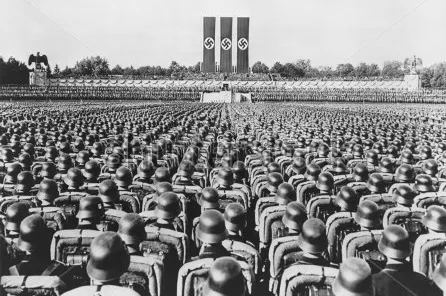
The Exceptional Regime and the Capitalist State
The transition from immature capitalism to mature capitalism, which was marked by a transition from liberal, competitive capitalism to monopoly capitalism, and the transition from formal subsumption to real subsumption of world-production, also saw the transition from the liberal parliamentary state, with its limited institutions of bourgeois rule, to the interventionist state, which systematically intervenes in capital accumulation and social reproduction. In turn, the economic and ideological state apparatuses tend to rise in importance, with the repressive state apparatus playing a more limited role in daily political life. Thus, what was once exceptional — the intervention of state power to stabilize production relations — has become the norm, and the size and power of the state has continuously grown, including in the so-called neoliberal period. This can be best characterised as a kind of permanent state-Bonapartism, in which the executive of the state rises permanently above the daily struggles of social classes in order to rule against society as a whole.
The period of transition between immature and mature capitalism, in all parts of the world, gave rise to various forms of Exceptional Regime. That is, the form of regime that emerges in a period of acute crisis for the ruling order. An analysis of these Exceptional Regimes is pertinent to any analysis of fascism and Bonapartism.
There are several distinct forms of the Exceptional Regime. These include:
- Police and Military Regimes;
- Bonapartism in its various forms: Social Bonapartism, National Bonapartism, and Sullaism;
- Fascism.
Fascism and the Crisis in Capitalism
The fascist movement reached state power in the middling capitalist countries (Germany, Italy, Austria, Japan, Spain, Portugal). All of these countries were characterised, first and foremost, by a later-developing capitalist class and a general weakness of bourgeois hegemony via the institutions of “civil society”.
In these countries, where the bourgeoisie sought to compete with the leading imperialist powers, it faced backwards forms of industry and agriculture as well as robust forms of class struggle. In this context, monopoly capital promoted a policy of national revolution to sweep aside underdevelopment and overtake the imperialist powers through a Total State. Fascism, then, was as much a modernisation program as a reactionary one.
The thesis that fascism is a form of “colonialism turned inwards” is false. While fascism mobilised the imperialist ideology of monopoly capital, it is actually the merger of this ideology with the petit-bourgeois populist ideology that gave fascism its unique character. In turn, the fascism-as-colonialism thesis is unable to parse the emergence of fascist movements in non-imperialist countries, such as Romania and Thailand, and its relative weakness in France and Britain, which were the primary imperialist powers.
In most countries, the fascist movement did not come to power in its own right but rather held power together in coalition with traditional religious and landed elites, military elites, and state bureaucrats. This gave rise to the traditionalist regimes (Spain, Portugal, Austria) and the statist-fascisms (Japan, Romania).
The Class Nature of Fascism
The identification of fascism with all counter-revolutionary regimes is incorrect. The classical form of the counter-revolutionary regime is not a fascist dictatorship. Rather, it is a military regime in which the repressive state apparatus takes control of the state. Pilsudski’s Poland, Horthy’s Hungary, Suharto’s Indonesia, and Pinochet’s Chile are all examples of this form of counter-revolutionary dictatorship. The “fascism as counter-revolutionary dictatorship” theorisation is a reflection of an economistic catastrophism that overstates the revolutionary potential of a given situation. In each of the countries where fascism came to dominate, the majority of the working-class has largely continued to support the reformist leadership in the workers movement. In short, fascism was not imposed upon the working-class for having taken the revolutionary road. Rather, fascism was the historical price the working-class paid for choosing the reformist road.
In the interwar period, the middling capitalist countries faced an equilibrium within the class struggle punctuated by “upsurges”. In both Italy and Germany (the epicenter of classical “Party Fascism”), neither the capitalist class nor the proletariat was able to deal the decisive blow in the class struggle. It is in this interregnum that mass fascism became the leading force in society.
In the context of the crisis in capitalist development, the fascist movement promises to sweep aside the enemies of the nation and impose an antipolitical dictatorship in which parliamentary politics is abolished in favour of the unity of the nation negotiated through corporate institutions. The extra-legal character of fascism is reflected in its most distinctive unit: the paramilitary fighting squads.
The mass base of fascism is found in the petit-bourgeoisie. This class faces a systematic crisis in the course of capitalist development, crushed between monopoly capital and the proletarian masses. This class has historically been over-represented in the ranks and leadership of the fascist movement, including small shopkeepers, professionals, independent artisan and tradesmen, and medium and large farmers.
Fascism has historically developed a left-wing, which seeks to win influence for the fascist movement amongst the working-class. This trend is represented by Strasserism in Germany and the national-syndicalists in Italy, as well as other left-Fascisms. However, fascism has historically failed to win a mass base amongst the working-class until after the seizure of power.
Fascism functions as a bloc between the petit-bourgeoisie and sections of monopoly capital at the expense of sections of the “Old Elite” and the workers movement. It is in the epoch of the most intense struggle between the petit-bourgeoisie and monopoly capitalism that fascism serves to weld these classes into a single bloc.
Fascist ideology consists of many elements, some of which are borrowed from the imperialist ideology of monopoly capital, while others have a petit-bourgeois populist character. The core elements of the fascist ideology are:
- Nationalist ideology (this element is primary),
- Stratocratic ideology,
- Imperialist ideology,
- Militarist ideology,
- Status-quo Anti-Capitalist ideology (a reactionary or bourgeois national socialism),
- Familial ideology,
- An Anti-Legalist ideology,
- A Moralist ideology,
- Racial ideology,
- Corporatist ideology.
Bonapartist Regimes
Bonapartism is a general form of exceptional regime in which a relatively weak and divided ruling order must be preserved through the intervention of a popular, demagogic movement that draws the masses into a broad alliance with sectors of capital in order to preserve society. Bonapartism has several types:
- Social Bonapartism, which rests upon the support of the working-class in particular and seeks to establish the state as the arbiter of class struggle. The Rooseveltian “New Deal” is the archetypical example.
- National Bonapartism, which develops in the most backwards capitalist countries as a means of overcoming “national backwardness”. This is often accompanied by a petit-bourgeois nationalist military regime. At times, this regime can have social-Bonapartist elements, especially when the petit-bourgeois nationalist movement has presented a national socialist ideology. The regimes of Nasser, Chavez, Peron, and Sukarno are all indicative of this type.
- Sullaism, which is a particularly reactionary form of Bonapartist regime that emerges in the struggle between factions of Capital. Trumpism is the archetypical form, but similar regimes can be seen historically in Putin’s Russia and the Emergency in India.
The Contemporary Reactionary Movement
The contemporary world situation is characterised not by advanced revolutionary struggle but rather a permanent, pre-emptive counter-revolution. Given the relative political weakness, both of the world proletariat and of international-monopoly capital, the interventionist state has opted for a policy of containment of the cyclical crises that allow for the restoration of the fraught “equilibrium” that punctuates the normal functioning of capitalist production. This has produced an untenable situation in which capital and the state have grown increasingly reliant on each other, and on the speculative financial markets that increasingly cannibalise the material basis of the capitalist mode of production (the modern factory system).
Given the increasing liquidation of the division between state and capital, the ideology that was produced by this division — liberalism — has also gone into systematic crisis. The entire political system of the imperialist countries now hurtles towards the most perverse forms of Bonapartism.
The contemporary reactionary movements lack many of the characteristics of historical fascism. These movements lack the characteristic paramilitarism and mass organisation, and indeed the mass party form of classical fascism. In turn, they do not promote a revolutionary struggle against the liberal state, but rather a “renovation” of the state through the incorporation of Bonapartist elements. These forces are also ardent opponents of all forms of corporatism, including those currently enmeshed in the interventionist state.
These movements are best understood as forms of petit-bourgeois reactionary populism, in that they are an “anti-systemic” bloc-of-all-classes directed against the “elites” — hated sections of Finance Capital and their corresponding political leadership.
When these movements are successful, they tend to throw up not fascist regimes, but a particular form of reactionary Bonapartism. Trump and his regime must be understood as representing the fractional interests of reactionary medium capital and Technology Capital in a struggle with Financial Capital which is heavily enmeshed in Washington. Such a reactionary regime seeks to smash previously won gains of the working-class through an Exceptional Regime. We can denote this form of Bonapartism as Sullaism.
Street Fascism
The conditions which give rise to mass fascist movements, including an equilibrium of class forces, do not exist in Australia today. Contemporary fascist paramilitary groups, such as the National Socialist Network and Australia First, are a shadow of the mass fascist movements of the early 20th Century. Even compared to the advent of Hansonism in the 1990s, the Australian street reaction remains weak and politically divided. There is no threat of mass fascist movements emerging, nor is there a threat of a fascist party taking power.
The fascist street organisations are not mass organisations in the style of the New Guard, nor do they unite large layers of petit-bourgeois civil society with factions of big capital. They are composed of the most degenerate elements of society, organised in a lumpenised, semi-criminal manner by small groups of charismatic thugs.
However, fascist organisations can pose a threat to the organised socialist movement and to the working-class, through individual and organised political terror. This terror must be confronted and defeated.
Fascism and Anti-Fascism
Unlike reformists and anarchists, communists do not view any particular tactic as a matter of principle, e.g. parliamentarianism or anti-parliamentarianism. Indeed, when it comes to tactics, the only principle we recognise is that nothing is automatically ruled in and nothing automatically ruled out. The tactics employed to counter organisations such as the National Socialist Network, Australia First, and other racist street organisations, etc have to be concrete. Therefore, they have to be flexible and constantly changing.
We do not rule out no-platforming political opponents. Nor do we rule out physical force. In the context of attacks on the socialist movement or the broader working-class, it may be necessary for socialists to organise to defend the movement from attack.
However, we reject any fetishisation of anti-fascist street action. This fetish elevates a tactic to the level of a strategy and pushes the socialist movement towards ineffective and ritualistic confrontations with small groups of rightists. The theory of killing fascism ‘in the egg’ is completely illusory. It is a diversion and has led either to the leftist futility of Squadrism or the quagmire of Popular Frontism.
The core of the struggle against the influence of fascism in the working-class is the ideological struggle against nationalist, racial, familial-patriarchal, imperialist, and corporatist ideology. This struggle manifests primarily as a political struggle against Laborism, which is the primary form of bourgeois ideology in the working-class.
This should not be seen as an endorsement of the sectarian “social fascism” thesis that was adopted by the Communist International in its “Third Period”. Laborism is not “fascist” nor does it constitute the “left-wing of fascism”. However, fascist organisations in the working-class utilise ideological structures produced and reproduced by Laborism.
We rule out entirely the policy of a “broad front” of civil society which brings together liberal sections of the bourgeoisie and petit-bourgeoisie to “fight the right”. We also rule out an alliance with the state and its institutions — including with the leadership of the Labor Party. Such a Popular Front would quickly liquidate the proletarian movement into a liberal-popular mass movement to defend the existing social order.
We also reject the sectarian-adventurist posturing of many on the left which fetishises “direct confrontation” and “bashing the fascists”. This is a form of paramilitarism with no mass base in the organised working-class. It will not succeed.
In contrast, we seek the broadest possible unity in action of all working-class forces in the struggle against racism and fascism. All working-class forces, including the socialist movement, workers organisations, trade unions, unemployed groups, and the Labor Left, should unite behind a common front in opposing racism in the streets, defending minority communities, and presenting a common platform of democratic and economic demands that address the immediate needs of the working-class. Anti-fascist and anti-racist organisations must move from a purely defensive, negative activity, and take on a positive, permanent, offensive character.

 PARTISAN!
You must be logged in to post a comment.