Nearly 100 years after the release of Metropolis (1927, Dir. Fritz Lang) Jean O’Donnell casts a critical eye over its seemingly revolutionary politics, revealing little more than neutered compromise.
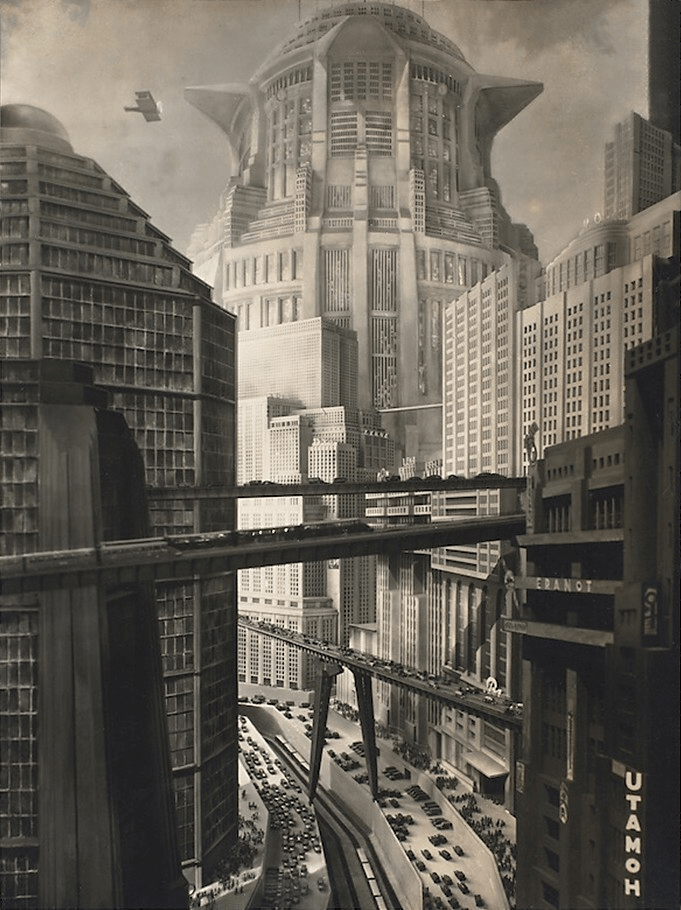
Metropolis (1927, Dir. Fritz Lang) is arguably one of the most famous and influential silent films to survive to the modern day. Visual references to it can be found across pop culture, from C-3PO’s design in Star Wars to the cover of Janelle Monae’s The ArchAndroid album, to the cinematography in Taylor Swift’s Look What You Made Me Do music video. Despite this, much of the film was considered ‘lost media’ for several decades. This is primarily due to the film being re-cut a couple of times after Metropolis’ initial release. Both of these cuts were hated by director Fritz Lang. It was only in 2008 when a damaged copy of the original film was rediscovered in an Argentinian museum, along with a print in New Zealand, that the original film was restored.
The first re-cut of the film was purely profit-motivated. The original film was 153 minutes long, something Paramount, the American distributor, feared would scare off audiences more used to 90 minute films. In order to make the film more profitable, Paramount had the film re-cut and even changed several parts of the film (the intertitles and character names). The second of these cuts was done by the German studio Ufa for Metropolis’ 1927 re-release. After taking charge of the company, German Nationalist and future Nazi financier Alfred Hugenberg requested the film be re-cut to remove perceived communist and religious rhetoric.
In its visual legacy and the story of its loss and rediscovery, there are many areas for political analysis. Perhaps in the future something can be written on how the devaluing of art by commercially-driven entities has directly led to the loss of the majority of early silent films. For today’s essay however, I’d like to explore the complicated politics of one of the world’s most famous silent films.
Metropolis, The Working Class & Dystopia
The visual imagery of Metropolis is striking and iconic. The setting is a clear dystopia, where workers live underground, literally underfoot of the bourgeoise. Their city is gigantic, dwarfing the workers and rendering them individually helpless against the machinery of capital. This is reinforced with the later imagery of workers being fed into furnaces as a sacrifice, highlighting how the machinery they are expected to work is slowly killing them.
These images of class struggle are contrasted against the above-ground bourgeoisie, initially represented through Freder, the dictator’s son. Freder lives a life of leisure in the sunshine, partying and playing sports. It is only by his infatuation with Maria, a woman who brings the working-class children above ground to show them how the upper class live, that spurs him into investigating the conditions the working class live in. This investigation and his father’s indifference is what radicalizes him into secretly helping the workers.
It is worthwhile to note that, when Maria brings the children above ground, she specifically describes the wealthy oppressors as “brothers” suggesting a level of connection or solidarity that does not exist. Later, when Maria addresses a gathering of angry and exhausted workers seeking a change from their current conditions, she does not prophesize a change in the system. Instead, she prophesizes the appearance of a ‘mediator’, someone who can advocate for the ‘hands’ of the system (the oppressed working class) to the ‘head’ (the bourgeoise) and bring the two sides together. The mediator within this film is Freder, who fulfills his role by the end of the film.
The film’s ending, while hopeful as it may be, also works to undercut any left-leaning sympathies it may have. Despite the visuals of the film indicating the terrible plight of the working class, Metropolis itself does not end with systemic change. Instead, a mediator is merely appointed to help find a compromise between the oppressed and the oppressor. This mediator is explicitly bourgeois. Given that he is the ruler’s son, one could go so far as to call him a nepo baby. The audience is also not shown any change to the structure, only the promise of improvement by Freder symbolically uniting a representative of the working class’ hand with his father’s. Even with the inclusion of a mediator, the hierarchy remains the same. This suggests that the film’s politics, while undoubtedly sympathetic to the working class, are not nearly as ‘communist’ as Hugenberg feared. Indeed, there was one group who loved Metropolis and hated communists: Nazis.
Metropolis as a Nazi Film
Metropolis was one of Hitler’s (and Goebbel’s) favourite films, influenced prominent Nazi filmmakers like Leni Riefenstahl and was reportedly the reason that Fritz Lang was asked to lead the Third Reich’s national film industry. Lang fled the country rather than agree.
It would be easy, if somewhat naïve, to attribute this to the Hugenberg cut of the film. In reality, it was the politics of the film itself that made it so appealing. The film’s screenwriter and Lang’s second wife, Thea von Harbou was a Nazi sympathiser. During the Third Reich, while her ex-husband fled, she stayed, directing two films and writing twenty-six. Many of these films were in collaboration with prominent Nazi filmmakers. Even before the Nazi regime came to power, von Harbou’s work contained deeply conservative and nationalistic themes. Several of her books were published by Scherl Verlag, an imprint owned by the aforementioned Alfred Hugenberg.
These conservative themes can be seen, to some extent, in the portrayal of the workers themselves in Metropolis. They are depicted as foolish and easily manipulated by the false Maria. In their haste to smash the machines that they are forced to work, they trigger a great flood that nearly drowns their children. The workers are portrayed as having forgotten about their children in their celebrations, with their foreman, Grot, chastising them for it. Both the thematic and literal readings of these choices are clear: the workers are foolish, deserving of their lot in life and in their efforts to strike out against their oppressors they will condemn their own children to death.
In his 2013 book, Crowds and Democracy: the idea and image of the masses from revolution to fascism, Stefan Jonsson highlights that, given that the workers are led astray by the false Maria, collective political organisation is implicitly linked to female hysteria. This depiction works to undercut the idea of systemic change. This is reinforced by the ending of the film: the structural powers that be are immutable, all the workers can ask for is someone to help them reach a compromise with their oppressors.
Conclusion
There are many, many cases of right-wing causes re-appropriating left-wing imagery, language and ideas for their purposes. While it would be easy to look at the visual language of Metropolis and state that the Nazi love for the film is merely an example of that: a redirection of class strife and struggle towards a scapegoat, to do so would lack nuance. While she claimed otherwise after the war, Thea von Harbou was, at best, a Nazi sympathiser who helped produce Nazi propaganda. Fritz Lang certainly had critiques of Hitler and the Nazi regime — The Testament of Dr. Mabuse was banned for that exact reason — but that does not change how reactionary his most famous film is. Rather than presenting the system as broken, like the dystopian setting would imply, the system in Metropolis is merely flawed. There is an implicit belief that the people in power ‘deserve’ to be there. All that is required is a mediator between the hands and the head to make things right.
Metropolis understands there is a problem; the imagery of sacrificed workers is not subtle. Yet, when push comes to shove, the film ends with a reversion to the status quo. Even the hint of change is undercut by the fact that the mediator is a member of the bourgeois class, highlighting how little the hierarchy has actually changed. Metropolis may contain left-leaning sympathies, even if undercut by the screenwriter’s disdain for the working class, but it naively believes that the current status quo is tenable, should we just find the right compromise between the abuser and the abused.
References
Jonsson, Stefan. 2013. Crowds and Democracy : The Idea and Image of the Masses from Revolution to Fascism. Columbia University Press. https://doi.org/10.7312/jons16478.

 PARTISAN!
You must be logged in to post a comment.