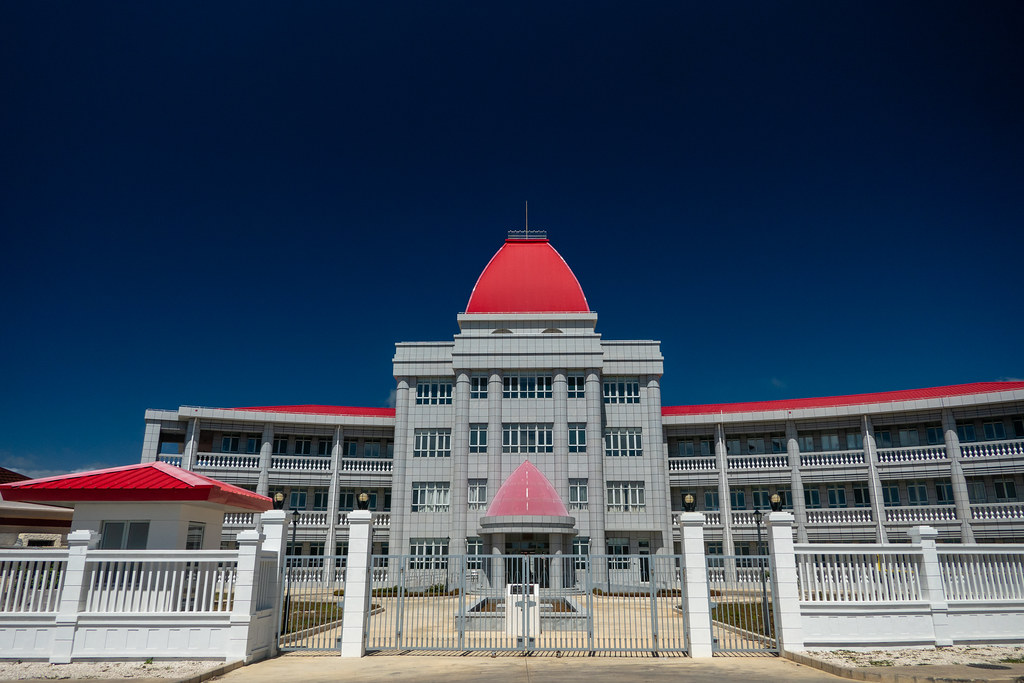
Max J, Newcastle
A debate has taken place on the web pages of Talanoa ‘o Tonga, a Tongan-based news website. This debate took place over the last week, between Senituli Penitani (a US-based, Tongan-American evangelist and reactionary), ‘Ikani Taliai (President of the Tongan Victoria Association), and Melino Maka (a ‘Tongan-Kiwi community leader). The debate was prompted by Penitani’s Feb 22nd article, The danger of extremism in Tonga’s democratic reforms. Reforms which, mind you, had been demanded by the workers and toilers of Tonga for years (they did not burn down half of Nuku’alofa in 2006 for a quick laugh).
In this article, he denounces Phil Uipi (a Tongan-American lawyer) as an ‘extremist’ for advocating for Tongan MPs to use their constitutional rights to stand against the king. What moron thinks telling people to use constitutional rights is extremism? As a reactionary evangelist, Penitani more or less believes that the King is sovereign and put in charge by God. He is strongly against any attempt to remove executive powers from the King – though he correctly states that the King would resist all attempts to do so.
Taliai, on the other hand, has a more liberal orientation. A supporter of the monarchy (monarchist liberals – don’t tell Robespierre!), he nonetheless believes that Tonga must develop into a modern, democratic state. Such a state requires the King to take a ceremonial, institutional role, as opposed to having direct executive power. While preferable to Penitani’s yammerings about faith and the notion, Taliai’s position maintains the status quo. The power of the kings and chiefs is not threatened, but coaxed into submission by a democratic, liberal government. If only!
Maka takes stock of previous Tongan democrat leaders such as Akilisi Pōhiva and Pōhiva Tu‘ionetoa. These were politicians emerging out of Tonga’s Human Rights and Democracy Movement (there is no socialist party in Tonga, nor a socialist movement, as far as I can tell), eventually becoming Prime Minister through the Democratic Party. Akilisi Pōhiva, while mostly a liberal, nonetheless resisted the king politically, but his government was held back by bureaucratic strain. Maka ends a rather weak critique of the previous leaders with a very loose ‘the voters will decide’. Will they, Maka? It is hard to imagine that the ‘voters will decide’ anything substantial in a state where the king still holds executive power, and uses it to trample over basic democratic and constitutional rights.
The situation in Tonga proves a few things. Mainly, that the Maoist-Stalinist thesis of the “progressive national bourgeois” is hocus pocus. Such a class, if it indeed exists in Tonga, is bound to the King and the chiefs. It is clear that the only force capable of carrying out a ‘democratic revolution’ (which in truth is a socialist revolution) is the workers and toilers. What little working class Tonga has must unite with the toilers and oppressed to form a mass movement capable of overthrowing the monarchy wholesale, and establishing a democratic republic. This is not impossible: such forces came together in 2006 to smash up the capital in a violent fury to demand change, which they soon got (with little thanks to the meddling of AU-NZ imperialists). See also the 2005 Public Servants strike.
Much of this debate took place between Tongans living outside of Tonga. It is clear that political forces in Tonga critical of the monarchy must rely on the relative security of living outside of Tonga to organise and coordinate. There is a vast immigration population of Tongans living in the US, in NZ, and in Australia. While Tongan communities are dominated by antique, patriarchal churches, it is the role of communists to nonetheless organise workers and smash these institutions. Tongan democrats don’t have the guts to see their own project – the path to democracy – forward. So it is up to communists to organise a movement to see a better project – the path to an emancipated society (communism) – all the way to the end.
[See also: Looming constitutional crisis in Tonga (DA11, March 2024)]

 PARTISAN!
You must be logged in to post a comment.