This is the third part of our publication of George Caffentzis’ essay concerning the Oil Shock of 1973.
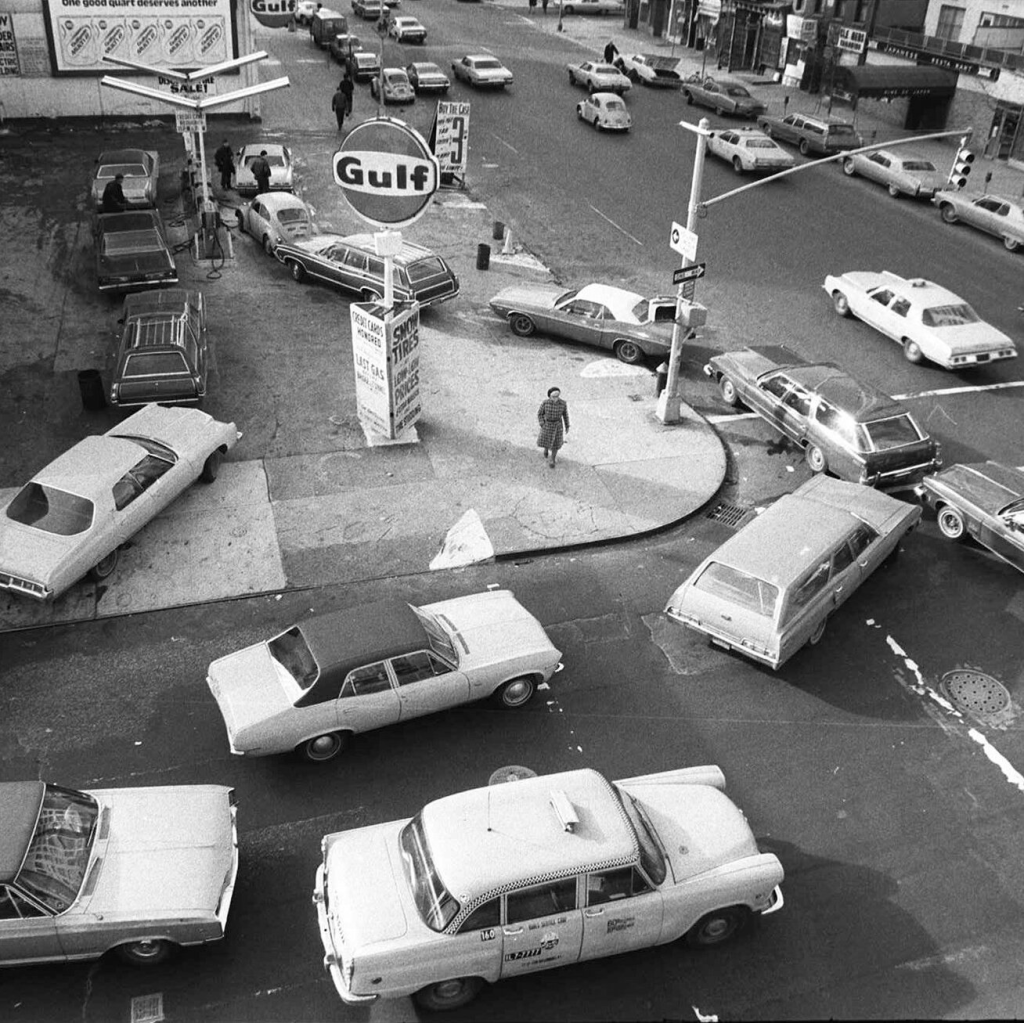
What was the relation between state and society during the “Keynesian” period? What distinguished US Keynesian planning was its concern with the reproductive sector, because US capital did not have an experienced working class whose production and reproduction had been bargained over for centuries. The waves of immigration and genocide barely gave any demographic and geographic constancy to rely on. The US working class was inevitably “volatile” and “unstable,” almost a “thing in itself.”
The basic realization of US Keynesian policy was that the enormous accumulation of fixed capital embodied in the assembly-line factories required a proportionate accumulation of capital in the working class (“human capital” as it was called later). Once capital reaches River Rouge dimensions, the short-term disciplinary effect of unemployment is more than counter-balanced by the long-term loss in the productivity of workers. And it was exactly in the productivity that profit was to be found. The obsession of New Deal planners was that the long stretches of unemployment would sap the “work ethic” from the latest generation of factory operatives who had undergone the rigid education of the line in the 1920s (You can learn a line job in a day, but it takes years to learn a line-life! ). This discipline could not be kept in “cold storage” until individual capitalists were ready for it, for it depreciated and could turn inside-out explosively. Thus the ultimate profitability of capital based on increasing the productivity of work made “mass unemployment” intolerable.
Not only must labor power be produced, it must be reproduced. The housewife becomes the correlate of the line worker in the Keynesian equations. Standardly, the housewife is taken as the consumer, but the Depression planners were more concerned with her as the producer of a “very special article,” the availability for work of a factory worker. This requires capital, the home. This was exactly the capital that was disintegrating during the Depression as more and more women left home, divorced and in general “gave up.” The Keynesians saw that no high intensity line worker would work or return to work without an equally high-intensity reproduction process.
The assembly line is peculiarly vulnerable to individual variations of work pace: the rhythm must be kept off the job as on. Regular meals, regular fucks, regular shits are essential for the gearing of labor power and capital in a stamping plant. Not only had unemployment to be “conquered,” but the real wage, which the working class “defended” during the starkest years of the Depression and later forced up, could be capitalized upon. If wage increases could be used to capitalize the home, this would eventually increase the productivity of labor, hence increase profit. Here we have the basis of a class deal: happy workers, happy capital, a compromise! The Keynesian system is delicately balanced upon the symbiosis of home and factory and the use of the wage not only for working class subsistence but as a form of investment for capital.
The dynamic equilibrium between home and line required a precise meshing of the variables of wage, factory work and housework. In the period from the late 1960s to the mid-1970s the mesh began to tear. Divorces, for example, accelerated with the wage, which revealed a new tension between the poles of the Keynesian synthesis, but “surely nothing that would be enough to cause a crisis.” The trouble with the Keynesian equilibrium, however, is that it is supremely vulnerable to such lapses (perhaps more vulnerable than to a “small” nuclear war). They were “boom” years, but not for capital. Not only did the struggle in the factories, homes and streets force capital to pay more for factory work; increasingly, capital had to pay, through the state, directly for reproduction work that had previously come financed via the male, factory wage. Women and young people would no more “naturally” do what they used to do under the direction of husband and daddy. Thus, though there was an enormous increase of energy generated by the working class during that period, it proved especially resistant to the transformation into work. There was a precipitous drop in the work/energy ratio; this was translated into a “profits crisis” and a subversion of the axioms of Keynesianism.
Prices and Values
Capital’s response to this invasion of entropic energy was not a “strike,” an “investment freeze” or the beginning of an era of “slow investment economies.” Allowing for the recession of 1974, investment since 1973 (relative to GNP) has sustained and even surpassed the levels prevalent in the 1960s (for all the crocodile tears of the business journals). There has been, however, a shift in the composition of investment, which to many, capitalists and workers, appears as a lack of investment. Why?
Simply because fewer people see it.
What has been seen by everyone, however, is the leap of the relative, as well as absolute price of “energy” commodities (in the form of oil, natural gas, coal, uranium as well as electricity). Inflation has directly attacked working class income by reducing the “average” real wage, but the changed ratio of energy prices to other prices has an immense indirect effect on the composition of the working class and organization of exploitation.
All throughout the post-WWII period up until 1973, a rough equality obtained between price increases in the industrial and energy sectors. From 1973 to the present, a major structural change occurred. Though both price series went up, the industrial price index rose by approximately 100 percent while the energy price index rose by more than 200 percent. Along with these price changes have gone parallel changes in the relative “sales” and “profits” of the two sectors.
These numbers are the hieroglyphics of capital’s response to the struggles of the late 1960s and early 1970s. They spell the end of the assembly-line-auto-home political economy, the end of the “blue collar” line worker/housewife nexus, the end of the delicate machine of Keynesian society. By giving primacy to the energy sector, capital can command an enormous amount of work because this command takes place away from the actual scene of exploitation. It almost feels ghost-like. It short-circuits the nodes of class power accumulated in the factories, mines and streets, for this reorganization centralizes the accumulation process, while at the same time it enormously decentralizes the exploitation process. By developing the energy sector, capital is able to exert its magnetic command and extract surplus from every “pore” of the social fabric; every coffee shop, every apartment, every sweat shop must pay for energy costs.
The very image of the worker seems to disintegrate before this recomposition of capital. The burly, “blue collared” line worker seems to blur in the oil crisis, diffracted into the female service worker and the abstracted computer programmer. The large concentrations of factory workers that proved so explosive are dispersed, the specific gravity of the worker’s presence is dramatically reduced. And it all feels so different! Your wages go up but they evaporate before you spend them, you confront your boss but he cries that “he has bills to pay,” and even more deeply, you don’t see your exploitation any more. On the line, you literally could observe the crystallization of your labor power into the commodity, you could see your life vanishing down the line, you could feel the materialization of your alienation. But in the service industries, your surplus labor seems to be non-existent, even “non-productive,” just” a paid form of “housework,” cleaning bedpans, massaging jogger’s muscles, scrambling eggs. While in the “energy/information” sector you seem to be engulfed by the immense fixed capital surrounding you, it feels as if you were not exploited at all, but a servant of the machine, even “privileged” to be part of the “brains of the system.” These feelings disorient struggles. As the vast spatial migrations “to look for a job” disaggregate militant circles, the old bastions are isolated and appear archaic, almost comic.
Finally, these price indices summarize the beginning of a shift in the organization of reproduction. A “society” built on autos is not like a “society” built on computers, McDonalds and nukes, where by “society” we mean the entire reproduction process. The new form of life dictated by the primacy of the energy/information sectors, like the struggles against it, is only beginning to be formed.
The “rationality of the energy crisis” for capital as a response to (and an attack on) working class struggles against the poles of Keynesian “auto-industrial” society will be shown below. However, an important objection to this account could be made immediately: if capital can, at will, change and manipulate energy and industrial prices on the basis of multinational corporate power, i.e., independent of the amount of work that goes into the production of commodities, then we must abandon work and surplus value (exploitation) as our basic analytical categories. Marx would be an honored but dead dog. We would have to accept the position of Sweezy and Marcuse that monopoly organization and technological development have made capital independent of the “law of value,” (viz., that prices, profits, costs and the other numerology of accounting are rooted in (and explained by) the work-time gone into the production of the commodities and reproduction of the relevant workers). Capital, it would seem, can break its own rules, the class struggle is now to be played on a pure level of power, “will to domination,” force against force and prices become part of the equation of violence, arbitrarily decided like the pulling of the trigger. We disagree with these “monopoly power” theorists; work and exploitation still remain the basic determinants of motion in capitalist development, whether you deal with computers and nukes or spades and cotton gins.
How then do we explain the apparent freedom the capitalists seem to have in setting oil prices independent of the labor that goes into the production of oil (i.e., its value)?
The divergence of prices and values is nothing new. On the contrary, it has always been an essential aspect of capitalist rule. Values (worktime) must be transformed into prices and this transformation is never one-to-one. The essence of the transformation of values into prices is that though capital extracts surplus value locally, it does not let those who do the extracting command and expend this surplus value. The hand of capital is different from its mouth and its asshole. This transformation is real, but it causes illusions in the brains of both capitalists and workers (including you and me!). It all revolves around mineness, the deepest pettiness in the Maya of the system. For capital appears as little machines, packets of materials, little incidents of work, all connected with little agents of complaint, excuse and hassle. Each individual capitalist complains about “my” money, each individual worker cries about “my” job, each union official complains about “my” industry; tears flow everywhere, apparently about different things, so that capitalism’s house is an eternal soap opera. But mineness is an essential illusion, though illusion all the same. Capital is social, as is work, and pitiless as Shiva to the complainers, but needs their blindness to feed itself. It no more rewards capitalists to the extent that they exploit than it rewards workers to the extent that they are exploited. There is no justice for anyone but itself.
The transformation of values into prices is ruled by capital’s instinctual demand to “get its just recognition.” For the body of capital has many different limbs, organs, arteries and veins, nerve strands, sensors and processors, each with its organic composition, its own need to be fed-back. The needs, balances, proportions and ratios they imply must be met – or else it would not see its illusions.
How much surplus value goes to a particular organ of capital is determined by its organic composition: the mixture of dead and living labor that is found there. Lets take three examples: a nuclear plant, an autoplant and a local “greasy spoon” restaurant and bar. Each is a machine with different needs and different products. The bar needs Jack Daniels, while the nuke needs refined U235; the restaurant and bar needs an easytalking bartender and a speed-freak grillman, the auto plant needs welding bonders and line workers. All these “needs” have histories derived from struggles. The nuke “needs” to have a “two man rule” in monitoring all vital operations; the autoplant “needs” guards at the gates and computers assessing the speed of flow to detect slowdowns; the restaurant “needs” dishwashers that can’t talk English. The struggles are written in the machine; they create the need for redundancy, since the struggles are a noise that keeps the message the machines send out from being reliable and eternal.
Each of these mixtures of living and dead, animal and mineral, energy and work, can be measured in a mathematical proportion roughly corresponding to the ratio of the value of constant capital (the value of the means of production) and the value of labor power (the value of the wages). A typical nuclear worker works with about $300,000 worth of equipment, a typical autoworker mixes with about $30,000 worth of other machines, while a typical restaurant-bar worker uses $3,000 worth of “means of production.” Yet, the wages of the typical autoworker and nuke plant worker are almost the same, while those of a restaurant-bar worker are officially half (although the inclusion of tips would increase it). Clearly the differences in capital per employee swamp out the differences in wages, and we see a segmentation in the skeleton of capital delineated in the exponential powers of the organic composition: 103, 104, 105. Let us call these the low, average and high sectors of capital and consider Graph #3.
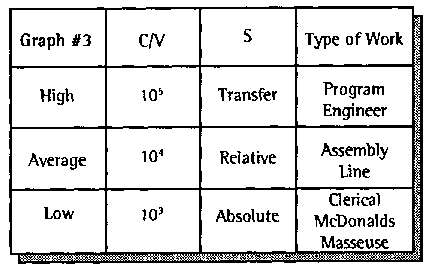
There is much to say of these vertebrae of capital, but let us concentrate on the work/energy relation in each of these sections. In the average section there is an obvious relation between the energy put in, the work that comes out and the profit gotten from it. It is clear to the autoworker that a speed-up increases the flow of cars off the line and GM’s profits. There appears to be here a one-to-one relation between increased investment in machinery and the productivity and intensity of work. This is the range of relative surplus value. The worker here can see his/her exploitation via the speed of the line. In the low sector the length of the work day becomes important. This is the area of absolute surplus value where the work comes by storing the energy of the worker within the job as long as possible. The problem here is that the worker cannot see the surplus. The local restaurant might kill its employees with overwork and still look like it’s making “no money.” The boss may be as depressed as his/ her workers and poring out his energy “for nothing,” thus the tears of the small business types, the “hard working” sector of capital. Finally, there is the high sector. There, enormous profits are made, but not off the workers who operate the nuke plants per se. True, they earn their wages on the way from the parking lot to the control room, but the amount of surplus value “produced” in the ensuing eight hours is absolutely minuscule, though relatively enormous! Where do their profits come from?
Surplus value is transformed into the nuclear industry by the divergence of prices and values. As Marx points out, social capital needs an average rate of profit, while individual capitals must be rewarded differentially according to the amount invested in each organ. But each organ has a different amount of constant capital in it. Those organs with a high capital investment per worker need an above average amount of surplus value feedback into them, those with an average amount of investment per worker requires an average feedback, while those with a low amount of capital “need” only a low return.
“Equal weights and Equal measures,” says social capital over the lamentations of its Jobs in restaurants, sweatshops and construction companies. “I only recognize myself,” “I am I” booms capital out of the whirlwind, and the petty bosses slink away with their boils. This feed-back justice is determined by prices. Commodity prices in the High industries are always greater than their values. Low industry commodity prices are always below their value. High industries “suck up” the surplus value produced at the bottom of the system through this price structure. The diversion of price and value makes it clear that extraction of surplus value and command over the expending of the surplus are different operations. The boss of Alice’s restaurant can complain, but he must still pay his electricity and heating bills (though he tries hard to avoid it). Like Job, the petty boss recognizes a higher power he cannot deny, for though it hurts him he would be annihilated if it abandoned him. So he must pay this power tribute, however unjust it appears. He perhaps even glimmers on the deeper, larger schemes of the Savage God, though it crusheth him.
Coda: Eulogy for Auto
The crystallization of the symbiosis between production and reproduction was the car and truck. Not only were they the concrete vehicular mediators between home and the line, they were a combined home-line itself. On the basis of the car-truck economy you get the space-time geometry of American Keynesian society: the car is a little home on wheels and a little factory you can sleep in. The workers at Flint in 1936 recognized this when they took to sleeping and cooking in the hulks of half-built Chevys. A car is an ambiguous piece of capital, a tool and a plaything: a serious, expensive and heavy piece of machinery and a bedroom, dining room and kitchen; something highly standardized and then deeply personalized. The nomadic tribe of truck drivers are the paragons of this economic geometry, they created a work-life society of speed on the basis of this crystallization. (In 1950 the real revenues of railroads and trucking were almost identical, while in 1976 trucking was pulling twice the money the railroads made; in 1960 trucking had fewer employees than railroads, in 1977 it had more than twice as many.)
The car became the model of the intermeshing of machine and worker throughout the social factory. The spatio-temporal freedom and power it delivers in the hands of male workers, the decentralization of life it provides, had to be, and was, countered by even more precise termini of life. The home schedule and the work schedule increasingly was timed to the minute. It is no accident that the car for Neil Cassidy, in Kerouac’s On the Road, became the expression of all that was anti-capitalist, anti-home, anti-factory, because he saw in it a potentiality that existed in the metal but was fought by all the levels (from the “car mortgage” to highway police radar) . . . the transformation of the productivity of labor into the freedom from labor. But the 1960s went further. The distance between Cassidy’s drive-away Cadillac and Kesey’s Merry Prankster bus reveals the distance between two periods of working class discovery . . . and Cassidy’s difficulty in bridging it: LSD approaches light speed while benzedrine and wine 120 mph. Ginsberg, who was always wiser in these matters, saw the mediator in the van of Wichita Sutra, perhaps. Kerouac went home and died.

 PARTISAN!
You must be logged in to post a comment.