This is the second part of our publication of George Caffentzis’ essay concerning the Oil Shock of 1973.

To decode the messages of the apocalypse we should see that both the anti-limitationists and the interactionists demand a complete change in the mode of production. They are “revolutionaries” because they fear something in the present mode that disintegrates capital’s touch: a demand, an activity and a refusal that has not been encompassed.
The anti-limitationists focus on the “need” to end the oil-auto assembly line economy of the post-war era. Taking “the father of the H-bomb,” Edward Teller’s “Energy – A Plan for Action”4 as indicative of their position, we see that by the beginning of the next century they envision a completely different world of production compared with the 1970s. Consider some proportions. In 1973 electricity production demanded 25 percent of the total energy of the US while transportation (excluding auto production) demanded 25 percent. There was a rough balance between these two sectors in the last decade.
Teller, on the contrary, envisions a radically new system where electricity would demand 50 percent of the total energy, with transportation reduced to 11 percent. (The “raw material” would come from a vast increase in Western coal strip mines and the use of nuclear reactors.) This would involve a complete reorganization of production and reproduction, though the number of workers necessary to supply the fuel and run the power plants would undergo relatively minor increases. Teller argues not only for a substantial increase in “energy” consumption, in line with the historical trend, but for a radical shift in the structure of work. What he has in mind is revealed by his “Manpower Requirements”:
No matter what popular opinion asks us to believe, technology will be crucial for human survival. Contrary to much of our current thinking, technology and its development is not antithetical to human values. Indeed, quite the opposite is true. Tool-making and the social organization it implies are very deeply ingrained in our natures. This is, in fact, the primary attribute that distinguishes man from other animals. We must continue to adapt our technology, which is, in essence, our ability to shape nature more effectively in order to face the problems that this human race faces today. It is for this reason that the development and expansion of technical education is so important. It is only through the possession of high skills and the development of educational systems for the acquisition of these skills that human prosperity can be insured.
Teller envisions a new “New Atlantis” with a priesthood of highly “skilled” scientist-technicians surrounded by an army of “craftsmen” who monitor, develop, and control the automated production processes with computer networks. This is a sample of how his vision would work:
Computers have been introduced in central control stations to control inerties for the purpose of optimizing the use of energy by drawing at any time on the cheapest available source of electricity. These computers are also beginning to be used to store and display data about the state of the major components of the generating plants and transmission lines. This will help the dispatcher to make the right decision, for instance, by accepting a local and temporary brownout, or even blackout, rather than permitting an overstrained system to breakdown.
We have here a centralized neural society where the work process is integrated at the speed of light in reverberating feed-back circuits modulated to prevent total breakdown. Capital finally finds its etymology. Teller spells the end of the ass-kicking truckers’ songs, the lyric of the stoned highway at 3 a.m.; everything is concentrated now, controlled in the wires of an air-conditioned brain. For the internal combustion engine, after all, has been an enormous source of “decentralization” of desires that cannot be tolerated, for it seems to lead to catastrophe.
Teller’s apocalypse flashes the desolation of an oil-starved assembly line economy, his utopia is an electronic techno-nuclear model of capital allowing for a new leap in accumulation. Yet one’s apocalypse is another ‘s utopia. We see this when we turn to the interactionists, who argue that any step down Teller’s path leads to human annihilation. The Odums, an ecologist and a social worker, serve as a precise counter-pole to Teller for they are extremists even among interactionists.5 They agree with Teller that the assembly line economy is over, but argue that the future holds no technological solution to declining “energy.” They dismiss both the solar energy enthusiasts and the fusion freaks. In their view, “various schemes for harnessing solar energy turn out to be installations based mainly on fossil fuels, with their main energy flows not really supported by the sun.” Their argument against the possibility of fusion power is certainly original: “Fusion could be disastrous to humanity either if it were so rich that it gave too much energy, or if it took all our capital and gave us no net energy.” If it failed and all the energy eggs were in the fusion basket, disaster would follow; but if it were successful it would release such an intense energy flow that too much energy would be required “to maintain control as it is diluted to the intensity of the human system.” The very price of success would guarantee disaster.
Thus “we” can neither remain with the present mode of production based upon dwindling reserves, nor can the path of “technological leap” save the system. They propose a new mode of production, a “steady-state and low-energy” economy, bringing the human race into a safe equilibrium with Nature. The price for survival, however, is not only the disco beat:
To become adapted to the steady state, people will have to give up their restlessness and their insistence on the large, the new and the different. But the young people who tried to form a low-energy subculture to avoid the excesses of the high-energy growth period will also have to change. More work will be expected from each individual in the low-energy society because there will be fewer machines.
Examples of the Odum’s steady-state utopia are rain forests, coral reefs and the “uniformly cold bottom of the sea (near freezing),” as well as pre-industrial India agricultural villages. The common element in such systems is “a great diversity; intimate, highly organized symbiotic relationships; organisms with complex behavior programs by which they serve each other; well timed processing of mineral cycles that do not lose critical materials; and highly productive conversions of inflowing energy.”
“The Octopus’ Garden in the Shade” becomes the solution to the energy crisis. Here are some features of the steady-state economy that more precisely describe the Odum’s vision:
- Growth stimulating industries are eliminated.
- Less emphasis on transportation.
- Balanced governmental budgets.
- Miniaturization of technology to use less energy.
- Decrease in public and private choices and experiments.
- Urban construction will be replaced by separate and smaller houses.
- Farms use more land, less fuel and more hand labor.
- Properties of high concentration of energy will decrease: crime, accidents, law enforcement, noise, central services, taxes.
No more cities, no more travel, no more factories, no more power plants and presumably no state. Just the quiet labor-intensive life on Jim Jones’ farm (after they’ve seen Paree?). The necessary restructuring of employment to realize this utopia is obvious. Unemployment in the “growth and luxury industries” will “shift people to agriculture” with wages being steadily cut and unions taking on the role of employment transformers.
It all sounds so wholesome, a world apart from the nuclear-computer philosopher-kings of Teller! Spots on apples! Birds and Bees! Nature’s watchful eye assures a fair day’s work for a fair day’s pay, instead of Teller’s electronic-eyed cyclops monitoring our neural hook-ups tottering on the edge of breakdown. However, there is a coldness here, for all the coziness, reminiscent of the H-bomb’s daddy; an anger, a fear that Teller and the Odum’s share. They offer opposite revolutions of production, apocalypses and utopias, but they agree on one thing: the present state of capital has had it, not only because it has lost its “energy” but because there is too much “chaos,” uncontrolled behavior, too many demands and not enough work.
This commonality emerges sharply in what appear as marginal remarks upon the “youth” of the 1960s and 1970s. Both anti-limitationists and interactionists agree: they are lazy! So Teller complains of “an antiscientific trend among young people,” while the Odum’s (in a passage quoted above) clearly expect the fuck-off young rebels to get down to work. Their deepest commonality however is that, like the apocalypticians of the past, they see their problem in Nature. On the one side the raw limit of energetic stuffs, and on the other side the “ecological” catastrophe induced by industrial development. They postulate a limit either on the natural “input” (fuel) or an “output” onto nature (pollution). But once again we cannot read their fears and solutions straight, for in their text Nature is identified with Capital pure and simple. They never declare the obvious: capital is a relation of struggle. Once this translation is made, their sybilline visions can be deciphered and their ominous somberness dispelled. Their limits are not ours.
Decoding the Apocalypse
The decoded message of the Apocalypse reads: Work/Energy. Both sides of the “great energy debate” want to rebalance the ratio, but what unbalanced it in the first place? If the “energy crisis” began in 1973, the logical place to look is the period immediately before. What was happening to work/energy then? . . . a capitalist catastrophe in commodity production and the reproduction of labor-power. Need we take out the old film strips? The ghetto riots, the Panthers, campus “unrest,” SDS and the Weatherpersons, a strung out imperial army, DRUM in Detroit and the West Virginia wildcats, the welfare office sit-ins, the shooting of Andy Warhol, SCUM, the Stonewall blowout, Attica. Let Graphs # 1 and #2 suffice.
The first deals with a historic transformation in the wage/profit relation, the second depicts the changed relation between defense and “social” expenditures. Both indicate that the late 1960s and early 1970s saw the inversion of long term trends.

If we look, e.g., at the two decades between 1947 and 1967 we see that in this period wages and profits intimated the fulfillment of an American Capitalist Dream: the class struggle can be bypassed, wages and profits can grow together, perhaps not at the same rate, but in a long-term growth equilibrium path. The Keynesian strategy of matching real wage increases with productivity increments seemed to succeed. To each his own, and thou wilt be satisfied. 1967 through 1972 was the shocker: for the first considerable period there was a decline in profits. This decline appeared at the cost of increased wages. The bets were off. Once again wages seemed antagonistic to profits as in the bad old days of Ricardo and Marx (lately exhumed by Sraffa). This period marked the end of the “social peace” worked out with the return of the vets from Europe and the Pacific into the plants. It was not, however, a period of wage “explosion” (as it could be characterized in Germany, Italy and France). Rather, it involved mathematical inversion and the return to the zero-sum game of wage negotiation that seemed transcended by capital’s game-theorists during World War II and immediately after.
Graph #2 deals with the state’s function as the general guarantor of the average rate of profit. This requires that the state oversee the reproduction of the working class and provide for proportionate revenues.
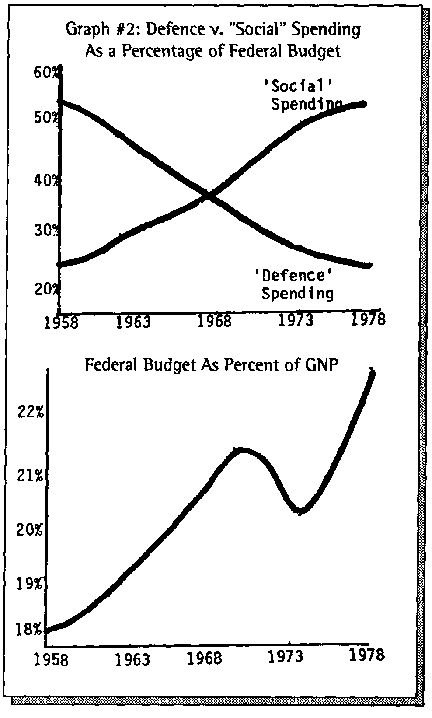
The bottom graph indicates the quantitative increase in the state’s “share” of the total social value. It is not surprising that it should increase during the Vietnam war. What is surprising is that at the very moment the war was ongoing, the proportion of “defense” spending dropped dramatically.
“War” and “defense” are an essential, though unrecognized, part of the reproduction of labor power, which can dictate the death of millions of workers. Auschwitz, Dachau, Belsun, were extermination factories whose product – the suffocation and cremation of millions of bodies – was an essential moment in Nazi capital’s “labor policy.” The reproduction of labor power should not be identified as the reproduction of “human bodies” and “beings.” Moreover, “social welfare” spending by the state can be defense spending. Indeed, this second aspect was apparent in the late 1960s. Another war was being fought white-hot in the streets of the USA that needed immediate attention. Hence the precipitate increase in “social welfare” expenditure, i.e., “transfer” payments (but what is not a transfer payment in this system?) to deal with women, blacks, youth, who were increasingly refusing the way they were being reproduced. This chart indicates that whether you call it “war” or “welfare,” the process of ensuring a population accepting the large-scale wages, profits and productivity relations as well as the micro-relations of love, job, discipline and quiet dying was in crisis. Not only was the work/energy ratio immediately in trouble, it was in more serious trouble over the long run.
Trouble, however, inspires thought, and capital’s thinkers turned with new apprehension to the work/energy ratio. A ratio is an expression of a two-sided relation and can be looked upon from either side. From capital’s point of view, the work/energy ratio is a more generalized form of the exploitation (or profit) rate. The crisis appears through these lenses as a decade-long, from the mid-60s to the mid-70s, plunge of profit rates. What were the causes of this decline? From the humblest industry gab and gripe sheets to the mathematical stratosphere of capital’s computer selfconsciousness the answer comes in reverberations: taxes and timidity.
The state is taxing “us” to death while “we” all too often take the “safe and secure path” that guarantees a small profit (but slow “growth”) instead of attempting risky, long-term ventures that really pay-off. The statistics showed this. Taxation on profits (calculated on “current production” profits) rose from 40 percent in 1965 to 60 percent in 1974. At the same time, the risk of investment fell. If we take as the measure of “risk” the interest rate on debt and equity that corporations must pay to raise financial capital, it is clear that capital collectively became chicken. The interest rate decreased from 8 percent in 1966 to 4 percent in 1972-73. Capital’s “claims” to its share of income were decreasing while what was claimed had to be increasingly given over to the state. US capital appeared to be catching the “British disease.”
W. D. Nordhaus, in his celebrated article “The Falling Share of Profits,” appeals to Keynes’ subjective theory of investment to explain why the interest on investment faced such a decline.6 According to Keynes, the capitalists must overcome their “ignorance of the future” through calculation of “mathematical expectations,” second-, third- (and even higher) order judgements on the “average opinion” of other capitalists in the investment market, and finally of “animal spirits,” i.e., capital’s “spontaneous urge to action rather than inaction.” In agreement with this Keynesian existentialism, Nordhaus claims that the fall in profits was due to an extraordinary period of calm in capital’s heart and mind:
The answer seems to me to lie in the general dissipation of the fear of a new Great Depression. For many years after the Crash, investors justifiably worried about a repetition of those events. Even as late as March 1955 when the fear might have reasonably faded, the statement by Prof Galbraith that the Great Crash could repeat itself was sufficient to send the market into a temporary panic – or so he claims. Since that time, however, the memory of the bad old days has dimmed, and this freedom from fear may well provide a rationale for the post-war movement in the cost of capital.
Presumably, in the different psychic “climate” prevailing in the post-WWII era, investors became more confident in the future, had a new sense of guaranteed horizons, the risk factor seemed reduced. Thus, (according to this theory of profits) the expected returns on investment fell. For if risk is high, the investor demands high profits, if the risk is low, s/he will settle for lower profits. What had brought about this freedom from fear, what psycho-analytical therapy had the capitalist mind undergone? Nordhaus does not explain, but to any therapist this much should be obvious: the healer must be paid his/her dues. In this case, the healer of capital’s long term fears was the state and the “dues,” taxes. This is why the major structural transformation of the GNP was in the share of the state. The Federal budget increased from 10 percent of GNP in 1940 to an average of 20 percent in the period between 1960 and the present. In other words, by investing in the reproduction of labor power the state exorcised the trauma of the Depression (and its potentially revolutionary consequences), and the increased tax on corporate profits was its fee. Every step capital takes in feeling more secure leads to a loss of profit.
But why should capital fear, why is investment risky, and the future so obscure? Why, indeed, must capital have “animal spirits” in the first place? Is this a metaphysical truth? Not really, because there are risks of different sorts. Some are dealt with in an almost mathematical manner, e.g., in fair toss gambling or in predicting the weather. You calculate future probabilities from past data, lay down your money and wait for the outcome. Such risks are not what Keynes is talking about. There are also strategy-game risks, those you take when you depend upon (or reply to) the actions of another player in a game where all the players agree to and are governed by the same rules. Here you cannot simply go upon past behavior: any game with a rich enough set of rules and positions can present completely novel situations and this forces you to speculate on the strategy of your opponent, to read out his likely move. This involves a risk, but the risk is encompassed in the network of rules that bind you with your opponents and allies (who may be continually turning into each other). This risk, typical of the poker game, is also calculable, as Von Neumann showed. There is however a final risk that is not dependent upon mathematical expectations nor upon considerations of strategy, because your opponents are neither predictable nor in agreement about the rules. Here, you have no clear basis for judging their future behavior in response to your moves. This is a totally new kind of risk that requires “animal spirits,” a “spontaneous optimism,” an “urge to action” or, perhaps, a “will to power.” This is the class struggle.
Keynes worried about capital’s “state of confidence” during the Depression not because it involved a downturn in the business cycle, however steep. Such dips in capital’s life are to be expected and capitalized upon. What concerned Keynes was the altogether novel “sixth sense” capitalists had to develop in their investment decisions after the revolutionary wave that followed the First World War. This involved shifting attention from risks “outside” (market fluctuations, weather, mineral discoveries, etc.) to risks “inside” (working class attitudes, training, work habits) the process of social production. The state had to intervene in Keynes’ prescription because of the increasing realization that the working class was not predictable nor “part of the game,” but powerful enough to rip up the rules. The mixture of taxes and timidity are a direct consequence of Keynes’ recommendations.
Since the New Deal, the state by careful use of collective bargaining, nuclear terror, FHA loans, had increasingly reduced the risks of investment. Hence the reduced interest on capital, for cooling capital’s anxiety inevitably reduced the pay-off of its projects. The transformation of the composition of the federal budget from “defense” to “welfare” in the 1960s indicated, however, that not only would the State’s “taking care” have an increased cost, but that the direction and nature of working class insubordination was changing in new, unpredictable ways. The period between 1967 and 1972 showed that the cost of calmness was increasing to a point where the therapy was ruining the patient. Freud never wrote that therapy could create the anxiety it was reducing. While the interest on capital followed the historical post-WWII trend, capital began to confront the fact that this trend meant euthanasia. Moreover, confidence was diminishing in the effectiveness of the State’s therapy when applied not to the traditional line workers, the veterans of Flint, Guam and McCarthy, but to altogether new subjects. Just what did those blackpowerlonghaireddopesmokingflagrant queerhousewifelesbians want!
Between the mid-60s and mid-70s, the tax-timidity syndrome intensified. The relation between state and individual capital proposed by Keynes was in crisis. Capital was in a knot, a double bind, and it attempted to cut it in October 1973. The relaunching of the profit rate depended upon capital taking the initiative, cutting out its most vulnerable areas and, most crucially, quit playing by its old rules.

 PARTISAN!
You must be logged in to post a comment.