A major war in the Horn of Africa now seems inevitable. But what are the stakes of such a conflict, and how did we get here? Edith Fischer explains.
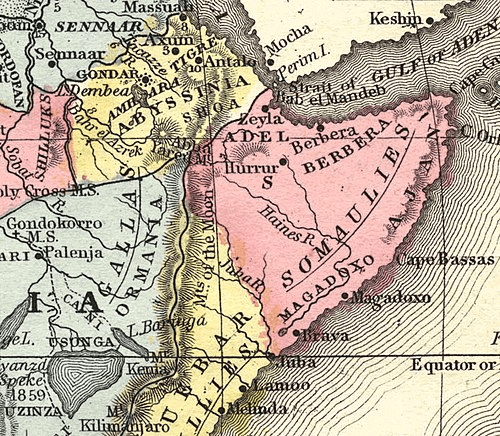
War in the Horn of Africa now seems inevitable1. As cross-border talks between the Abiy government of Ethiopia and their Eritrean counterparts break down once again, the Ethiopian military has mobilised to place pressure on the shared border. This comes amidst a more general crisis in eastern Africa which has seen state disintegration and civil war spread from Somalia to Sudan. Most Australian workers barely register these conflicts, despite them consuming millions of lives and having international ramifications. Even the most class conscious socialists are unlikely to print about these issues in their papers. However, the crisis in the Horn is just another site in the global crisis in capitalist development, and a site of intense competition between rival imperialist capitals.
This conflict is not new. Eritrea secured its independence from Ethiopia in 1991 after a thirty year long independence struggle against first the Ethiopian Empire and then against the Derg military regime. While many advocates of the Rules Based International Order had hoped that the 2018 peace accords between the two nations would serve to limit future conflicts, the last few years have seen a spiralling failure to reach any agreement between the two states. Central to these talks have been the problem of oceanic access for landlocked Ethiopia.
Ethiopia’s development program, which has placed it on a collision course with its neighbours in Egypt over the damming of the Blue Nile, requires access to ports. As Abiy stated in a meeting with President Erdogan of Turkey,
Due to our enemies’ plot, keeping Ethiopia a geographic prisoner for so long is not right… Logistics is the major bottleneck to our growth, and sea access is the key.2
In Ethiopia’s sights is the port of Assab, 60km from the Ethiopian border. While not previously claimed in irredentist border disputes, this port city has become central to Ethiopian nationalist demands3.
Capitalist Development and Nation State Formation
Ethiopia’s road to capitalist development has been a long one. Once ruled by the autocratic Solomonic Dynasty, Ethiopia is less of a nation-state and more of a complex network of client-patronage relationships between various ethnic groups and local elites, all nominally ruled from the capital of Addis Ababa. Under the rule of the old Emperors, it was the Amhara that dominated the others – they made up the old aristocracy that presided over a largely feudal society. Becoming a useful ally of the European colonial powers, the Ethiopian monarchy was able to preserve its independence, and the feudal aristocracy kept the country languishing in backwardness4.
However, Ethiopia could not maintain its splendid isolation forever. As the winds of modernity swept Africa and Asia, the monarchy sought to centralise the state and introduce a degree of modernisation of the military and state bureaucracy. The aristocracy resisted any attempt at modernisation, and the central government under reforming monarchs found their efforts stymied. This conflict remained central to Ethiopian politics until the overthrow of the monarchy in 1974 by nationalist petty officers, leading to the formation of the military junta widely known as the Derg.
The Derg and many of their opponents represented a form of politics that became all too common in the latter path of the 20th Century – petty bourgeois nationalists draping themselves in the language of Marxism-Leninism for the purposes of courting support, both from their domestic working classes and from the Warsaw Pact. The adoption of Marxist slogans was often superficial, but even when it was not, it was a Marxism adapted to the firmly petty bourgeois nature of these national struggles – revolutionary, but largely not proletarian or communist. The seizure of power by the Derg precipitated a revolutionary wave in Ethiopia – the seizure of feudal lands by the peasants and rolling strikes by Ethiopia’s small industrial working class. However, within a handful of years, the wave of revolution had been subordinated to the interests of the new petty bourgeois ruling class, with demands for industrial democracy leading to the suppression of independent working class activity. The Marxist left in Ethiopia represented by parties like All-Ethiopia Socialist Movement and the Ethiopian People’s Revolutionary Party were suppressed. The peasantry in turn faced draught, conscription, forced villagisation, and land fragmentation brought about by land reform – a crisis that drove many peasants into support for the revolution against the Derg5.
The fall of the Derg at the hands of the Ethiopian People’s Revolutionary Democratic Front (EPRDF) in 1991 saw power transfer from the Amharan state bureaucracy to the leading force in this ethnic rebel coalition – the Tigray People’s Liberation Front, representing the highland Tigrayan ethnicity from the country’s north. The EPRDF saw a period of Tigrayan dominance in Ethiopian politics, as well as the federalisation of the state6.
Federalisation, while promoted on the basis of ethnic peace and cooperation, has only strengthened tribal and ethnic identity, and allowed for the proliferation of a variety of local interest blocs within national politics. Abiy Ahmed’s career is a testament to this exact process of federalisation – hailing from the Oromo ethnic group, Abiy successfully united the non-Tigrayan ethnic groups against the TPLF and successfully drove them out of national politics. In place of the EPRDF, Abiy rules over the ethnically segregated Prosperity Party, named for the Prosperity Gospel style of evangelical Christianity which serves as its dominant ideology.
Abiy’s attempt to forge a national Ethiopian state that can rise above ethnic divisions has been as unprofitable as his predecessors. With the Tigrayans effectively isolated, the now Oromo-dominated state has faced rebellions by Amharan militias and border disputes with Somalia over the status of the Somalian minority in Ethiopia. In turn, the government has undertaken successive military campaigns against the Tigrayans in the single most bloody military campaign of this century prior to the slaughter in Ukraine.
The crisis in Ethiopia is indicative of the problems of state formation in Africa at large. Without a strong national-state, the capacity for the Ethiopian state to undertake any kind of development program is limited. Ethnic federalism is often promoted as a solution, but absent the destruction of the local elites and significant reforms to the economic base that produces them, this only furthers the fragmentation of the state. This crisis is not secular, but rather it is the product of the limits of capitalist development itself. The Ethiopian bourgeoisie, deeply intertwined with the imperialist interests of the world markets and limited by the global composition of capital, are neither willing nor able to undertake a process of state formation that would allow for the development of the domestic industrial sector7.
Sub-Imperialist Exploitation and Social Crisis
The Horn of Africa is a playground for imperialist interests. Ethiopia, Sudan, and Somalia all export significant quantities of agricultural products such as sheep and coffee, as well as having significant deposits of minerals such as gold. This has long made them a site of struggle between imperialist interests – Britain, France, Italy, and the United States. Today, it is competition between sub-imperialist powers that shapes the conflicts in the region.
Demand for animal protein from the booming Gulf States is driving cycles of violent conflict between pastoralists and farmers over land and water rights. Mark Duffield and Nicholas Stockton, writing in the Review of African Political Economy describes the emergent form of militarised ranching as
a social and environmentally destructive mode of production. It is necessarily expansive, land-hungry, livelihood destroying and population displacing. Sustained violence, livestock exports have attracted little outside attention despite being at the core of the Horn’s political economy. In a region once dominated by agro-pastoral subsistence economies, changes in the ownership, rearing and export of livestock reaches down into the social bedrock. Violent land clearances, livestock theft and armed grazing have devastated life-chances over vast swathes of territory to a greater extent than any other form of commodification.8
In turn, vast land grabs are today driven primarily by Saudi, Qatari, and Emirati investment. These buy ups of “unproductive” agricultural land place the Gulf imperialists in direct conflict with the peasants and pastoralists who find their lands enclosed and owned by foreign capitalists. Water rights, privatised in the long shadow of the end of “state socialism”, are bought up by Gulf-backed consortiums, and peasants and agricultural workers labour under backbreaking exploitation for Saudi Star Agricultural Development, Elite Agro, and MIDROC9.
Meanwhile, Ethiopia under Abiy has become the United Arab Emirate’s (UAE) strongest ally in the region. This remains the case despite Israel and Turkey working hard to court the Abiy government. The UAE today rivals China for the title of the single largest investor in Africa, bringing with it a whole series of geopolitical interests in the region. This has produced a spiral of competition, primarily between Saudi Arabia and Egypt on the one hand, and between the UAE and Ethiopia on the other10. Across the whole region, proxy conflicts are shaped by these competing interests. It is the Saudis and Egyptians who stand behind the Sudanese Armed Forces in their struggle against the Emirati-backed Rapid Support Forces, while the UAE and Saudi Arabia openly supported rival factions in Yemen’s long civil war. Notably, amidst this whirlwind of competition, both the UAE and Saudi Arabia remain important allies of the United States and the European imperialists, receiving extensive military investment as well as being deeply economically entwined with the dominant imperialist bloc11.
The coming war between Ethiopia and Eritrea also bears the marks of this imperialist rivalry. The UAE has strengthened its relationship with Ethiopia, while Saudi has invested in an expansion at the port of Assab as well as in Eritrean agriculture and fisheries. Saudi investments will warrant defence, should war threaten them. The stage is then set for a wider conflict – one that pulls in Egypt, Saudi Arabia, Sudan, and the various warring factions of Somalia. It will be the sons of Ethiopia and Eritrea’s workers and peasants who die in the coming war – fighting and dying over irredentist border disputes and oceanic access for their capitalist masters, and their master’s masters. And as the imperialist system careens from crisis to crisis, and the spectre of global war grows ever greater, all working people will be posed the same question as those in the Horn: international socialism, or a world divided between imperialist bandits?
- See the International Crisis Group Report, “Ethiopia, Eritrea and Tigray: A Powder Keg in the Horn of Africa”, 2026. ↩︎
- Simon Marks, “Historic Rivalries Spark Fresh Tensions in the Horn of Africa”, for Bloomberg, 2026. ↩︎
- For more on this conflict see: Yohannes Gedamu, “Ethiopia and Eritrea are on edge again: what’s behind the growing risk of war”, in The Conversation, 2026 ↩︎
- For commentary on the Ethiopian “prisonhouse of nationalities”, see: Ayantu Tibeso & J. Khadijah Abdurahman, “Tigray, Oromia, and The Ethiopian Empire”, in The Funambulist, 2021. ↩︎
- For further reading on the topic of the Ethiopian Revolution, its successes and its failures, I recommend the following:
John Markakis & Nega Ayele, Class and Revolution in Ethiopia, 1978
Andargachew Tiruneh, The Ethiopian Revolution, 1974–1987, 1991
John Markakis, “Garrison Socialism: The Case of Ethiopia”, in MERIP Reports, 1979
Michael Chege, “The Revolution Betrayed: Ethiopia, 1974-9”, in The Journal of Modern African Studies, 1979
Addis Hiwet, “Analysing the Ethiopian Revolution”, in Review of African Political Economy, 1984
John Markakis, “The Military State and Ethiopia’s Path to ‘Socialism’”, in Review of African Political Economy, 1981
Legesse Lemma, “The Ethiopian Student Movement, 1960-1974: A Challenge to the Monarchy and Imperialism in Ethiopia”, in Northeast African Studies, 1974. ↩︎ - For more about the TPLF:
John Young, Peasant Revolution in Ethiopia, 2009. ↩︎ - For more on the problem of state capacity and development in Ethiopia I recommend Emanuele Fantini’s “State formation and capacity in Ethiopia: Between the legacy of a centralised past and the promises of a federalist present”. ↩︎
- Mark Duffield & Nicholas Stockton, “Capitalism, war and plunder in the Horn of Africa”, in the Review of African Political Economy, 2023. ↩︎
- For more on sub-imperialism in Africa, see: Sarah Cotte, “Food, land, water: Africa and emerging Gulf sub-imperialisms”, in the Review of African Political Economy, 2026. ↩︎
- For more: Sean Mathews, “Egypt and Saudi Arabia focus on Eritrea as UAE bolsters ties to Ethiopia”, for Middle East Eye, 2026. ↩︎
- See the Clingendael report by Jos Meester and Willem van den Berg entitled “The political economy of Gulf investments in the Horn of Africa”. ↩︎


 PARTISAN!
You must be logged in to post a comment.