Black Liberation (Communist Unity) takes a look back at the history of the movement for Indigenous liberation in Australia, comparing it to the current state of the movement, arguing that much progress still needs to be made in order to continue the struggle for Indigenous liberation.
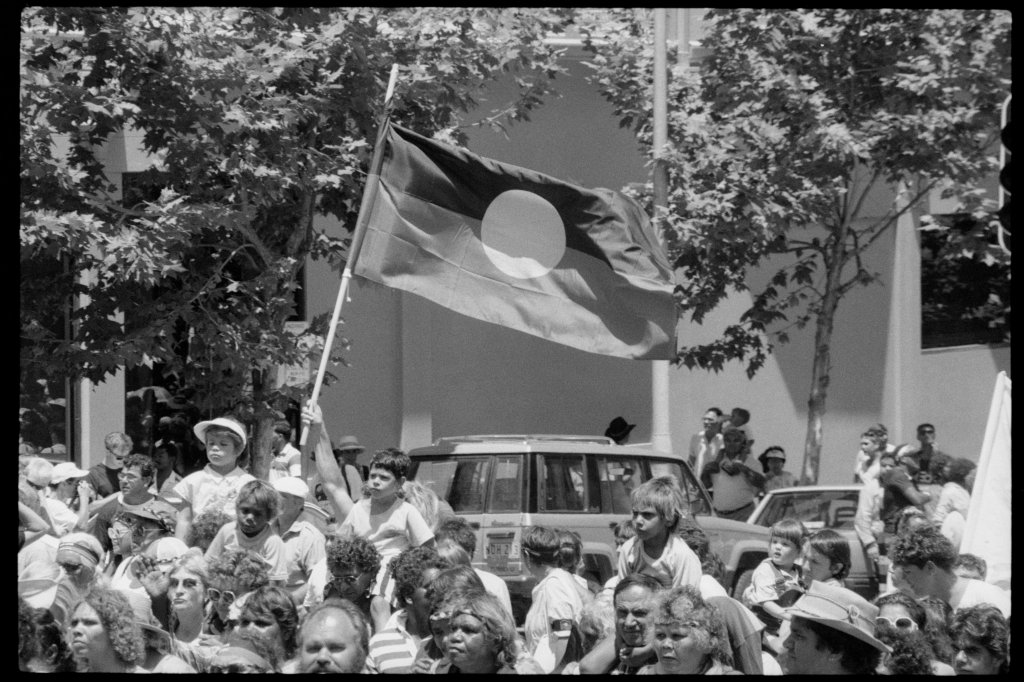
This year marks 238 years since British colonial forces first began what would become a centuries long process of colonisation. What we now know as Australia was a continent home to innumerable Indigenous nations, each with a distinct language and culture. These nations were subjugated and dispersed by a genocidal campaign of conquest waged by British colonial forces alongside free and convict settlers, who occupied land, slaughtered Indigenous people, and extracted natural resources.
“Formal” colonisation seemingly ended in the late 19th century. The final act of consolidation was federation: the merging of the colonies into a modern, federal government, under the British crown. Since federation in 1901, the Commonwealth has continued a colonial campaign of violence and genocide against Indigenous peoples. Despite this consolidation, an internal periphery persists across a substantial area: from the Kimberley in the north-west, to much of the Northern Territory, to south-western parts of Queensland and the north-central regions of South Australia, not to mention the Indigenous reserves scattered across the continent.
Indigenous peoples have never accepted colonisation passively: they continue to wage a long campaign of struggle against colonisation and for basic civil and democratic rights. Much progress has been made since the first political activists of the early 20th century. Indigenous people now ostensibly have the same civil and democratic rights as non-Indigenous Australians do. But despite this, Indigenous people continue to suffer from colonial violence and dispossession. Far from ending the violence, the Commonwealth hides its violence, covering it in layers of legitimacy via the police, the courts, and Parliament. It becomes clear that Indigenous people having the same on-paper rights as everyone else does not abolish their oppression – it instead provides a legal basis for the continued enforcement of destitution and poverty onto a substantial portion of their population.
We must not forget the Northern Territory Intervention, drafted by Howard’s Liberal government, and implemented by Rudd’s Labor government. This intervention was a dramatic and indefensible attack against the civil and democratic rights of Indigenous peoples in the Northern Territory, in which the police and military were sent to subjugate and occupy Indigenous communities. The Racial Discrimination Act 1975 was torn up, and with it, on-paper protections for Indigenous peoples. Such an intervention would be unthinkable in New South Wales or Victoria. The Commonwealth government’s willingness to overturn legal recognition of equal rights is such that even liberal international institutions such as the United Nations and Amnesty International provide strong condemnations, for all the good they do. Canberra has no regard for even on-paper legal rights.
In 2023, a referendum was held to adopt a proposed law implementing an Aboriginal and Torres Strait Islander Voice to Parliament. This referendum failed spectacularly, with right-wing pundits agitating against it, and left-wing pundits conducting sabotage against it. The “Progressive No” vote was a politically disastrous position which gave the Albanese government the “consent” it needed to not make any more effort in advancing Indigenous rights. While many in the Yes camp were wrong to assume that a No vote would lead to circuses of racism, the failure of the Voice, which was supported by over half of Indigenous voters, has set the movement for Indigenous rights and liberation back.
The movement for Indigenous Liberation is in pieces. Many devoted and committed activists, such as Gary Foley and Robbie Thorpe, are ageing out of politics. The movement has become dominated by activist personalities with self-serving agendas, who use the memory of the movement for their own benefit. Programs for the liberation of Indigenous peoples have become replaced by action campaigns of disruption – overall, turning Indigenous activists into insurrectionists whose primary political practice is irritating the government through stealing flags and vandalising statues.
Sovereignty was not ceded by Indigenous peoples, it was stolen from them by the colonial forces, now held captive by the Commonwealth government. Indigenous peoples cannot reclaim their sovereignty through declarations and assertions – they must win this sovereignty back through real power. Indigenous peoples must have control over their affairs: in education, in health, in the provision of services, in the workplace, and in politics. Real sovereignty can only be won back through a struggle waged by workers of all nations and backgrounds, united together.
Communists don’t aim to take over social movements, but neither do they aim to follow behind every cynical activist personality. Instead, we aim to provide our political support to Indigenous workers and toilers in their struggle for liberation, and we fight to win non-Indigenous workers (white, migrants, so on) to a program for the liberation of all peoples; regardless of race, nation, sexuality, religion. This is because we can’t just goad the non-Indigenous majority into supporting Indigenous liberation through moral condemnations. We need to make them see that their liberation is bound up with the liberation of Indigenous peoples.
Only a socialist Australia, in which working people of all nations and creeds are in power, can truly uplift Indigenous peoples and come together with them as equals through treaty. The main barrier to a socialist Australia is the Commonwealth government, a colonial outpost of the rump British Empire. The fight for Indigenous liberation is therefore inseparable from the fight for socialism, the struggle for an emancipated society.
“We’re strong, we’re united and we’re working on a multitude of levels, all of which ultimately form one great self-determination for Aboriginal people in this country: we must achieve economic independence for ourselves as communities of people. But if we achieve that in the next ten or twenty years, we will still be surrounded by an Australia that is in all aspects diametrically the opposite of our society. We’ll end up as what amounts to socialist enclaves in the midst of a mad capitalist white Australia; a twisted white Australia.
The only sort of Australia that I think Aboriginal Australia can ultimately live alongside in true harmony is some form of socialist republic where racism, sexism and exploitation have been eliminated. Now, we’re doing alright in organising our mob. What the hell are you mob doing? You are so disorganised and splintered. It’s vitally important that you get your act together, because whether we like it or not, we’re all in this together.” (Gary Foley, 1988)

 PARTISAN!
You must be logged in to post a comment.