C. Bourchier reports on the fourth general conference of Communist Unity (formerly Revolutionary Communist Organisation), laying out the perspective of the Spartacist Tendency.
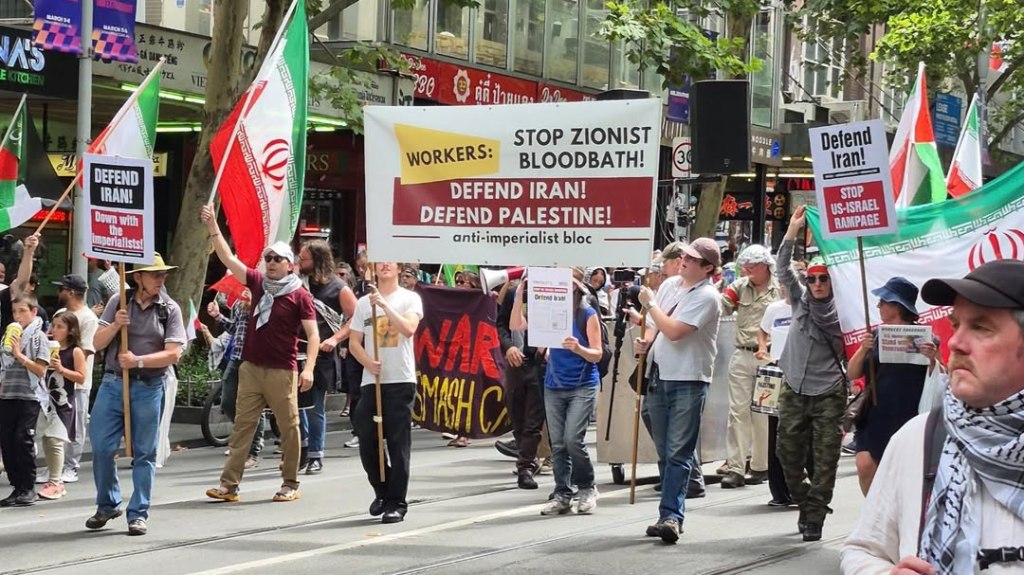
Over the weekend of 17-18 January, the Revolutionary Communist Organisation (now renamed Communist Unity) held its fourth general conference, the first one Spartacist comrades have attended. The Spartacist League of Australia was unanimously accepted into the organisation and we were able to participate fully as a minority tendency.
The coming period portends burgeoning reaction and economic turmoil for the “lucky country,” as well as further fractures in its already perennially splintering socialist movement. Especially in this context, it is a welcome development that the SL/A and RCO have been able to merge our forces. It is true that this is only one step forwards of the many we will need to take, and our status as a medium-sized fish is only relative to the very, very small pond of Australia’s left. Nevertheless, it is a breath of fresh air.
The conference itself was well organised and leading comrades of the Mountain tendency (MT) (which form the majority of the newly-voted CC) made great efforts to ensure Spartacist Tendency (ST) comrades were fully able to air criticisms and motivate our motions and amendments. As a result, discussion allowed for healthy debate over topics which the left as a whole needs to have. Over a myriad of key questions, agreements were able to be had and differences brought to the fore.
Whither Australia?
One of the key questions that framed the conference was: “Where is Australia going, and what do we do about it?” As ST delegates emphasised throughout the conference, we understand the world not as rival imperialist blocs vying for redivision of the world, but from the standpoint of the relative decline of US hegemony and its struggle to stay on top—principally against a rising China. For this purpose, the American Empire is tearing up the international liberal status quo of the past four decades, and Australia’s liberal order will be no exception.
Working-class discontent, having previously reared its head during the lockdowns and in the resounding defeat of the Voice referendum, has not gone away. The Labor government and the union bureaucracy have thus far been successful in preventing frustrations being channelled through class-struggle action—especially in regards to the CFMEU state takeover. But it has not been successful subduing discontent altogether.
With the failures of the workers movement, backlash at the status quo has increasingly turned rightwards, with One Nation’s Hanson emerging as the de facto leader of the Opposition. In the aftermath of the Bondi killings, One Nation has been able to skewer the Labor government for its response to beef up “hate speech” laws and further gun control while tapping into frustration at the immigration policies maintained by the Labor government and its predecessors. It is no accident that Albanese has increasingly treated token reforms as more tarnish than varnish. Support for Australia Day is higher than its been in years. With the American Empire escalating its moves against Australia’s biggest trading partner in China, the liberal order’s economic stability is set to crater which will put these trends on overdrive.
This is bad news. A rightwards turn amongst the working class will only further isolate the left. Australian capitalism is set to further tighten its vice, crack down on campus radicals and increase repression more generally. In the face of this, left groups remain hitched to their strategy of tailing the liberal leadership of worker and social movements or of further isolating themselves in a little radical bubble. The recruiting pool is set to stagnate and muddy. Pressure will push some towards further isolated desperate actions or to simply burn out. In this context the task must be to break from our current course and brace ourselves—both the CU itself and the socialist movement as a whole.
This was the perspective that the ST struggled for in the conference, as exemplified in our proposed program, but also through key motions which sought to concretise specific points for discussion and deliberation. Rooting ourselves in a materialist understanding of the world, and Australia’s place in it, and setting tasks accordingly, has been key to the SL/A’s method since its political reorientation—which previously contented itself with r-r-revolutionary sloganeering divorced from both an understanding of the world and what is to be done.
Unfortunately, one is hard pressed to even find the most basic discussion of Australia’s present juncture being discussed in the left, reflecting a similar void in Australia’s bourgeois press. As such, it was refreshing that the conference brought some of these questions to the fore. Discussion over MT-supported theses dedicated to the international and Australian situation took up a significant portion of the conference. These discussions not just strengthen CU more generally but also the ST specifically. Thoroughly engaging with comrades on this question has enabled the ST to further sharpen and develop our arguments. And on the international situation, some agreement was even reached with other CU comrades.
This included an ST proposed motion which defined the world by a hegemonic American Empire in decline. The motion concluded that international revolutionary unity must be forged on the basis of opposition to the American Empire and its attachés, including defence of China and the gains of the 1949 revolution. Some leading MT comrades voiced their support to the motion which was critical to it passing.
Where the sharpest differences were brought to the fore was on Australia’s place in the world. Unfortunately, the MT-supported theses argued that Australia in many ways will be shielded from the coming world crises. Instead of a working class being driven rightwards against Labor and the liberal order it governs for, the theses argues that “The Labor Party still broadly commands the votes and support of workers in this country.” It went further to argue that “other capitalist parties do not offer an alternative government to that of Albanese,” with MT comrades even arguing that Albanese is well on course for a decade in government! Such a view disarms CU in the face of increasing reaction and underrates the necessity to address the vital questions that attract workers to right-wing demagogues.
If those theses aimed to answer the question “Where is Australia going?” the “Three-Year Plan”1 effectively functioned as a counterpart to it answering the question “what do we do in the coming period?” The effort and detail that was put to this effect in the plan and its accompanying report is commendable. However, where the plan suffers is in its detachment from an understanding of both the capacities of the CU and the class dynamics in the country.
Year one alone of the plan projects every city having its own publication, running a Marxism school, reading group, social events, and more. It remains a question how we will accomplish this in Melbourne or Brisbane, let alone the Newcastle or soon-to-be Central Coast section. This “recruitment conveyor belt” is projected to double our membership in the first year, and double it again in the next before CU eventually becomes the “centre-of-gravity” of the Australian left by the third year.
This presumes a reservoir for recruitment far vaster than what actually exists. It also assumes that these recruits are just waiting in the wings for a conveyor belt to scoop them up. In the current context of increasing reaction such projections are especially illusory. Not only are we setting ourselves up to be disappointed, it risks burning out the cadre we’ve already won over in the process. It was for this reason that the ST argued against adopting this motion as well as the theses on the Australian situation, both of which ultimately passed.
How do we build a party?
If the Three-Year Plan proposed a lot for the years ahead, one thing it argued to not do was to intervene into the workers movement. Well, not until year three. This gets to the heart of another question that was debated throughout the conference—“how do we a build a party?” The debate over the ST motion “Towards a Proletarian RCO,” which aimed to fight for a 50 percent blue- and pink- collar CU, brought this question to the fore.
There were myriad arguments against the motion, much of it over the definition of a worker. But the argument that emerged in the debate that best got to the core of why the proposal was so controversial is summed up by the title of a polemic written against the (now former) SL/A: “Party first, then split the class.” That is: “How can we intervene into the workers movement today? Our forces are too small to meaningfully impact anything until we reforge a party. Let’s sort out the left, let’s reforge the communist party, then let’s talk about the fight for revolutionary leadership.”
This argument starts from a point of truth, that the left’s forces (much less the CU’s forces) are currently too small to break the working class wholesale from its misleaders. Where the argument goes awry is precisely over how we can build and develop the necessary forces for this.
There were a lot of correct points made about how the left today is a mess. But nothing would change the political landscape of the paltry and almost chemically pure petty bourgeois left more than an influx of working-class militants committed to not just talk-shops but actually “what is to be done?” Nothing would strengthen the CU’s forces, harden its cadre and make it a pole of revolutionary regroupment and reorientation more than forging itself as an organisation of proletarian militants committed to this goal. Building a mass workers party is a dialectical process. We must build up the forces to intervene into the working class, yes, but those forces will only be built through intervening into the workers movement and demonstrating to working-class militants and the left that we are “that section which pushes forwards all others” (to quote Marx). The union work that has been backed by the ICL internationally highlights that isolated revolutionary militants can have a modest but real impact.
While the ST intervened on this basis, other CU comrades also spoke up in favour of the motion. The debate was lively and the most contentious in the entire conference, ultimately losing by the smallest of margins through an evenly split vote.
The fight for communist unity
The most fundamental difference highlighted at the conference was: what basis for unity? Some MT comrades, correctly seeing two different methods behind the motions proposed by the MT and ST, have argued that the difference is over the question of “actionism.” While there is a certain truth in that the ST very much emphasises that Marxism is a guide to action, the difference between the two tendencies is not so much how much we do, but on what basis.
Where the differences were most clear was the debate over the ST-proposed program and the MT-proposed Docklands Program. The Docklands Program seeks unity on the basis of not the road to power but the idea of it, a shared “vision” of the dictatorship of the proletariat. Its “minimum” program is explicitly what a communist party ought to do once it ascends the reins of power. As MT comrades motivated, this program was consciously made to be more-or-less unobjectionable (at least in theory) to the rest of the left. Its strength is that it touches on a truth that today the left is splintered due to a thousand sectarian reasons, and there is no real programmatic basis for all these different little groups.
Where it suffers however, is tackling why the left, ostensibly sharing the same ideas of a socialist future, is nevertheless in a weak and divided state. Striving towards workers power entails breaking from the biggest failure of the left—its attachment (or its sectarian phrase mongering, aloofness) to the current-day leadership of the working class. The labour movement today is led by all sorts of Laborites who preach nice words for the working class, Palestine and peace but in one way or another are attached to the Labor government. It is the left’s conciliation of these labour fakers that has driven it to its current-day irrelevant status, which in turn has empowered its most sectarian and cannibalistic elements. For socialist unity to be tenable, it must be on the basis of struggling to break these chains which bind the working class to its oppressor—not a “vision” of a future when oppression is done away with. While action is crucial to this fight of separating the wheat from the chaff, it is but the concrete expression of this broader framework.
The discussion over this question was where we made the least progress at the conference, aptly described as two ships passing in the night. Nevertheless, there will be plenty of opportunity for further discussion and to put our views to the test. Emblematic of this is two MT-supported theses on the Labor Party and the Socialist Party (SP), in which almost all of the politically crucial ST-proposed amendments passed or were accepted as “friendly” (thanks to backing of some MT comrades).
The theses on the Labor Party now explicitly argues that struggling for democracy in Labor is key, but this can only happen on the basis of “driving a political wedge between Labor’s working-class base and its pro-capitalist tops, exploding the contradictions of this rotten entity.” It continues by arguing that “our goal is not to build a better, more left, more democratic ‘cleaned up’ Labor Party. Rather, this struggle would expose the ‘left’ Laborites….” Such a perspective puts the CU against both those hitched to the current day liberal-Laborite leadership of the working class (like Solidarity, Socialist Alternative and Socialist Alliance) as well as those who stand aloof from it (like the Socialist Equality party).
Similarly, the Socialist Party theses argues that key to CU’s struggle within the SP will be to “break its members from electoralism and capitulation to liberalism and the left Laborites that is conditioned by the dominance of Socialist Alternative’s program.”
These theses if put in practice would expose the ambiguities within the Docklands Program (now officially the CU program). The Docklands Program proposes unity with the left as they are, albeit with more democracy and sans sectarianism. The Labor Party and SP theses propose unity on the basis of irreconcilable struggle against the current day misleadership of the working class and those who conciliate with it. The latter means a struggle to break the left from its current trajectory—the only way we can succeed in regrouping the revolutionary left, which is today scattered.
What now?
The discussions at the conference and resulting motions are only the beginning. Now the real test begins for both the motions, the merger and CU as a whole. Key to this will be to put the motions voted into practice. The ST is committed to making as real as possible not just the motions we put forwards (the “American Empire” motion), or agreed with (the Labor and Socialist Party theses) but also those we argued against, including the Docklands Program and the Three-Year Plan. While there are sure to be differences on how to apply these motions, fighting for them in the struggle to build a common organisation, will test both agreement and disagreement and will be the only way forward for political clarification. It is a testament to the goodwill and political seriousness of CU comrades that we have been able to reach this stage. Continuing this approach on all sides will be key to ensuring its success, and we look forward to building CU as comrades united in a common organisation.
1 In reference to a “three year plan” produced by Mila V. to outline the future of the organisation over the next three-year period.


 PARTISAN!
You must be logged in to post a comment.