The following is the final instalment of our republication of Loren Goldner’s exceptional study into the agrarian question in the Russian revolution. While the editor has some objections to Goldner’s characterisation of Bolshevism (particularly his understanding of What is To Be Done?, which is unfortunately marred by a Cold War-era reading, we think our readers will find his contributions valuable. – Edith Fischer, Editor
Russian Peasants and the Commune in 1917 and Thereafter
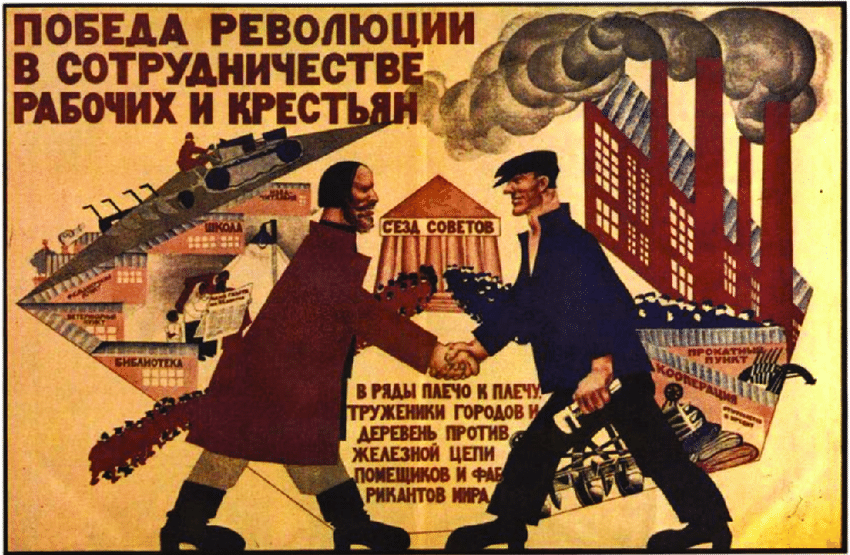
Within a month of the February revolution that overthrew the Romanov dynasty, the peasantry had risen en masse. They attacked the large landowners and the commune peasants attacked the separate farms. As in 1905, the commune was at the center of peasant struggles, taking charge of confiscations and the redistribution of lands.
After “reorienting” the Bolshevik Party following his return from exile and the famous “April Theses,” Lenin was arguing that the rural soviets had already shown far greater creative social imagination than the Provisional Government. A Bolshevik rural Red Guard had formed in March-April 1917. In the April 4 edition of Pravda, Lenin wrote: “If the revolution is not settled by the Russian peasant, it will not be settled by the German worker.” Lenin’s draft program in April–May 1917 was 1) nationalization of all land 2) transformation of large estates into model farms, under soviets of agricultural workers and run by agronomists. But these formulations, observed Crisenoy, were deeply alien to the peasant movement1.
The Bolsheviks, at this point, were still a minority, outnumbered by the Mensheviks and the SRs. Workers and soldiers had beaten up demonstrators carrying Bolshevik signs in April. By May, nonetheless, Lenin was telling the Congress of Peasant Deputies that peasants should at once seize all land, to the consternation of the Provisional Government and in particular of the SRs, who headed ministries and were prevaricating on the land question. The SR and Menshevik ministers were ready to defer any transfer of land to the peasants until a Constitutional Assembly could meet. Some SR observers noted with dismay the impact of Lenin’s appeal for land seizures and the damaging political case the Bolsheviks made against the SR ministers in the coalition. The leading SR political figure, Chernov, was assaulted by a peasant shouting “Why don’t you take power, you s.o.b, when it’s given to you?’ The Congress of Peasant Deputies in fact called for soviets of peasants everywhere, and attacks on individualized property accelerated.
As the Provisional Government and above all the front disintegrated in the summer of 1917, peasants were deserting the army in droves and returning to their villages to get their share of the land newly distributed from the gentry estates. This movement, like the soviets in 1905, was the work of no political party. Peasant disturbances peaked in October 1917. Immediately after overthrowing the Provisional Government, the Bolsheviks issued their Land Decree, recognizing the fait accompli of land seizures in the countryside; under the decree, peasants were free to set up communes or artels (cooperatives). The Bolshevik Land Decree was essentially the SR program. A wave of egalitarianism had swept the countryside and in 1917–1918 the peasant commune had extended beyond any previous historical frontier. The peasants distributed gentry, church and monastery lands to families based on the traditional criterion of the “number of eaters”; some independent peasants from Stolypin’s reform were forced back into communes. The confiscations were largely complete by the spring of 1918. 96.8 percent of all lands were in peasant hands, and three million landless peasants had received allotments. The commune at this point encompassed almost all rural households.
Lenin, in Kingston-Mann’s account, had always insisted that the dangers involved in peasant land seizures were always outweighed by benefits from attacks on bourgeois property. The land decree of October 1917, taken from 242 peasant mandates and from the SR agrarian program, had abolished private property in land, and went against the Russian Marxist tradition in its respect for peasant communal traditions. Its terms were populist, and the non-Bolshevik left recognized its expedient, even opportunist character:
“The Russian Marxist tradition was rooted in a denial of the sociological insights which Marx himself had praised in the work of populists like Danielson.”
“Unaware that peasants re-entered the communes in increasing numbers during the pre-war period, Bolsheviks and Mensheviks found no constructive socialist significance in the peasantry’s successful efforts to return the otrubshchiki [the Stolypin-promoted “splitters off”–LG] to the communes in the course of 1917.”
“[O]bsessions with capitalism in the countryside…and awareness of the individualistic property fanatics and bigots among the peasants, had blinded Russian Marxists to much evidence about the agricultural economy, about the widespread resistance to the Stolypin reforms, and about the collectivist notions of peasants who demanded abolition of private property in land…Fears of the kulak flourished in official circles, as peasant communes carried out an unprecedented equalization of land on behalf of the poor without any help from the Soviet authorities.”
Early on, the Soviet government was interfering with the distribution of animals and farm materials, a policy aimed at leaving the poor peasants unable to farm and encouraging them toward the new state farms (sovkhoz). Once in power, the Bolsheviks had discouraged further destruction of estates, which the peasants, for their part, saw as a further guarantee that the former owners would never return. Bolshevik policy favored specialists in the countryside (as sovkhoz directors). At the 7th Congress of Soviets, there was already criticism of the privileges of the specialists. Sometimes the director of the sovkhoz was the former landowner! In these debates, Lenin again turned to the example of German (Prussian) state capitalism: its modern techniques were in the service of imperialism and the Junkers, but “replace ‘state capitalism’ with ‘the Soviet state’ and you have all the conditions of socialism.”
But quarrels over administrative measures were soon to be greatly complicated by the drastic falloff in agricultural production. In November 1917, Russia had still produced 641 million tons of wheat. Requisitions to feed the cities began in early 1918, when already only 7 percent of the grain planned for Petrograd and Moscow was delivered. As the civil war intensified in the summer of 1918, some fertile lands fell under the control of the Whites, and famine set in. In response to requisitions, peasants cut back production to the basic needs of their families; land under cultivation declined by 16 percent by 1919. The Bolsheviks had counted on the support of the poorest peasants but land distribution had moved many of them out of that category; the committees of poor peasants had great difficulty functioning. The party cells in the countryside had 14,700 members but were mainly made up of functionaries. By 1921, after three years of civil war, harvests were at 40 percent of 1914 levels. Between 1918 and 1920, in the years of war communism, epidemics, hunger and cold killed 7.5 million Russians; four million had died in the civil war. People returned to the land to survive; of the 3 million workers who made the proletarian side of the “dual revolution” in 1917, only 1.2 million remained in the factories by 1922.
By 1921, furthermore, the proletarian democracy of 1917, embodied in the soviets and workers’ councils, had been destroyed or turned into rubber stamps of the party. The left SRs, who shared power with the Bolsheviks for a few months, were suppressed in July 1918 after they assassinated the German ambassador, in an attempt to undermine the Treaty of Brest-Litovsk2. Repression against anarchist “bandits” had begun in early 1918. The Bolsheviks crushed the Kronstadt uprising in March 1921, and had earlier crushed the anarchist peasant Makhno movement in the Ukraine. At the 10th Party Congress, also in March 1921, internal factions within the party itself had been suppressed. That Congress also inaugurated the market-driven New Economic Policy (NEP). Oppositional currents within the Bolshevik Party, such as Miasnikov’s Workers Group or the Democratic Centralists, had been suppressed. By 1922, the remaining independent Mensheviks were offered the choice of execution or exile. From that point onward, the only open discussions remaining in Soviet Russia with any real influence over events involved a few hundred Old Bolsheviks at the top echelons of a party ruling uneasily over 150 million people, the great majority of them peasants. That party had also absorbed hundreds of thousands of new members after the October seizure of power, often people more interested in jobs and careers than in the real history and outlooks of Bolshevism3. A number of former bourgeois and even large landowners rallied to the new power, often becoming directors of sovkhozes, factories and mines. The nucleus of a new ruling class was in place. Ninety percent of state functionaries were carried over from the Tsarist regime, and 90 percent of officers in the Red Army had been Tsarist officers.
The legacy of modernizing Second International Marxism on the agrarian question remained the outlook of the Bolshevik Party in power. Thus the disconnect between the emerging factions of the regime—all of them—and the reality of the countryside, having the overwhelming majority of the population, remained as great as it had been prior to the Bolsheviks’ arrival in power. As historian John Marot put it, to implement the development plans of all factions—the Trotskyist left, the Bukharinist right and the Stalinist “center”—meant “to destroy the peasant way of life,” the commune. Lenin had recognized after 1905 that he had exaggerated the presence of capitalism in the Russian countryside, but, as indicated earlier, he merely set the clock back on the same dynamic.
The fundamental problem was that the peasant world, centered on the mir, was not on Lenin’s timetable at all, belated, contemporary or otherwise; the owners of the newly-distributed private plots within the framework of the mir were not capitalist peasants producing for a market, but were participating in household economies, producing primarily for their own use, occasionally using markets to acquire the relatively few goods they could not produce themselves. Their surplus had previously gone to the Tsarist state through taxation to pay for industrialization, and to the landlords for their consumption. With those two burdens removed, the sole external compulsion remained the modest taxation of the Soviet state. No industrialization program assuming a peasant capitalist rationality had any chance of achieving its goals. The peasant economy, as Marot put it, was neither capitalist nor socialist, and “the peasants had little or no interest in the collective organization of production and distribution beyond the confines of the village.”
By the spring of 1921, the ebb and isolation of the Russian Revolution, internationalist from the beginning in the strategic conceptions of Lenin and Trotsky (in their different theoretical frameworks4) could not have been more clear. The world revolution which had in 1917–1918 seemed weeks or at most months away henceforth had to be reckoned in years. In quick succession the spring of 1921 saw the suppression of the Kronstadt uprising, the failure of the “March Action” Germany, the Anglo-Soviet trade agreement, the implementation of the market-driven New Economic Policy (NEP), the suppression of factions in the Bolshevik Party, the Treaty of Riga, formalizing the Soviet defeat in the 1920 war with Poland, and the commercial treaty with Attaturk’s nationalist government in Turkey, which a mere two months earlier (January 1921) had murdered the entire central committee of the Turkish Communist Party. This general ebb of hopes for revolution in western Europe weakened the position of the internationalist, cosmopolitan wing of the Bolshevik Party and strengthened the position of the internal “praktiki,” the long-term veterans of the party apparatus from the years of clandestinity under Tsarist autocracy, personified of course by Joseph Stalin. The regime turned inward, and with famine still raging in the countryside, nothing had a higher priority than the peasant question.
For Lenin, the Bolshevik regime was a dual revolution, based on the “democratic dictatorship of the workers and peasants,” completing the bourgeois revolution of eradicating pre-capitalist agriculture. He wrote:
“Yes, our revolution is a bourgeois revolution, as long as we march with the peasantry as a whole…we have said it hundreds and thousands of times since 1905…”
This bourgeois revolution, in his view, could move to a socialist phase when aided, and only when aided, by revolution in the West. The alliance with the peasantry (the so-called “smychka”) remained crucial in Lenin’s strategic perspective for the rest of his political life. He would have viscerally rejected Stalin’s 1924 proclamation of “socialism in one country.”
My purpose here cannot be to put forward a specific theory of the “class nature of the Soviet Union,” harking back to the state capitalist/ bureaucratic collectivist/ degenerated workers’ state debates of the 1960s/1970s. I merely signal my agreement with some variant of the class, as opposed to workers’ state theories, but explaining my analysis in detail would further shift the focus away from my main purpose, namely tracing the impact of the agrarian question and the fate of the Russian peasant commune in shaping that outcome. I mention Trotsky and his theory of permanent revolution primarily to indicate the difference between his framework and Lenin’s, who never accepted that theory5, however close they were in the spring of 1917.
The Russian working class had its own thoughts about the NEP, built on the destruction of the soviets and workers’ councils they had created in 1917, and the return of the managerial elite they thought they had overthrown in that year. It waged a series of militant strikes in August and September 1923. A second Workers’ Group had formed in the spring of that year and played an important coordinating role in these strikes; according to Marot,
“(it) sought out alliances with elements of previous oppositions. Denouncing the New Economic Policy as the New Exploitation of the Proletariat by bureaucratically-appointed factory managers and directors of industry, the Workers’ Group tried to recruit among party and non-party workers. It strove to lend political definition and direction to to the massive strike wave…It even looked for support abroad, among left-wing elements of the German Communist Party…and among Gorter’s Dutch Communists.”
And where was Trotsky while these strikes were going on? Marot is eloquent:
“Trotsky’s political opposition toward the factional activity of the Workers’ Group of 1923 outwardly expressed (his) firmly-held and ideologically internalized insistence on unitary, single-party rule… Trotsky even refused public solidarity with the over two-hundred members who dared to participate actively in the workers’ strike movement, and who had been subsequently expelled from the party… Although Trotsky did next to nothing to lend political guidance to rank-and-file dissent outside the Communist Party, he was almost always prepared to respond favorably to invitations of political co-operation by one or another of the party leadership.”
Lenin was forced by rapidly declining health to withdraw from political activity in early 1923, and died one year later. In the last months of his very reduced activity, he had planned to “throw a bomb” under Stalin at a forthcoming party congress and, in his testament, called for Stalin’s removal from the position of general secretary of the party.
The fact that Soviet Russia emerged from the civil war in 1921 with the nucleus of a new ruling class in power still leaves open the fate of the mir, in which 98.5 percent of the peasantry—itself at least 90 percent of the Russian population—lived, up to its demise in 1929–30. It is thus important to sketch out the faction fight in the “commanding heights” of the Bolshevik Party up to Stalin’s collectivizations. There was nothing foreordained about what actually happened, which transformed Soviet Russia from the “guided capitalism” of the NEP of 1921, conceived as a holding action prior to revolution in the West, into the mature totalitarian form consolidated under Stalin in 1929–32. No one in the three-way faction fight up to 1927, Stalin included, advocated the violent collectivizations that finally gave the Soviet Union the definitive contours through which it became known to the world as “communism.”6
Here is how Moshe Lewin (though offering statistics somewhat at odds with those cited previously) describes the situation of the mir, shortly before its destruction in 1929–1930:
“On the eve of revolution, fewer than 50 percent of the peasants were still members of the mir… Eight million households held their land as private property, while 7.4 million holdings were still communally owned. The decay of this relic of the ancient peasant community was hastened by the increasing degree of social stratification within the peasantry. However, at the time of the revolution, the mir took on a miraculous new lease on life. The miracle can be explained by the fact that the agrarian reform, which freed the peasants from the bonds of feudalism, also evened out the differences between them to a very considerable degree. Having got rid of the pomeshchiki [the last descendants of the service aristocracy of the 16th–18th centuries–LG] and some of the kulaks, the peasants reverted to the old egalitarian relationships of the mir, and by the same token to the institution itself… Ample evidence of the… communal form of land tenure is afforded by the agrarian code of 1922, which deals with it in great detail. The Party, however, appeared to take little account of this factor, and of its possible implications… between 1922 and 1927 the village society, by virtue of the general improvement in the economy, had grown considerably in strength, its budget had increased and, despite the efforts of the authorities to encourage the [rural soviets–LG] it was the mir which continued to be the ‘sole organization in charge of the economic life of the village.”
The 1921 turn to the NEP (New Economic Policy) did revive both industry and agriculture, in terms of the Bolshevik strategy of “guiding capitalism” while marking time until revolution in the West. The NEP cannot be critiqued as a “restoration of capitalism” because capitalism had never been abolished in the first place. To the charge of the Workers’ Opposition, at the 10th Party Congress in March 1921, that the Bolsheviks were creating state capitalism, Lenin replied that state capitalism would be a major step forward for backward Russia, dominated as it was by petty producers.
Under the NEP, peasant food production by 1925 approached for the first time pre-World War I levels, in contrast to the famine conditions of 1921–22.
The NEP, however, also led to the famous “Scissors Crisis” of 1923 and 1925, in which the prices of industrial goods produced in the cities rose much higher than the prices for agricultural produce from the countryside, making it impossible for peasants to buy, and undermining the strategy of a controlled “socialist primitive accumulation” off the peasantry advocated by the economist of Trotsky’s left-wing faction, Evgeni Preobrazhensky. This strategy, moreover, was doomed because, as indicated earlier, nothing, short of force, compelled the peasants to interact with the urban-industrial economy on the scale envisioned by the planners of the left, or for that matter by Bukharin and the “socialism at a snail’s pace” theorists of the “right.”7 By the mid-1920s, it was clear that the differences between the Trotskyist left and the Bukharinist right were more quantitative than qualitative, coming down to differences over the appropriate pace of “pumping” the peasants, as Bukharin increasingly recognized the need to industrialize with a surplus taken from agriculture. Bukharin early on had prophetically written, against the left’s industrialization plans,
“…Taking too much on itself, (the proletariat) has to create a colossal administrative apparatus. To fulfill the economic functions of the small producers, small peasants, etc., it requires too many employees and administrators. The attempt to replace all these small figures with state chinovniki (see footnote)—call them what you want, in fact they are state chinovniki —gives birth to such a colossal apparatus that the expenditure for its maintenance proves to be incomparably more significant than the unproductive costs which derive from the anarchistic condition of small production; as a result, this entire form of management, the entire economic apparatus of the proletarian state, does not facilitate, but only impedes the development of the forces of production. In reality it flows into the direct opposite of what was intended, and therefore iron necessity compels that it be broken… If the proletariat itself does not do this, then other forces will overthrow it.”
By the end of 1927, Stalin and his “center” had defeated, marginalized and expelled the Trotskyist left from the party, with the support of Bukharin and his faction. Even then, the left remained largely clueless about the real danger represented by this “center.” Trotsky had said, prior to his own initial exile to Alma Ata (in Kazakhstan): “With Stalin against Bukharin, perhaps. With Bukharin against Stalin, never.” What was ultimately at stake was the preservation of the “smychka,” the worker-peasant alliance, the last pillar of Lenin’s “dual revolution,” which would not survive any concerted attempt to squeeze the peasantry harder to pay for industrialization. Many figures, across the political spectrum within the party, imagined the NEP lasting for years, perhaps decades, into the future.
The break in the situation occurred with two successive years of crop failure in 1928 and 1929. Breadlines were forming in Moscow by the end of 1928, and Stalin used the emergency to launch his infamous “war on the kulak” (the wealthiest stratum of peasants, estimated at 4-5 percent of the total). Party cadre were ordered to confiscate whatever food they could find in the countryside, using “Uralo-Mongolian” (i.e., violent) methods, in what amounted to military operations going beyond anything done in the confiscations during the civil war. The fine distinctions among the peasants, which Lenin had first laboriously worked out in his 1899 book and which had never been terribly successful for political purposes such as rousing the poor peasants against wealthier strata, were largely obliterated in the frenzy to meet quotas. Further, food confiscations were combined with forcing peasants into collective farms (the sovkhoz) or into the cooperatives (the kolkhoz).
The peasants resisted violently. Not only did they murder party cadre where they could, but, faced with no future but unremunerative wage labor on the collective farms, they destroyed their own crops and slaughtered something on the order of 40 percent of all livestock (horses, cows and pigs), often in order not to appear as kulaks. In many situations, far from dividing along the “class lines” predicted by misguided theory, peasants of all strata banded together in self-defense. Significantly, during a few months’ breather decreed by Stalin in the spring of 1930, many peasants rushed back into the communes, but it was not to last. By 1932, an estimated 10 million peasants had died in forced collectivizations and relocations, and all communes, 98.5 percent of all Russian rural territory in 1918, had been destroyed.
Stalin, as he had done before and would do again, used the very real crop failures of 1927 and 1928 to achieve political ends, which in this case meant the destruction of the Bukharinist “right.” The smychka, which Lenin had seen as the foundation of the regime for the foreseeable future, was at an end, and “bacchanalian planning,”with tremendous speedup, piece work, and armed GPU units overseeing work in the factories, could begin.
In conclusion, it is important to note the reaction of the Trotskyist “left” (minus, it must be said, Trotsky himself, already in exile) to Stalin’s “left” turn after 1927, in which he “crudely and brutally” took over the bulk of the left’s program. The general attitude was: Stalin is implementing our program; we must support him. Dozens, possibly hundreds of members of the left clamored for readmission to the party so they could participate in the collectivizations. Typical was the case of Ivan Smirnov, former convinced Trotskyist, who capitulated in October 1929: “I cannot remain inactive! I must build! The Center Committee is building for the future, barbarous and stupid though its methods may be. Our ideological differences are relatively unimportant compared to the building of major new industries.”
From Five-Year Plan to Final Collapse
Soviet agriculture never fully recovered from Stalin’s 1929–1932 “war on the kulak,” and thus became a permanent drag on the economy and society as a whole. The peasantry was permanently alienated from the regime. Quite apart from the huge loss of human life, the massacre of so many horses in a country with almost no metallic plows crippled the planting season for years into the future. Agricultural activity was henceforth organized in the wage-labor collective farm (sovkhoz) and the cooperative (kolkhoz), with additional small private plots, consisting of about 1 percent of all land under cultivation, and yet which over time produced a remarkable percentage of all food delivered to the cities.
The low productivity of the sovkhoz and kolkhoz sectors of Soviet agriculture played a large role in the ultimate collapse of the system in 1991. After the post-World War II reconstruction period, the Soviet rate of growth was slowing from the late 1950s onward, from one five-year plan to the next. The so-called Liberman reforms of 1965 were an attempt to reverse the downward trend by a certain decentralization of the planning process to the regions and to managers at the plant level; they failed against the resistance of the bureaucracy. The planners bent over their statistics to discover the obstacles in the system, only to discover that the “plan” itself, and the bureaucracy promoting it, were the main domestic obstacles (quite aside from the fundamental alienation of the workers and peasants, and from the pressure of the capitalist world market and the Western embargo on key technologies). There was in reality no plan; the plan was more like an ideological superstructure underneath which competition between firms—above all competition for skilled labor, scarce resources and perhaps most importantly for spare parts—raged just as intensely as in any openly capitalist economy. By the 1960s at the latest, corruption was endemic and also essential to the operation of the real economy. In some Eastern European (Comecon) countries such as Poland, if not in the Soviet Union itself, the United States dollar was indispensable for managers in need of key supplies. Over time, the underground economy was to a large extent the economy that worked at all. A further albatross was the very significant military sector, which drained the best technical workers and resources for this further sinkhole of unproductive consumption. (In addition to national defense, Soviet bloc arms sales were an important source of foreign exchange.)
The 1929–32 crippling of the agricultural sector, which still included almost 40 percent of the work force (also involving huge hidden unemployment) when the system collapsed in 1991, was, however, a key factor in the overall crisis. In the West, the 1873–1896 world agrarian depression, marking the entry into the world market of the major grain and meat exporters Canada, Australia, Argentina, the United States and Russia itself, combined with the transport revolution of steamships and trains, made possible the long-term reduction of the cost of food in the worker’s wage from 50 percent ca. 1850 to substantially lower levels. This new purchasing power of workers made possible access to consumer durables (radios, household appliances, and later cars) that was a fundamental part of the phase of real domination of capital, the reduction of labor power to its abstract interchangeable form. In the postwar World War II boom in the West, the total wage bill of the productive work force (as opposed to the ever-growing population of middle-class unproductive consumers) declined as a percentage of the total social product while the material content of the average working-class wage rose.
Yet after World War I, it was precisely the impact of this nineteenth century worldwide remaking of working-class consumption by the agrarian and transport revolutions that was sorely lacking in Soviet Russia. Hence the ever-increasing post-World War II demand for consumer goods ran up against the barrier of generalized low productivity and hence higher prices for food. The only alternative was to import consumer goods from the West, at the cost of ever-increasing foreign indebtedness, which was $51 billion at the time of the Soviet collapse in 1991.
Conclusion
“The multiplication of human powers is its own goal.”
– Marx, Pre-Capitalist Economic Formations
The peasant question, almost 25 years later, is still with us on a world scale. Space does not permit an overview of its many contemporary forms, from the rural insurgencies in India to the Chinese regime’s inability to meaningfully absorb its several hundred million remaining peasants, by way of Africa, Latin America, Southeast Asia and the Middle East. Today, even more than 100 years ago, the combined agricultural capacity of the United States, Canada, western Europe, Australia and Argentina, in a global order producing for use, could feed the entire world several times over. That potential, blocked as it is by capitalist social relations, hangs over the agrarian subsistence producers of much of the rest of the world like a sword of Damocles; decades of world trade negotiations (as most recently the so-called Doha round) have shattered upon it. US and Canadian agricultural exports, after the conclusion of NAFTA in 1993, swamped what remained of Mexico’s peasant economy. Today’s “Fortress Europe” (the European Union), like “El Norte” (the United States), are magnets attracting millions of people, including millions of peasants, from the devastated rural economies of Latin America, Africa and the Middle East, risking their lives to cross the Mediterranean or the Sonoran desert in hopes of joining the ranks of the sub-proletariat in the so-called developed world, providing the “reserve army of the unemployed” for capital and conveniently, in the bargain, the perfect scapegoat for whipping up nationalist/racist populism inthe indigenous working class.
In this reality, emerging from the rubble of the ex-Soviet bloc as the former apparent alternative to capitalism, Marx’s decade-long fascination with the Russian peasant commune returns with all its urgency as the international left increasingly reconnects with the full dimensions of Marx’s project, first suppressed by Engels, and lost for more than a century in the Second, Third and Fourth International confusion of the developmental tasks of the bourgeois revolution and those of the proletarian revolution. That latter revolution does not “build socialism” but rather “midwifes” a higher form of social organization already present and implicit as the “determinate negation” of the moribund old order, the “real movement unfolding before our eyes,” as the Manifesto put it.
For four decades, since the 1970s, world capitalism, in fits and starts, has struggled against the growing evidence of its superannuation, both for truly developing global humanity and increasingly for avoiding environmental apocalypse. China and India may have, in those decades, given rise to some tens of millions (out of, let us recall, a combined 2.6 billion people) of a newly-affluent middle class striving for a “Western life style” of consumption centered on the automobile. Nonetheless, the most elementary extrapolation of the resources and environmental destruction (pollution, atmospheric degradation, shortened life expectancy) involved in such a “life style” to the world’s 7.5 billion people (9 billion by 2050) shows its future existence as a grand “fallacy of linear composition.” And this recognition takes us to the “future past” of Marx’s vision of the re appropriation of the world’s productive forces, correcting, obviously on a far higher level, the fundamental “schism” of the expropriation which began more than 500 years ago; to the overcoming of the separation of city and countryside and hence to the more even distribution of the world’s population over the earth’s surface (in the United States, for example, 99 percent of the population currently lives on 1 percent of the land).
The coming revolution will not have as its goal the elaboration of a five-year plan in order to out-produce capitalism in “steel, cement and electricity,” to return to our initial quote from Trotsky, (though it may do that, incidentally, as part of its realization of more fundamental tasks). It will rather, for starters, dismantle worldwide the several hundred million jobs, from Wall Streets “quants” to tolltakers, existing solely to administer capitalism, freeing that labor power for socially useful activity and combining it with the several billion people marginalized by capitalism altogether, to radically shorten the working day for all. With the dismantling of the car-steel-oil-rubber complex still at the center of both capitalist production and consumption (not to mention capitalism’s “imaginary”) the social labor time lost in commutes and traffic jams alone, in North America, Europe and East Asia, largely a product of the post-World War II urban, suburban and exurban development schemes framed by real estate priorities, will be regained by society; similarly with the huge expenditure of fossil fuels made necessary by the conscious suppression of mass transit by the auto and oil industries, as a cursory tour of most American cities will reveal. Unraveling the full social, material and energy costs of urban, suburban and exurban space as it currently exists will already be a giant step toward the full de-commodification of human life. Or as Marx put it 150 years ago:
…When the narrow bourgeois form has been peeled away, what is wealth, if not the universality of needs, capacities, enjoyments, productive powers, etc. of individuals, produced in universal exchange? What, if not the full development of human control over the forces of nature—those of his own nature as well as those of so-called “nature”? What, if not the absolute elaboration of his creative dispositions, without any preconditions other than antecedent historical evolution which makes the totality of this evolution—i.e., the evolution of all human powers as such, unmeasured by any previously established yardstick, an end in itself? What is this, if not a situation where man does not produce himself in any determined form, but produces his totality? Where he does not seek to remain something formed by the past, but is in the absolute movement of becoming?
- Lenin was aware of this. A few months later, before the October Revolution, he admitted “what [the peasants] want is to keep their small property, preserve egalitarian norms and renew them periodically.” “Pages from the journal of a publicist,” Sept 1917, volume XXV, quoted in Crisenoy, p. 273. But Lenin’s realism made him admit the attachment of the peasants to the commune, and their desire to see it enlarged. – LG
↩︎ - The Treaty of Brest Litovsk was the treaty of Soviet surrender to the Central Powers on the eastern front, signed at the end of February 1918. Under its terms, Russia ceded 34 percent of her population, 32 percent of her agricultural land, 54 percent of her industry and 89 percent of her coal mines. The Bolshevik Party decided to approve the treaty following a series of tumultuous meetings, in which a majority initially rejected it. For the basic story, see (among many other accounts), I. Deutscher, The Prophet Armed: Trotsky 1879–1921 (1980 ed.), p. 359–394. From Lenin’s viewpoint, it was a successful gamble which paid off months later when the Central Powers collapsed, nullifying the treaty. For those who opposed it, Brest-Litovsk was a first step whereby the Soviet Union placed national interests ahead of the international revolution. For an analysis of the treaty in this perspective, see Guy Sabatier’s The 1918 Treaty of Brest-Litovsk: Curbing the Revolution. – LG ↩︎
- Charles Bettelheim, not a source I like to quote, recounts the story of the group around Oustrialov, an ex-Cadet in Paris exile, known as the Smenovekhovtsy, from the name of their journal meaning “new orientation.” This group called on any bourgeois intellectuals remaining in Russia to rally to the regime, which in their view had entered its Thermidor period. Bukharin analyzed these “friends” of a very special type, who hoped that under the cover of the “monopoly of knowledge” bourgeois power might be restored in Soviet Russia. They believed that the October Revolution had accomplished an indispensable historic task, of which a new bourgeoisie could take advantage. The revolution had mobilized “the most courageous and pitiless adversaries of the rotting Tsarist regime, crushing the corrupted strata of the intelligentsia which only knew how to speak of God and the devil…they opened the way to the creation of a new bourgeoisie.” Quoted in Bettelheim, Les luttes de classes en URSS, volume l (1973), p. 263. Bettelheim’s book, despite insights of this kind, is vitiated by his numerous bows in the direction of Mao’s China, in 1973 at the peak of its prestige in Paris. – LG
↩︎ - Because Trotsky looms so large in the left-wing anti-Stalinist currents in the West, it is necessary at this point to signal his differences with Lenin’s formulation in 1917–1918; Trotsky’s analysis of Stalinism also set down the framework for many would-be revolutionaries who later broke with him to declare Russia a class society (usually “state capitalist”), such as CLR James, Castoriadis, Shachtman, or Dunayevskaya. – LG
↩︎ - One good, and typical, example of a state capitalist analysis of the Soviet phenomenon that breaks with Trotsky, but which emerges directly from Trotsky’s framework, is Walter Daum’s 1990 The Life and Death of Stalinism. While generally superior to most other works in the state capitalism camp, Daum’s book never mentions the mir, and it discusses the peasantry, like most other works in the genre, only in passing as a backdrop to the 1920s faction fight. – LG
↩︎ - In taking this tack, I take my distance from some attitudes current in the libertarian or left communist milieu, in which I generally situate myself. I first of all reject the commonplace view one finds among anarchists, who see nothing problematic to be explained in the emergence of Stalinist Russia. Did not Bakunin already predict, in his 1860s struggle with Marx, that a Marxist-led revolution would result in the authoritarian rule of a centralizing intellectual elite? I do not believe, further, that there exists a straight line, or much of any line, from Lenin’s 1902 pamphlet What Is To Be Done? to Stalin’s Russia, especially since Lenin admitted after 1905 that he had been wrong. Such a “teleological” approach does not hold up in a close, month-to-month analysis of developments from the 1890s to the 1920s. I cannot fathom the mindset of a milieu in which it has long been fashionable to refer to C.L.R. James, or more recently, in certain circles, to Amadeo Bordiga, whereas it has been distinctly unfashionable to refer to Lenin, whom both James and Bordiga greatly admired. – LG
↩︎ - I put “right” in quotes because no one was more reactionary than the leader of the “center,” Stalin. I am here neglecting here the important foreign policy debates that were intertwined with factional positions on Soviet economic policy, starting with the failure of the aborted 1923 uprising in Germany, the failed British General Strike of 1926, and above all the disastrous Soviet intervention in China from 1925 to 1927, the latter two laid at the door of Stalin and Bukharin. – LG
↩︎

 PARTISAN!
You must be logged in to post a comment.