Below is the third installment of our publication of Loren Goldner’s essay on the agrarian question in the Russian revolution. We hope that it provides some insight into the thorny topic of agrarian revolution in the 20th century, and today. – Edith Fischer, Editor
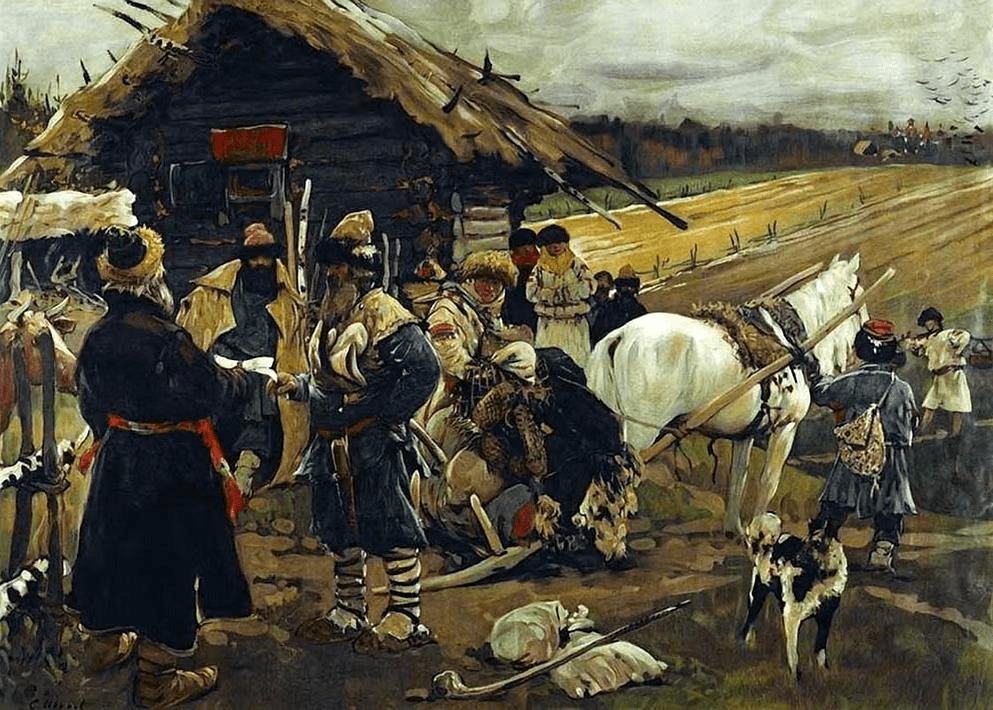
1905–1907: Ideology Meets Reality
In January 1905, Father Gapon, Orthodox priest and also Tsarist agent provocateur, led a mass worker demonstration in St. Petersburg to the tsar’s palace with petitions virtually begging the tsar to grant certain basic rights. The Cossacks fired on the crowd, killing hundreds, and the 1905–1907 revolution, the “dress rehearsal” for 1917, was on. During those years, the Russian peasants revolted as intensely as did the working class, completely upsetting the schemas by which Russian Marxism, under Kautsky’s influence, had predicted that peasants would aspire to individual private plots of land and nothing more.
The peasants in 1905 themselves submitted, all told, 60,000 petitions to the government. (The substance of numerous peasant demands for all land to the mir was not taken seriously by any Russian Marxist at this time.) The peasants invaded forests and grazing lands from which they had been excluded; they robbed stores, warehouses and manors, burning estates and killing the squires. The large majority of rural strikes in Russia in 1905–07 were strikes of peasant small holders, partly or seasonally employed. Most of these strikes were directed by the communal assemblies.
In 1905, the crops had failed again in 25 of Russia’s provinces, closely linked to the locales of the uprisings. As Shanin put it “Once the tsar’s will could no longer be treated as a force of nature…the whole social world of rural Russia came apart. Everything seemed possible now.” The uprisings peaked initially in June 1905. The differentiations between wealthy, middle and poor peasants, which Lenin had so laboriously worked out in his 1899 book, seemed to recede in importance, as wealthier peasants helped poor neighbors with food.
Under the impact of these events, Lenin, still in Zurich exile in the spring of 1905, prior to his return to Russia, proposed a “revolutionary democratic dictatorship of the proletariat and peasants” to establish a provisional government for the bourgeois-democratic revolution. “This formulation was so inconsistent with pre-revolutionary Marxist programs that Lenin would be forced to prove again and again that he had not sacrificed his Marxist principles.”
Lenin’s peasant policy, during all the struggles of the summer of 1905, is summarised by Crisenoy as “support the peasant movement, but above all don’t tie one’s hands for the future. It is necessary to advance and strike hard blows for revolutionary bourgeois democracy…to march separately and strike together, not hiding divergent interests, and to watch over one’s ally as one would an enemy.” There remained, she points out, still a sort of fear about peasant struggles, fear of the their spontaneity, and great contempt for the peasant’s “lack of culture.”
Meanwhile, the action of the peasants and the statements of their representatives “were a striking refutation of (Lenin’s) assessments.” In the summer of 1905, the peasants created a central organisation with delegates from several provinces. The Pan-Russian Union of Peasants met for the first time clandestinely at the end of July and called for the abolition of private property and the expropriation of the big landowners; a majority favoured no indemnification. The peasants did not limit themselves to the land question but also demanded free public education, amnesty for political prisoners, convocation of a Duma, and a Constitutional Assembly. Lenin conceded that the peasant congress grasped its own interests well.
The Social Democrats called for the formation of revolutionary peasant committees, but they played no role in the countryside. It was young peasants back from the factories who spread revolutionary ideas. In the summer of 1905, the Bolsheviks held their Third Congress in London, with the peasant question as a major issue. They were divided, unable to foresee or control events. Lenin was torn; the party program was unsatisfactory from a political viewpoint, but perfectly founded, in his view, from a theoretical viewpoint. When the peasants went beyond the party slogan of taking over the otrezki (once again, the strips of land retained from the 1861 reform by the big landowners), and seized other lands, were they “reactionary”? There was a constant contradiction between what Lenin saw as politically necessary and his economic analysis; if he continued to defend points from his 1902 agrarian program, it was because he remained convinced of the domination of capitalism on the large estates. In March 1905, he continued to assert that “in Russia there are few vestiges of feudalism.”
On October 17th the tsar issued a manifesto in response to the months of insurrection, “speaking much about freedom and saying nothing about land—the one thing that mattered.” It had no impact, and in October 1905 “attacks on estates erupted on an unprecedented scale and rapidly turned into mass destruction of manor houses in the Black Earth belt.” This was no blind explosion; the peasants wanted to be rid of the squires and to ensure that they never returned; 2000 manor houses were destroyed. The government strategy consisted of heavy repression and ineffectual appeasement in the manifesto of November 3rd, which abolished payments still due from the 1861 serf emancipation. State repression was, however, an “orgy of brutality.”
It did manage to temporarily staunch the worker uprisings, but the peasant revolts did not stop, climaxing only in July 1906.The June 1906 eruptions of rural violence had been so serious that the Emperor of Austria considered military intervention. In July 1906 as well, Lenin argued that the peasantry was “revolutionary democratic,” but that the Social Democrats would fight it when it became “reactionary and anti-proletarian.” As Kingston-Mann put it, “Despite the extraordinary incisiveness of his political insight into the problems of his adversaries, the deficiencies of Lenin’s economics and sociology continued to render the concept of a Marxian peasant revolution a contradiction in terms.”
Prior to these developments, the first Duma had met in April, and had not even considered peasant demands. The movement finally ebbed, and the state and the squires regrouped. This did not prevent grazing lands from being invaded for a third time in the winter of 1906–07.
Meanwhile, in April 1906, the RSDLP held a Bolshevik-Menshevik “unity conference” in Stockholm. There, Lenin called for the nationalisation of all landed property. Lenin, then, favored nationalisation as opening the way to capitalism; for the peasants, on the other hand, it meant expanding communal property to the national level. The Mensheviks feared that fragmenting large properties would slow down the development of capitalism. Plekhanov argued that transfer of land to the state would leave the autocracy with more land than ever before. (Kautsky, in the Second International journal of record Neue Zeit, had come out once again against any Social Democratic program for the peasantry.) Lenin quoted from Marx’s Capital about transferring land to the state as a bourgeois measure which would create competition, as in the American West. The Congress ultimately voted to approve the Menshevik Maslow’s plan for the municipalisation of land. Lenin opposed this, saying it would only give power to local elites.
The initial slogans of the peasant uprisings were expressed in a language different from that of the urban revolts, expressing a desire for political power and civil rights, land reform, “charitable government,” “liberty” and “being listened to.” In Shanin’s view, many doubted the very existence of general peasant political goals in rural Russia in 1905–07, and Lenin said in 1917 that the problem with the peasant revolt of those years was that they did not finish the job, burning down only part of the manors.
Other breakthroughs occurred in places such as Georgia, where in Guria province what Shanin called “the first case in history of a peasant rule led by a Marxist elite” held out from 1903 to 1906, and news of which moreover traveled widely. The Latvian Social Democrats led widespread attacks on manors in the Baltic provinces in a “mini-civil war” situation, during which 459 manor houses were destroyed in Latvia and 114 in Estonia. The designated enemies of the revolts throughout the Russian Empire were the state apparatus, the kulak (wealthy peasant) “commune eaters” who bought up communal lands for themselves, and the reactionary bands of the “Black Hundreds.” The 2nd Duma met in 1907, was more radical than the first, and the peasants were more anti-government. “Peasants looked at their lives in ways unthinkable before.” They were very sophisticated, and the demand for transfer of land to the peasantry and for the abolition of private land ownership was total.
Under the impact of these cumulative events, Lenin called for the revision of the RSDLP’s 1903 Agrarian Program and said, in contrast to his 1899 book, that “the economy of the squires in Russia in based on repressive enserfing and not on a capitalist system…Those who refuse to see it cannot explain the contemporary broad and deep peasant revolutionary movement in Russia.” Most Social Democrats now admitted that the 1903 program was overly pessimistic about the peasants’ revolutionary potential. This change of attitude was formulated as a call for a “democratic dictatorship of workers and peasants” that would promote an “American road” of agricultural development under a revolutionary regime.
The forces of reaction also had to revise their views on the peasantry: “As manors burned and the first and second Dumas heaped abuse on the government, the commune was singled out more and more as the reason for the peasant rebellion.” This shift in perception presaged the post-1907 policy of Stolypin, who replaced Witte as Finance Minister in 1906, and attempted to undermine the communes by subsidising individual peasants who wished to leave them and farm their own plots. The peasants did end the 1905–07 upsurge with more results than any other group. Rents went down and rural wages went up; most peasant debt was cancelled by the state. There had also been an important leap in peasant self-esteem.
Years of Reaction: Stolypin’s Attempt at a “Prussian”-Style Revolution from Above
In 1906, P.A. Stolypin took over from the fallen Witte as the most powerful minister in the Tsarist government, carrying out harsh repression against the 1905–1907 revolution and simultaneously pursuing a policy of breaking up the peasant commune. His many executions of revolutionaries by hanging became known as “Stolypin’s neckties”.
Under the impact of the revolution, the government almost more than the Marxists had become aware that the commune, previously viewed as a pillar of the regime, was in fact the main source of peasant radicalism. Stolypin and his advisers looked back to the Prussian reformers of the 1820s who had carried out a revolution from above to prevent a revolution from below. Private enterprise was to be promoted throughout the economy, and in agriculture this meant creating credits to enable individual peasants to leave the communes and acquire their own land, often by privatising communal land. Stolypin was assassinated in 1911, but his policy, aimed at breaking up the commune, remained in effect until 1917, in the hope of creating a Russian “Vendée” against any future revolutionary movement.
As Crisenoy put it, “the ruling classes were not mistaken…After 1905–07, the mir become in their eyes one of the causes of peasant radicalism … We have to say that, aside from the Social Democrats, this link between the mir, the revolutionary peasant movement and its demands for land was obvious to all. But Lenin was convinced of the opposite. For him the commune was still nothing but a ‘juridical envelope maintained artificially’… For Lenin, the peasant’s call for the nationalisation of land was negative, and should not mask his instinct to be an ‘owner’ … In Lenin’s view, the peasant did not know what he wanted, didn’t even know what he was saying… For Lenin, (there was) no uncertainty: the nationalisation of the land necessary brings with it a capitalist agrarian organisation.”
In fact, Lenin and Stolypin had rather similar views on the entrepreneurial peasant as a promoter of capitalist development in Russia. To defend this change of orientation from the one he had held from 1899 until 1905, “Lenin had to abandon his earlier claims that Russia was already capitalist.” Lenin, like Stolypin, saw the role of the Russian government as similar to the earlier Prussian model. Stolypin’s reform, in his view, would “encourage the economically incompetent landlords to be become Prussian-style bourgeois ‘Junkers.’ ” Nationalisation would clear away feudal vestiges and make possible free competition, as in America. “Despite quotes from Capital and Theories of Surplus Value, Lenin was hard pressed to make the case that Marx ‘had taken pride in the economic virtues of the small farmer.’ ”
As Kingston-Mann put it, ”His was a tactical move that reflected the strain which the complex reality of the Russian situation placed upon his Western-centred ideology…. The commune played no role in Lenin’s plans and strategies… Lenin ridiculed the idea that the ‘medieval’ commune retained any of its equalising functions.” “In 1907–08, Lenin argued that the process of rural differentiation had already destroyed the commune in all but name. A still functioning commune remained inconceivable to Lenin… Certain that the peasantry lacked historically significant forms of social organisation, Lenin inaccurately referred to commune peasants as only the tool of the village kulak… Lenin had however moved far closer to a realistic approach than any other members of RSDLP.”
Under the auspices of Stolypin’s agrarian reforms, between one-fourth and one-third of all Russian peasants, by some estimates, left the communes between 1906 and 1917. (Russia in these years became one of the world’s biggest exporters of cereals while also having terrible famines.) Communal peasants often responded to these desertions with violence.111 Two to three million peasants got property in the decade after 1906, or about one-fourth of the twelve million peasant households in European Russia. Some of the obstacles to the reform were a lack of roads, long winters, and the village assemblies proposing the worst and most distant lands to those who wished to leave.
In Crisenoy’s view, Stolypin’s reforms also ran up against overpopulation, the lack of land, and communal tenure. She also sees Lenin’s post-1905–07 break with Second International conceptions as “very relative”; he continued, as in 1899, to confuse capitalist agriculture and commodity agriculture. In 1915, he was still writing: “The development of capitalism consists above all in the passage from natural economy to commodity economy.” To recognise his error, Crisenoy writes, would mean breaking with what he had been saying for twenty years. “By failing to recognise the attachment of the peasants to the mir, Lenin missed the reason for the failure of (Stolypin’s) reform and one of the reasons for the 1917 revolution.” In the revolutionary years 1917–1919, serious violence was still being brought to bear against “splitters-off” from the communes, and not, as Lenin’s theory would predict, between rich and poor peasants.
 PARTISAN!
You must be logged in to post a comment.