Originally presented at Marxism Fringe in 2025, Brunhilda Olding presents a revised history of the Partyist Tradition. The following is part one of a two-part transcript.
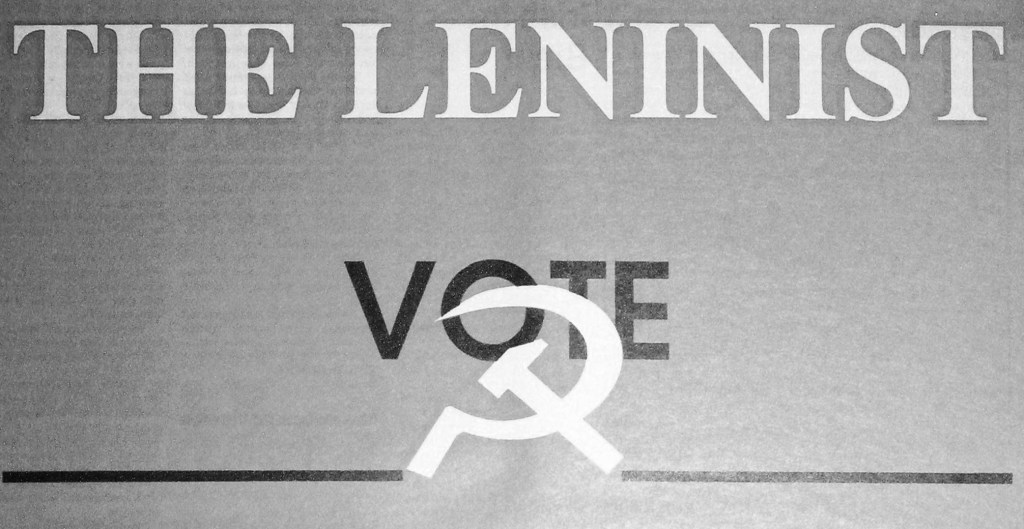
Now I wish I could come up here and say that the presentation I’m about to give is something entirely new and unheard of, that I’m breaking some mystical ground, but I most emphatically am not. While this could perhaps be understood as the first universal history of Partyism as a global political tendency, it emerges from a collection of histories beforehand. I am indebted to the works of Jack Conrad, Lawrence Parker, Myra Janis, and our own Edith Fischer in the development of this history.
First, we must understand what Partyism is. Because, to be honest, very few people really know, and a quick search online doesn’t really help. Partyism is a very dubiously defined political tendency compared to its peers; Orthodox Trotskyism, Marxism-Leninism, Cliffite Trotskyism, Left Communism, Marxism-Leninism-Maoism principally Maoism with the universal contributions of Chairman Gonzalo thought, mainstream Trotskyism, and so on, so forth, into the wretched dregs of the past hundred years of failure; all of those tendencies have a clear concrete definition, and the sects within them even more so. Trotskyism, for example, has a clear basis, acceptance to various degrees of the First Four Congresses of the Communist International, adherence to the concepts of degenerated workers states, permanent revolution, and defending the Fourth International, until a certain cutoff date, in which case the relevant international or sect is upheld and defended as the one true political current of world communism. Marxism-Leninism is a decaying relic of the 1970s clinging to stale Brezhnevite dogma. Left Communism is such a thorough mess that the International Communist Parties have devolved to using the names of their newspapers to tell themselves apart.
Partyism doesn’t exactly have those strict lines. The ‘cannon’ that does exist is best summed up as Mike MacNair’s Revolutionary Strategy, and a selection of articles by Donald Parkinson, MacNair, and Jack Conrad scattered throughout the pages of Cosmonaut and the Weekly Worker. Even then, it can stretch to include those who more accurately fall under one of the labels above, who accept the need for a mass Communist Party united around programmatic unity, to a firm and unrepentant defender of the Marxism of the Second International up until 1909, and everything in between.
Nonetheless, in short, Partyism can be summarised by three core pillars: the support for a mass communist party, unity around acceptance rather than agreement with the programme of the party, and that said programme is based around the Revolutionary Minimum-Maximum formula. There is also a strong recentering of the ideas of Democratic Republicanism in the focus of Marxist strategy, including a mass national militia and the abolition of the army, annual elections to a unicameral parliament, and the right to recall all elected officials. But the core three pillars are the closest thing to a basic definition of Partyism, as a broader political tendency separated from its closely related tendency of Republican Marxism.
Now, if we understand this definition, we can ask the most interesting questions. How did this tradition form? What were the political contexts that pushed it towards these viewpoints? And why do we bang on about the Communist Party?
Origins
But first, to begin with a question. Where did Partyism begin? The United Kingdom? Perhaps the United States? Maybe the Netherlands? Turkey?
The correct answer is, of course, all the above. But Turkey is by far the most important one, because it was Turkey, or more precisely the Communist Party thereof, that transformed a young British Marxist-Leninist into the man who has waged a forty-year fight for the Communist Party of Great Britain. That man, of course, was none other than Jack Conrad.
To fully explain this story, we’ll need a brief context of the political scene that Conrad emerged from and was shaped by. So, we’ll turn to where all truly great stories begin, Surrey 1977.
This was when Sid French – chair of the local Communist Party of Great Britain (CPGB) branch – split to form the creatively named New Communist Party (NCP). The long-term roots of the split emerged in 1968, as French’s pre-existing disagreements with the increasingly Eurocommunist and pro-Labour views of the CPGB grew. French was not the first internal faction within the CPGB fighting against the British Road to Socialism. Oppositional groupings had emerged ever since its introduction in the 1950s.
However, the French group was the first of these with something close to an active long-term political strategy, as well as a more coherent political basis for their opposition. As opposed to earlier groupings, which were de facto fights within Stalinism, the French group was able to posit itself as an opposition to Eurocommunism and Labourism. While I’m not going to go into the weeds of details about the full struggle within the CPGB, for those interested, Lawrence Parker’s The Kick Inside is a masterful work that breaks down a lot of the evolution within the political context of the CPGB. A similar breakdown of ‘Revolutionary Opposition’ within the Communist Party of Australia would be a very worthwhile project, albeit one beyond the capacity of the movement as it currently stands.
Now, the NCP that emerged was a firmly Stalinist institution. One that correctly viewed the CPGB as a reformist deviation from communism. Arguing that following the adoption of the 1977 version of the British Road to Socialism, which dropped many of the crucial pillars of Leninism, the CPGB had become reformist. Now, the consensus these days among those Communists not relegated to constant defence of the Stalinist line is that from the adoption of the 1951 edition of the CPGB’s programme ‘The British Road to Socialism’, the political strategy of the CPGB was one of a universal concession to labourism, reformism, and the myth of a parliamentary road to socialism. Indeed, Jack Conrad’s memories from the time complain that work in the CPGB was just ‘Selling the Morning Star and waiting for congress’.
Now, the next little section is going to be mostly focused on the personal journey of Jack Conrad because, for better or for worse, much of the historical record of this struggle is focused on him and his small group of comrades. Or as they’re more commonly known, the Leninist group.
Following the death of Sid French in 1979, the NCP would rejig its leadership, with Jack Conrad being moved to the position of National Organiser. It would be here that he first started engaging with the Communist Party of Turkey.
The 20th century saw somewhat of a tradition developing of Communist migrants forming local branches of, say, the Communist Party of Turkey, or Greece, or Italy, rather than forming Turkish language branches of the local Communist Party, which meant that by the turn of the 1980s the Communist Party of Turkey – which was illegal in their homeland – had its third largest branch in the United Kingdom. The 70’s saw a period of increasing class struggle in Turkey; the largest May Day rallies in the Western world were in Istanbul.
Conrad’s engagement with the TKP made him realise, and I quote directly: ‘the NCP was pathetic on every level’[1]. According to him, Rüştü Yürükoğlu’s book, Turkey – The Weak Link of Imperialism, was the book that really made him realise the bankruptcy of official communism. In his own words at the time, his politics could best be described as ‘Revolutionary Stalinist’; his engagement with the TKP began to shift that.
Initially, he and another comrade, known at the time as Frank Grafton, planned to step back and start studying Marxist theory. But further engagement with the TKP shifted that plan, as he increasingly engaged with the more militant wing of the exile movement, based around the Newspaper İşçinin Sesi or Worker’s Voice. He consolidated his conception of what his task was with engagement from the TKP. Conrad’s own words put this much better than I could; as such, I’ll quote him directly.
‘Firstly, as I had a certain following, I had a duty to my comrades. I had to lead them the best I could. Secondly, the most serious should be won to join the TKP. Thirdly, we would constitute a definite group within the TKP, a group which would engage in intense study with the aim of eventually separating off in order to produce a polemical journal directed at and based in the CPGB.’[2]
The factional fight within the NCP was short; around 30-40 members were expelled, but only six followed Conrad into the TKP. Many of them were most likely just looking for an honourable way out of the NCP. At the time, a revolutionary situation was emerging in Turkey, and to the young, internationalist, and militant comrades around Conrad, the best thing they could do was organise for an actual revolution. Which meant work in the TKP.
Then came the 1980 coup. This isn’t a history of the Turkish counter-revolution; all you need to know is that it was brutal. Thousands of dead, tens of thousands fleeing from Turkey. Half a million arrested. The British group would dedicate itself to Turkish Solidarity work, half of their members actively doing illegal work, including printing, smuggling in papers and documents, and all in all, thoroughly abusing the protections of a British passport in the most stridently revolutionary way. The other half organised the Committee for Defence of Democratic Rights in Turkey, where Conrad served as secretary. Though it was never his major focus, that took the form of the emerging journal, which would serve as the basis for the political struggle within the CPGB.
The Leninist
Sadly, the work required for this would be disrupted quite abruptly by what many of us know quite well. A personal delusion of control over a sect culminating in both self-sabotage and undermining the workers’ movement. Rıza Yürükoğlu, the de facto leader of the British TKP, expelled most of the ex-NCP grouping, with only two of the original six surviving the purge. The main four would first do what else, but go to the pub.
They would then decide that the fight wasn’t over, that they were going to keep on fighting for a CPGB that stood for what they believed in and for the world revolution. So, they applied to rejoin the CPGB. Conrad himself had his membership denied, but the other three were accepted, and they got to work on getting The Leninist ready. The first issue would launch in November 1981 with 5,000 copies, costing £1,100. While a common rumour at the time was that East Germany or Cuba had paid for these, the funding came purely from principled political donations.
What’s interesting to note is that the First Issue carried an article by Gus Hall analysing the situation in Poland at the time. Whilst Conrad argues that it was partly selected to add an air of mystery, I would argue that it represented the still ongoing political evolution of these cadres towards their current position. While Conrad had engaged deeply with Trotsky, he never accepted some of the key positions upheld by the Trotskyist movement and never called himself one. I believe that the Leninist’s politics was still very much influenced by and descended from the old pillars and positions of Marxism-Leninism. Nonetheless, the struggle within the CPGB had begun.
The Leninist was controversial because it wasn’t waging a bureaucratic struggle with political debate hidden behind the monolithic walls of the party. It was openly waging a political fight against the liquidationist Eurocommunist leadership and the equally liquidationist internal opposition. At the time, their primary focus was ensuring that the CPGB survived not only at the organisational level but also at the political level. Membership had fallen by 10,000 in the six years before 1981. By the time the paper was launched, the party was in the final stages of a long-running collapse. Lawrence Parker’s argument that The Leninist launched a decade too late has quite sadly been borne out by history.
The party had given in to movementism, supporting the height of Tony Benn in Labour Left as the road to socialism. With one of the major internal groupings around Fergus Nicholson and his newspaper Straight Left arguing that the CPGB shouldn’t even stand candidates and just support Labour unerringly.
The Marxist-Leninists remaining in the party were denounced as conciliators, willing to march alongside the Liquidationists as they dissolved the party rather than waging a fight. The Leninist often drew on Lenin’s fight within the Russian Social Democratic Labour Party, in which the Bolsheviks worked alongside what were dubbed pro-party Mensheviks, whilst still criticising them in order to keep the party as a fighting group and alive, rather than working within the narrow bonds of Tsarist law.
By the mid-80s, The Leninist Group was an increasingly influential group on the left, even with its tiny membership size. The act of an open and active struggle within the CPGB, with an accessible and high-quality magazine, granted them far more leverage than you would think if you were purely looking at membership size. Their primary strength came from their rigorous analysis and constant political struggle and polemics, though you could also argue that people just viewed them as a CPGB gossip rag.
Despite this, and because of their increasingly growing influence, they began to engage with other socialist groups outside the CPGB, and in a surprising turn of events, probably by far the most influential of these, as well as the most well recorded, was their engagement with the Spartacist League of Britain. The increase in political engagement between the two groups influenced the Leninist Group in some important ways, and I would argue that it was part of the de facto break with ‘official’ Marxism-Leninism, which would prove a crucial turning point in the long march towards what we now understand as Partyism.
The 55th Issue of the Leninist on the 1st of November 1987 was a key part of this turn because of one article contained within it. ‘After 70 Years – USSR needs a political revolution’ by Jack Conrad. I’m focusing on this article as the turning point because it represents a total rupture both with the Euro leadership and the opposition grouped around the Morning Star that became the Communist Party of Britain.
Now on a political level, The Leninist would keep on understanding themselves as Marxist-Leninists of one form or another for a few more years. Their 1989 ‘To the Working Class of Great Britain’ outlined the position that ‘Only a party steeled in Marxist-Leninist ideology and organised on the basis of iron discipline deserves to be called a Communist Party.’[3] But when you contrast the positions put forward in this notionally ‘Marxist-Leninist’ newspaper with the ones of ‘Official World Communism’, you find an increasingly growing gap. Rather than tailing the national liberation struggles in Central America, they quite openly put forward the political criticism that the Soviet calls to weaken the struggle were a surrender to Imperialism.
The break with Marxism-Leninism and the solidification of the viewpoints of the Leninist group were sadly too little too late. Lawrence Parker has argued that the struggle within the party was a decade too late, with the 1977 New Communist Party poisoning much of the relationships between key Leninist cadre and the broader CPGB, as well as the declining factional struggle within the Party. You can see this in the earlier mentioned 1989 ‘Declaration to the Workers of Great Britain’ which was summing up the Fourth Congress of supporters of the Leninist.
This declaration saw the proclamation of a ‘distinct, revolutionary, wing of the CPGB’,[4] the CPGB (The Leninist). The logic behind this declaration was simple: the Euro leadership of the party was collapsing into liquidationism and opportunism. The Communist Party of Britain and the New Communist Party were opportunist splits from the party that were neither communist nor parties. The newly elected National Committee of the Leninist was tasked with “the task of preparing a draft programme to be presented for discussion in Party organisations and in our working class and subsequently presented as a proposal to the congress of the reforged CPGB.”[5] The past forty-one years have been a struggle for the completion of the second half of that task.
The next two years, however, would be more than just an uphill battle; the fight against the Liquidationist Euro leadership was undermined by the events currently sweeping across the Eastern Bloc. The collapse of the Eastern Bloc was both a human tragedy of a cost that we have yet to truly grapple with, and a massive political defeat for the working class, as the bourgeois heralded from every rampart and street corner that ‘Communism was dead.’ Across the world, many of the ‘official’ Communist Parties liquidated themselves. In Australia, the CPA – also under Euro leadership – dissolved and formed the SEARCH Foundation. The Communist Party of the United States of America (CPUSA) split between Angela Davis and Gus Hall, and the leadership of the CPGB dissolved the party that they claimed leadership over, at a 1991 Congress at Congress House in London. Though to quote Mark Fischer, a crucial member of the Leninist group, ‘As far as we’re concerned, they stopped being a party quite some time ago, and they quite certainly stopped being Communists.’ The dissolution of the party was nothing if not a major defeat and step-back for the British working class based on the fundamental perspective that capitalism had won, Communism was dead, and the party that represented it had given up the ghost.
The Leninist rejected this lie; here you can see them protesting outside the CPGB headquarters bearing the banner Communism Lives! – a position that I find particularly important for people to remember when engaging with Partyism. Our fundamental political core is simple: Communism isn’t dead, it lives, and it fights. In fact, to quote directly from Anne Murphy’s speech outside Congress House to the media CPGB Lives!, ‘Despite the best efforts of her [Nina Temple] and her chums in the media, the Communist Party lives and will be built into the mass Party we need!’[6] and a bit further on in the same speech, the proclamation which is the root of the slightly unwieldy full acronym of the Communist Party of Great Britain – Provisional Central Committee.
[1] The Weekly Worker 702 ‘Past Present and Future’ Jack Conrad, 20/12/2007
[2] The Weekly Worker, 1000, The Leninist: Before This there was That 06/03/2012
[3] The Leninist no. 85, December 23, 1989
[4] Ibid
[5] Ibid
[6] CPGB Lives!, The Leninist No. 113, December 4th, 1991
 PARTISAN!