Independent socialist and Rohinya youth activist Noor Sadaque reports on ethnic cleansing and persecution of Rohingya peoples in Rakhine State, Myanmar.

The Rohingya crisis is one of the gravest humanitarian tragedies of the 21st century. This report, titled ‘Struggle Story & Report on Ethnic Cleansing and Persecution of the Rohingya in Rakhine State During 2024–2025’, provides a firsthand account from a survivor of ethnic persecution in Rakhine State, Myanmar. It documents the unbearable suffering faced by the Rohingya community at the hands of the Arakan Army and the Myanmar military. Through this testimony, we witness not only the brutality inflicted upon a stateless people but also the geopolitical and economic structures that continue to enable such violence.
It is essential for international community to understand who the key actors are, the Myanmar military (Tatmadaw), the Arakan Army (AA), and their political wing, the United League of Arakan (ULA) , and how the interplay between ethnic nationalism, resource exploitation, and militarism has driven the genocide against the Rohingya. Understanding these connections helps us situate the Rohingya genocide within the broader global context of imperialism, capitalism, and ethnic domination.
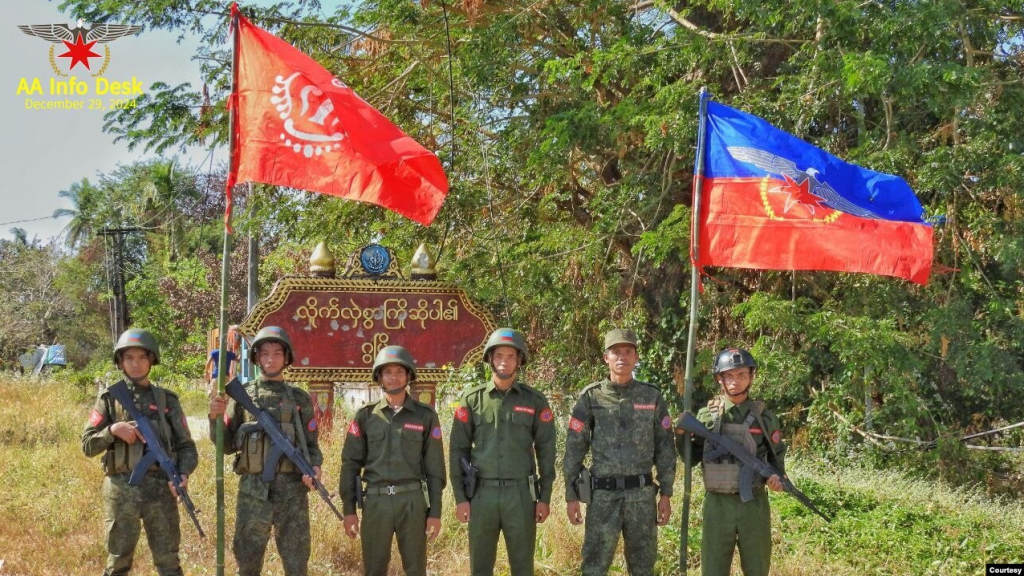
Who is the Arakan Army (AA)?
In 2021, the Tatmadaw (Myanmar Armed Forces) overthrew the elected National League for Democracy. This coup caused turmoil across Myanmar, and started a civil war which rages to this day. As of writing, over eighty thousand have died, while millions more scrape by as refugees, internally displaced or otherwise.
Rakhine State, also known as Arakan, is located on Myanmar’s west coast. Bangladesh sits to its north-west border. Ethnic Rakhine make up the majority of Rakhine state’s population, alongside a substantial minority of Rohingya.
The Arakan Army was formed in the late 2000s, and fought alongside other separatist and nationalist militias in the 2010s. It was initially based in Kachin state, in north Myanmar. Currently, their forces are concentrated in Rakhine state.
Both the Arakan Army and the Tatmadaw have repressed the Rohingya peoples living in Rakhine state and beyond. Rohingya refugees fleeing the conflict, often into Bangladesh, must travel long distances through Arakan Army occupied territory. Many of these refugees end up in the Rohingya refugee camp in Cox’s Bazaar, in southern Bangladesh.
-The Editors
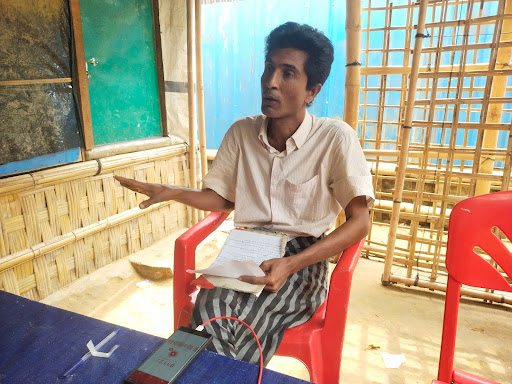
Bosher Ullah’s testimony
My name is Bosher Ullah. I was chairman in our village, I am from Naimma Hali, a village in Buthidaung, located in Arakan State. In 2025, my family and I left Arakan to seek safety in the refugee camps of Bangladesh. The journey from Arakan to the camp in Bangladesh was extremely difficult. We walked all the way from Naran Seik in Arakan to the Bangladesh border. It took us around 18 days on foot. We crossed the border into Bangladesh through brokers, who charged us 1.3 million Burmese kyats per person. From our home in Naimma Hali to the crossing point, the path was full of hardship. We had to pass through mountainous terrain. When our food ran out, we were forced to survive by eating banana plants.
On the way, many children, elderly people, and pregnant women died due to the harsh conditions. In some areas, there were landmines, and people lost their lives after stepping on them. When we arrived in Bangladesh, we were confused and did not know where to go. Then, another group of brokers brought us to the Rohingya camp in Bangladesh, charging 18,000 Bangladeshi taka per person. Many of us were also robbed by the brokers, both in Myanmar and in Bangladesh. They stole all the money and jewelry from people along the way. This is how, in 2025, we fled from Arakan in groups and arrived in Bangladesh. I now live with my family in Balukhali 8W camp.
When we arrived at the camp, we saw that there was hardly any space left to stay. Some people from our group, whose relatives had already arrived at the camp, found shelter in their relatives’ places. As for those of us who had no one, we managed to build small shelters using tarpaulins and bamboo fences in abandoned areas. Some even set up shelters in the ravines of the hills, but these places were very risky. Just a little rain or storm, and our homes would be submerged in water up to our knees. Although we started to build our shelters in these abandoned and risky areas, we could not get permission from the camp authorities to build them due to the situation. We are still in a state of uncertainty, as we don’t know when we might be evicted from these places.
If I talk about Maungdaw and Buthidaung, I must say that from March 13, 2024, the military started severe control in these areas, and they imposed curfews. During the curfew, people in these areas struggled to gather essential goods. At that time, the price of one kilogram of onions went up to 160,000 Kyat. Rice was 90,000 Kyat, and the price of chili was 120,000 Kyat, everything was extremely expensive. Many people died due to the lack of medical services, and many children died due to the lack of treatment. I personally saw two pregnant women who were told by doctors to go to the hospital for delivery but could not make it. Later, both died during delivery. As time passed, these problems only worsened.
Amidst this struggle for survival, Ramadan came. On the 20th day of Ramadan, the Arakan Army attacked Maungdaw and Buthidaung. They seized two military cantonments in the northern part of Maungdaw. Afterward, the Arakan Army launched an attack on Puimali, located next to Maungdaw. The Arakan Army, as outsiders, entered the Muslim neighborhood and fought against the military. During the attack, a large bomb dropped by the military exploded in the Muslim neighborhood of Puimali. As a result, 18 Rohingyas were killed, and 28 others were seriously injured.
The next day, the residents of Puimali, carrying the injured, fled to another area to save their lives. Many of the injured people died during the escape, and many children and women died from exhaustion. Later, when those who had been shot were admitted to hospitals in a safe area, it was revealed that the bullets found in their bodies were from the Arakan Army. This news spread widely among the people at that time. What I’ve described here is the situation in Maungdaw and Buthidaung in 2024.
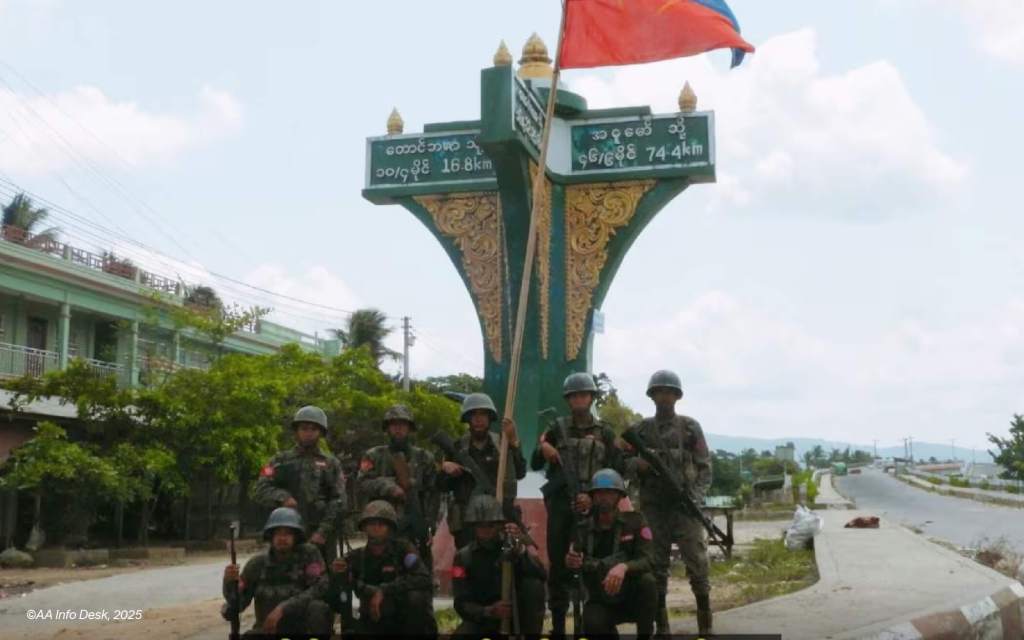
Then, on March 17, 2024, the Arakan Army took control of Buthidaung city and all its surrounding areas. Before this, up until March 15, there were armed groups of military forces and Rohingya youth positioned in Buthidaung city, and they had occasionally fired small arms against the Arakan Army. However, on March 15, suddenly the military and all other armed forces vanished from Buthidaung. Then, on the 17th, the Arakan Army entered Buthidaung city and began indiscriminately bombing the area. They continued to drop bombs using drones. The places where these bombs fell and the surrounding areas were completely burned to the ground. In this situation, when the people of Buthidaung city were running for their lives, many lost their children, and many elderly people and children, unable to leave their homes, were burned alive. Most of the houses in the city were completely destroyed by the fire. More than 100 Rohingyas lost their lives in this attack. At that time, the only people remaining in Buthidaung were ordinary civilians. There were no armed forces in Buthidaung at that time. I don’t know whom the Arakan Army was targeting in this attack. The Arakan Army claimed that they carried out this brutal attack to stabilize Buthidaung.
Then, after the bombing stopped, the entire population of Buthidaung began walking together towards a safer area. But at one point, the Arakan Army stopped them. They then separated 40 people from the group, called them aside, and issued an order that they could not proceed along that route. If they wished to leave Buthidaung, they would have to take a different path, and the Arakan Army specifically told them where they could and could not go. That night, the people of Buthidaung were made to sit and stay there for the entire night. During that time, another horrific event occurred. Due to a disagreement, the 40 people who were separated were taken by the Arakan Army. From that moment on, no one ever heard from those 40 individuals. Many others who stayed in that location overnight died due to a lack of food and medical care. The Arakan Army did not provide a single meal to anyone that night. The following morning, they forced the people of Buthidaung to leave and relocated them to a distant area. This was the severe persecution of the residents of Buthidaung by the Arakan Army on March 17, 2024.
On that night, there was a village in Buthidaung called Taimma Hali. This is my village. On the night of March 17, Arakan Army launched a horrific attack on Taimma Hali. The village was bordered by mountains on three sides and rice fields on the other. From their position in the mountains, the Arakan Army opened fire on all three sides of the village and launched bomb attacks using drones. For not even 20 minutes did the Arakan Army stop firing. They continuously showered the village with bullets throughout the night. The residents of Taymma Hali could not even lift their heads to walk. They abandoned their homes and tried to sleep in the rice fields. Their homes were burning to the ground. At that time, around 30 villages, seeking safety, had taken refuge in Taymma Hali. Many children, women, and elderly people were trapped in their homes and burned alive that night.
In the early morning, the Arakan Army entered the village from the mountains, shooting and killing the wounded lying on the village roads. They conducted a search in every corner of the village, gathering all the living residents into the rice fields. Then, when three doctors from the Burma community came to treat the injured, the Arakan Army took them away to a distant spot, slaughtered them, and killed them. The villagers who had fled to the mountains for safety were also killed there. The bodies of the killed residents were gathered in one place and burned. The remaining survivors were told they could not stay there and were driven out. They were taken to Narayasingh area on March 18. These people then set up shelters in Narayasingh and nearby areas, but they had no food supplies. The Arakan Army did not provide them with even a single grain of food.

The Arakan Army mostly uses drones for attacks, along with various weapons, bombs, and mines. On the other hand, the Myanmar military uses jet fighters, as well as various types of small and large weapons, mines, and other equipment.
Regarding the Arakan Army, they say, “Arakan is the land of our ancestors, taken from them almost 240 years ago, and now we will reclaim this region. There is no place for Rohingyas here. Rohingyas have no place in this region.” Currently, the situation for Rohingyas living in the Maungdaw and Buthidaung areas is horrific. A curfew has been imposed on them, and they are only allowed to reside in certain designated areas given by the Arakan Army. If they step outside these designated areas, they are arrested and then imprisoned. They are detained for three months, during which they face severe torture. Prisoners are provided with only one meal per day. The situation of the Rohingyas living under the Arakan Army’s rule in Maungdaw and Buthidaung is indescribable. The Arakan Army conducts searches in the areas where Rohingyas live on a daily basis. During these searches, many Rohingyas are arrested on false charges, such as collaborating with the military, supporting the Rohingya armed forces, or burning the homes of the Mro ethnic group. The arrested individuals are presented in court based on these false accusations. The Arakan Army has a separate department called ULA (United Liberation Army), which administers governance in the region. The court, which operates under this department, issues verdicts on the false charges against the Rohingyas under the direction of prominent members of the Mro community, called the Arian Committee. The detained individuals are presented in court three times, and most of the time, they are sent to prison for seven years by ULA.
Since the day the Arakan Army took control of Buthidaung, they have looted from the general public whenever and however they pleased. For example, if someone was riding a motorcycle, they would demand the vehicle, saying, “Give me this vehicle,” and would take it away. This is how they oppressed people. After a few days, they would come together for meetings and discussions. When the Rohingya elders would say, “We want to live peacefully” (they do not use the word “Rohingya,” they use “Muslim community”), they would respond, saying, “Those of you who want to live peacefully can live, but those who have committed crimes, such as collaborating with ARSA, aiding the military, or providing food and children to support them, cannot live in peace, and we will punish them in any way possible. They will not be allowed to stay here. However, those who were not involved in such activities can stay, but everyone else who was involved in these activities will be opposed by us.”
The Rohingya elders asked them, “Why are there seven stars in your logo? Why seven community? Where is our community in your flag? We are also a community here, why aren’t there eight stars in your logo?” In response, they said, “You will not understand these things, they are beyond your comprehension. If you want to live under us, you must follow all the rules we have made. And those who have done wrong will not be allowed to stay here, our laws are clear for them.”
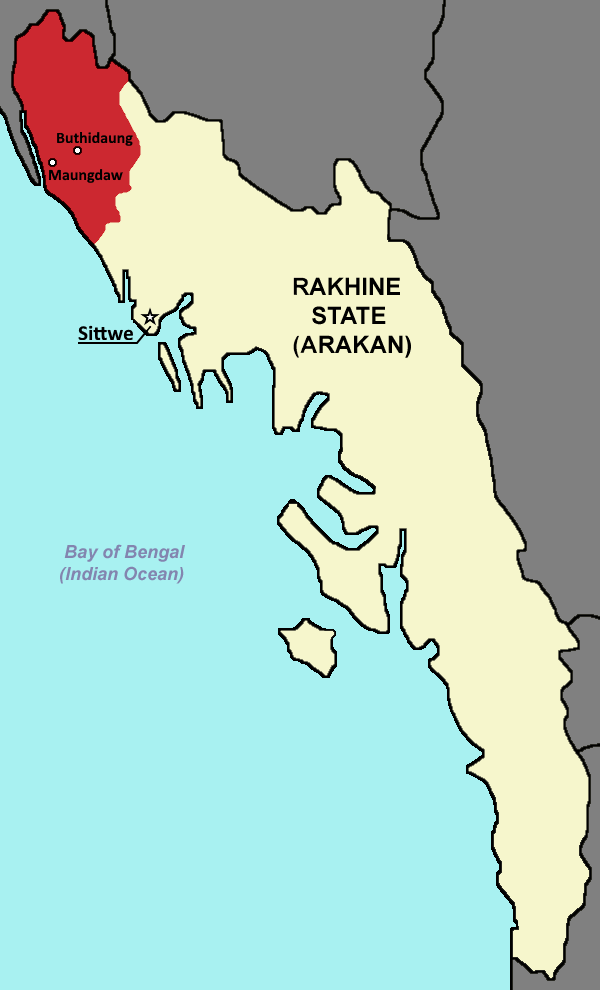
After the Arakan Army took control of Maungdaw and Buthidaung, they killed about 2,500 to 3,000 ordinary people in these areas. The most deaths occurred in places like Buachiri, Neragu, and Fuyimali. In Maungdaw, around 1,000 to 1,500 people were killed. On the day the Arakan Army took over Buthidaung, they killed at least 100 people in the town. According to the Arakan Army’s law, those who were aligned with the government, worked with the Arakan Rohingya Salvation Army (ARSA), or supported the military, will be sentenced to seven years in prison. Anyone caught working with ARSA or the military will be sentenced to twenty years in prison.
I have seen people die from the Arakan Army’s gunfire, and there are also injured people in the current camp. The families of those who died from their gunfire are in the camp, and the families of the injured are also there. The Arakan Army, which carries a flag with seven stars for seven communities, does not include the Rohingya in these seven communities. They do not address us as Rohingya; instead, they refer to us as “Muslim Kawm” (Muslim community). They also say that they will address the issue of the Rohingya later.
Another thing I cannot understand is that the Arakan Army has a group whose goal is to reduce the Muslim population. I have met with them personally, although they don’t explicitly say they belong to that group. However, during an argument, one of them accidentally mentioned that they were part of the group. I heard this from the leader of that Muslim-reduction group. This committee is working towards their goal. For example, they go around the areas of Arakan, asking people if they want to leave for foreign countries like Bangladesh, Malaysia, or Rangoon. They say, “Let us know, we’ll help you cross, but you have to pay us ten lakhs in Burmese currency and then give us five to ten lakhs for the travel costs, and we’ll send you over.”
For instance, it costs 25 lakhs to get to Bangladesh, and the Arakan Army takes ten lakhs as their share, then the remaining 15 lakhs is used to send the person to Bangladesh. The people involved in this are part of the committee formed to reduce the Muslim population. We, the people in the camp, are under their control. There are two groups within the Arakan Army: one is the AA fighters, and the other is ULA, which takes on the role of the government. Both groups share the same goal: to eliminate or reduce the Muslim population.
We can understand their objective when they forcibly remove Muslims from an area and tell them, “You cannot stay here; the land belongs to the Baghis. Go somewhere else.” They then bring in people from the Mro, Chakma, and Marung communities to replace them. This shows that their ultimate goal is to finish off the Muslims or reduce their numbers. In their soldiers’ areas, there is a banner that says, “Earth cannot finish people, but people can finish other people.” They continue to work with this ideology and these principles. This is their politics, this is their policy.
Currently, the Rohingya people living in Maungdaw and Buthidaung are suffering immensely. They are facing extreme hardships with food, mobility, and medical care. No aid or supplies are coming from outside. It’s not just Muslims people of all communities there are going through severe distress. Even amidst all this suffering, certain individuals are being targeted those who are educated, wealthy, or well-known in the community are being abducted. Their families have no idea what happens to them afterward. No one is able to show or speak about the oppression they face. People are living with constant fear for their lives. I realized I was also being targeted, so I escaped and came to the camp for safety.
Back there, there is no food, no medical support, and no basic services. I can’t even express in words how much they are suffering. Just like the Myanmar government never accepted us as Rohingya, the Rakhine people (locally known as “Mog”) are also behaving the same way. They are following the same rules of exclusion. They do not recognize us as Rohingya. When we try to coexist with the Rakhine and the Burmese, they turn against us and say, “These Bengalis cannot live in our land.” They made this claim loudly in 2017.
Now we realize that behind every wave of Rohingya displacement 1992, 2008, 2012, 2017 there was the hand of the Rakhine. Even if they did not directly force us out, they manipulated the Myanmar government to do it. Between 2010 and 2020, they wrote many books that insulted the Rohingya, portrayed us with hatred, called us “guests,” and claimed we came from Bangladesh. They planted this narrative to fuel hatred in the hearts of the younger generation of Rakhines, so they would oppose the Rohingya. Now we see clearly how calculated and intentional this was.
The historical killing of 70,000 Rohingya in 1942 was not carried out by the Burmese government, it was done by the Rakhine community. Now it is clear that they have always wanted us out. Since 1962, they have been influencing the Burmese government to push us to this point. However, now in 2024, it seems the Myanmar government is starting to understand that much of what the Rakhine claimed about us was false. They are beginning to see that the reasons behind forcing the Rohingya out of the country were mostly based on lies.
If we are ever to return to our country, we do not want to go back under the hands of the Rakhine. We want to return under the authority of the Myanmar government, because at least they may not treat us with the same cruelty as the Rakhine. Even the Arakan Army is giving the Rohingya no peace or protection. Our people can no longer explain their suffering to anyone, nor can they show the world what is happening. The Rohingya people are being silenced, trapped in a life of fear and quiet destruction.
I want to share one more thing. I have a friend who is an officer in the Arakan Army’s MI (Military Intelligence) line. He was called to a meeting where one of his senior brothers told him that the Rakhine people have a vision to transform Arakan by 2040 into something like Saudi Arabia, Israel, or Singapore. By comparing it to Saudi Arabia, they mean that, just like in the past Arabia had people from many religions, and Prophet Muhammad united them into one nation, they too want to turn Arakan into a single, unified ethnicity. By comparing it to Israel, they mean they want to become strong and powerful like them. And by Singapore, they mean they want to be economically developed. These are their hopes and ambitions.
That friend of mine, who is also my nephew, told me, “Uncle, their future plans are very dangerous. Their intentions are not good at all. Even though I am with them now because of political reasons, I will not be able to stay here much longer. I think I will have to come to the camp very soon.” That was the last conversation I had with him. That’s all I wanted to share with you. I hope you understand the seriousness of it.
Reflection and Broader Understanding
Reading this testimony, I am reminded that what we see in Myanmar is not an isolated case of ethnic hatred, but a reflection of systemic oppression rooted in power, militarization, and exclusion. We must learn from this that silence and neutrality only strengthen the hands of oppressors. The struggle of the Rohingya people connects deeply to global struggles for justice, equality, and self-determination. It teaches us that solidarity must transcend borders, that our collective voice, especially from socialist and anti-imperialist perspectives, can expose and resist the machinery of genocide. Australian and international comrades, by understanding the social, political, and economic forces at play, can stand with the Rohingya people more effectively and help amplify their call for justice, recognition, and freedom.
In conclusion, the testimony of Bosher Ullah is not just a personal story of survival, it is a mirror reflecting the systemic destruction of an entire community. It exposes the ongoing persecution that remains largely invisible to the world. We must document, learn, and act upon these truths to ensure that the struggle of the Rohingya people is not forgotten. Justice and protection for the Rohingya must be understood as part of the global fight against ethnic cleansing, capitalism, and imperialism. Only through unity and awareness can we prevent such atrocities from repeating. This documentation, therefore, serves not only as evidence but also as a call to conscience for all humanity.
Also read:
Rohingya ‘genocide intensifying’ as war rages in Myanmar’s Rakhine: BROUK
 PARTISAN!
You must be logged in to post a comment.