Rising Tide exploded back onto the activist scene in 2022 after a decade of absence. Since then, it has hosted increasingly larger “blockades” of the coal port in Newcastle, NSW. Max J writes about the history of Rising Tide, its politics, and the momentum model of activist organising it adheres to.

Rising Tide is one of the largest environmentalist activist groups in Australia, in particular of the civil disobedience, direct action variety. Since their relaunch in 2022, they have hosted the People’s Blockade, which has grown in size each year. They are based in Newcastle, a city which hosts the largest coal port in Australia. Their interactions with the organised socialist left are few and far between: beyond hand-shakes with Socialist Alliance and more recently The Socialist Party, politically, Rising Tide is much closer to the Greens and the Animal Justice Party.
Rising Tide’s history (2005-today)
Rising Tide has its origins in the early 2000s. It was one of three “Rising Tide” groups that were independently formed, along Rising Tide US and Rising Tide UK, though they are not part of an international grouping. Information about Rising Tide’s first iteration, from the early 2000s to the 2010s, is hard to come by. A 2009 issue of Opus Magazine (University of Newcastle’s student publication) contains a photograph of an alleged People’s Blockade that took place on March 21st (2009).
Rising Tide demobilised in 2012, for a variety of reasons. One of the main reasons seems to be the power-sharing deal made between the Greens and Gillard’s Labor government, during which many environmentalist activist groups demobilised. Labor abandoned climate action and soon abandoned its agreement with the Greens. Officially, Rising Tide states that they “were active in Newcastle from 2005 to 2012, when our members became involved in climate research and other climate campaigns.”
Eventually, climate change would become a hot button topic again. In August of 2018, Swedish high school student Greta Thunberg would hold the first of many ‘school strikes’, which would spread internationally as School Strike for Climate/Fridays for Future. In Australia, School Strike for Climate (SS4C) would host large school strikes that brought in scores of high school students and adult supporters. This rejuvenation in climate activism was spurred on primarily by the 2018 election of Scott Morrison (LNP), and his tenure would oversee numerous climate disasters, the most notable of which was the 2019 bushfires (during which he infamously took a family holiday to Honolulu).
Rising Tide would soon regroup in 2022, and form as the current iteration we see today. It would host its first Blockade in a decade in 2023, and host another in 2024. As of writing, it plans on hosting a third this year. Rising Tide is registered as a charity, which is not out of the ordinary for groups of its type. Since it is a registered charity, it visible on the charity register through the Australian Charities and Not-For-Profits Commission (ACNC) website.
The Momentum model
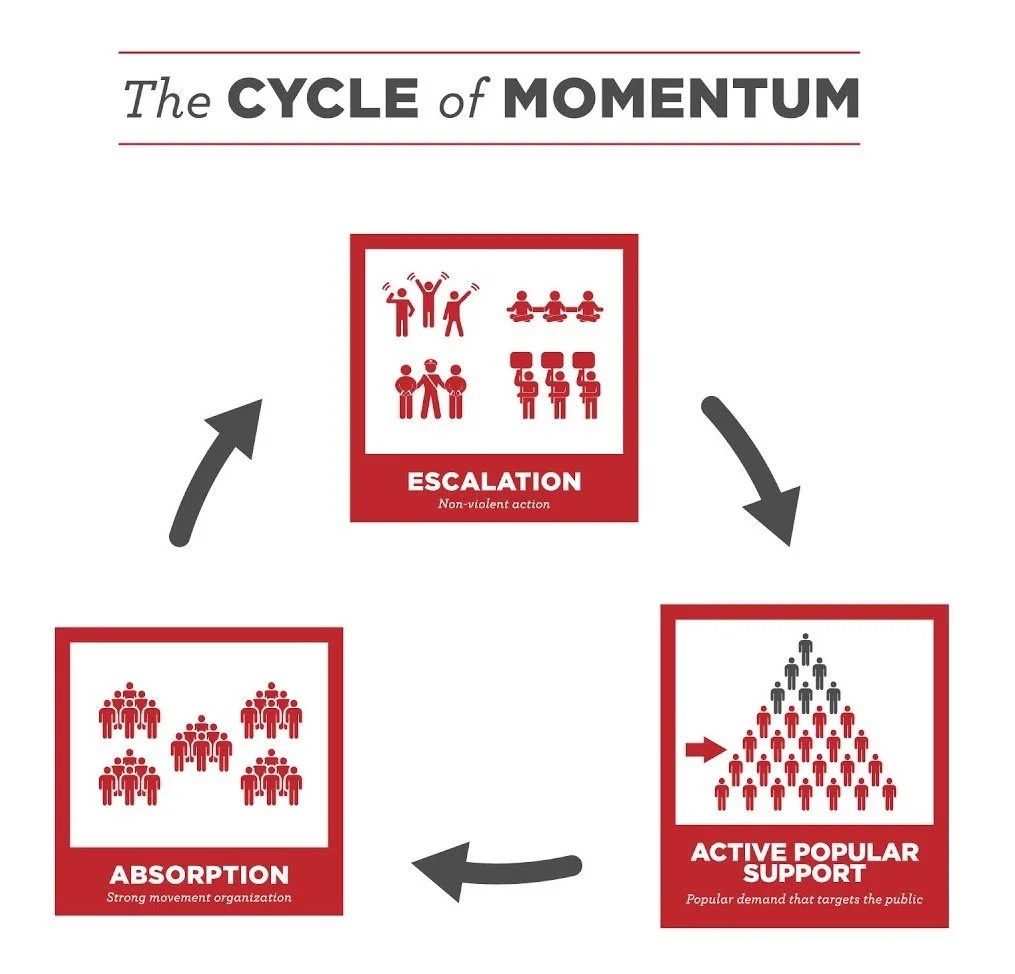
Rising Tide’s politics are vague to outsiders. This is as much a consequence of the ‘swamp’ of environmental activism as it is a product of Rising Tide itself. There are a few things that need to be cleared up from the start. Rising Tide does not present itself as a revolutionary, or anti-capitalist, grouping. This is a misconception that many on the left have: that environmentalists trend toward anti-capitalism or socialism. This is especially not the case for Rising Tide. While Rising Tide and environmentalists make appeals to ‘workers’, they view their central subject as being a classless ‘public’, often ‘the people’ (hence, the people’s blockade).
Rising Tide organises primarily along the momentum model. This is a model of civil resistance organising which takes a broad view of the social movements of the past and attempts to synthesise a model for future organising, viewing activism as taking place within a ‘social ecosystem’. It is a hybrid model aiming at merging ‘structure-based organising’, described as “organising that tends to target a decision-maker with an instrumental demand”, and ‘mass protest’, described as “disruptive action that publicly expresses outrage and urgency around a given issue”. It is a model which does not aim to win over a broad layer of society, but instead it believes that “a movement wins when it has the support of a sustained active minority and a passive majority of the public.”
Similarly organised environmentalist groups, such as the Tomorrow Movement (est. 2019), also follow the momentum model. Adherents of the momentum model believe that there are four components to a movement’s “DNA”:
- Story, which is the public facing identity and dominant narrative(s) of the movement.
- Strategy, the aims and goals of the movement.
- Culture, an internal system of values, principles and practices.
- Structure, how the movement is organised materially.
The momentum theory of change is one of healing people’s connection to themselves, their communities, and the planet. It believes in restoring “wholeness, reciprocity, and community”. The momentum model takes an “ecological” view of social movements. That is, that there are a diversity of roles in social movements, and a diversity of groupings, which all inter-relate and support each other in different ways. Deepa Iyer of the Building Movement Project describes the following roles within a “social change ecosystem map”:
- Weavers, who understand and analyse the connectivity between people, places, organisations, ideas, and movements.
- Experimenters, activists who pioneer, innovate and invent.
- Frontline Responders, those who support the community through marshalling and organising resources for community care.
- Visionaries, who imagine and generate ideas for communities and movements.
- Builders, those who develop, organise and implement ideas and practices, etc.
- Caregivers, who nurture and nourish activists and community members.
- Disruptors, who take risky actions to shake the status quo.
- Healers, who tend to traumas caused by oppressive structures and practices.
- Storytellers, who craft and share community stories, experiences, etc.
- Guides, who teach, counsel and give advice.
Social change efforts as part of the ecosystem belief are grouped into three broad categories:
- Personal transformation (yoga, therapy, education)
- Alternative institutions (co-operatives, time banks, ashrams)
- Dominant institutional change (advocacy, community and labour organising, mass protest).
Understanding Rising Tide
Once you understand the momentum model, you will broadly understand the general way that Rising Tide organises itself and views the world, as well as its theory of change. We can broadly understand its “DNA” per the momentum model in the following way:
- Story: Rising Tide publicly identifies itself as a civil disobedience activist organisation, aiming at doing grassroots organising to win its main demands.
- Strategy: It has three core demands, and a two-part plan in winning them (having them institutionalised)
- Culture: It has a set of guiding principles and values.
- Structure: It is a “grassroots” organisation which is organised along affinity groups and local activist hubs.
Rising Tide has three core demands made of state and federal governments:
- Immediately cancel all new fossil fuel projects.
- Tax fossil fuel export profits at 75% to fund community and industrial transition, and pay for climate loss and damage.
- End all coal exports from Newcastle, the world’s largest coal port, by 2030.
They have a two step plan which involves a climate defence pledge, a build-up phase, and a civil resistance phase. Their climate defence pledge is a pledge to commit toward actively engaging in Rising Tide’s civil resistance movement to defend the climate. It reads as such: “I pledge to be one of 10,000+ participants in the Rising Tide climate defence movement by engaging in sustained, nonviolent civil resistance – or supporting others who do so. I commit to help end Australia’s biggest contribution to the climate crisis and stop the export of coal via Newcastle, the world’s largest coal port.” (Rising Tide Handbook, pg. 19).
The “build up phase”, which had been undertaken from 2023 to 2024, was the phase in which Rising Tide focused on building relationships with other activists and groups, training its own activists, and building the numbers necessary to carry out its plan of stopping coal ships, primarily through building momentum (via the climate camp and blockade).
The “civil resistance phase”, which Rising Tide is building toward, is the phase in which the organisation will commence wide scale actions to disrupt the coal industry across Australia. They claim to require “ten thousand or more active participants” for this phase. Rising Tide claims to be rapidly growing, “doubling their numbers every month” since at least November 2022. It is difficult to confirm this, as Rising Tide is not a membership organisation. That is, the only mark of being “in” Rising Tide is actively showing up.
Rising Tide’s activists (it is difficult to describe them as “members”) are organised into formal activist hubs, which are city and regional based pseudo branches. For example, Rising Tide is comprised of the following “hubs”: Adelaide, Brisbane, Canberra, Northern Rivers, Sydney, Newcastle, and Melbourne. These hubs are autonomous and make decisions via consensus (which is common for environmentalist activist groups). Isabella Todd’s case study of Rising Tide (from 2022-2024) describes “growing pains” in the organisational model of the group, culminating in proposals for a “national steering team”.
Rising Tide’s 2024 handbook describes their structure and decision-making. Activists are organised into local hubs (as described above), who elect representatives who in turn attend national level meetings. They, via consensus, decide the direction of the organisation, amongst other things. They describe their national steering team as “consisting of seven of our most active and experienced members who meet once or twice per week to discuss issues and formulate proposals for consideration at the hubs meetings. Rising Tide does not list who is on their “national steering team”.
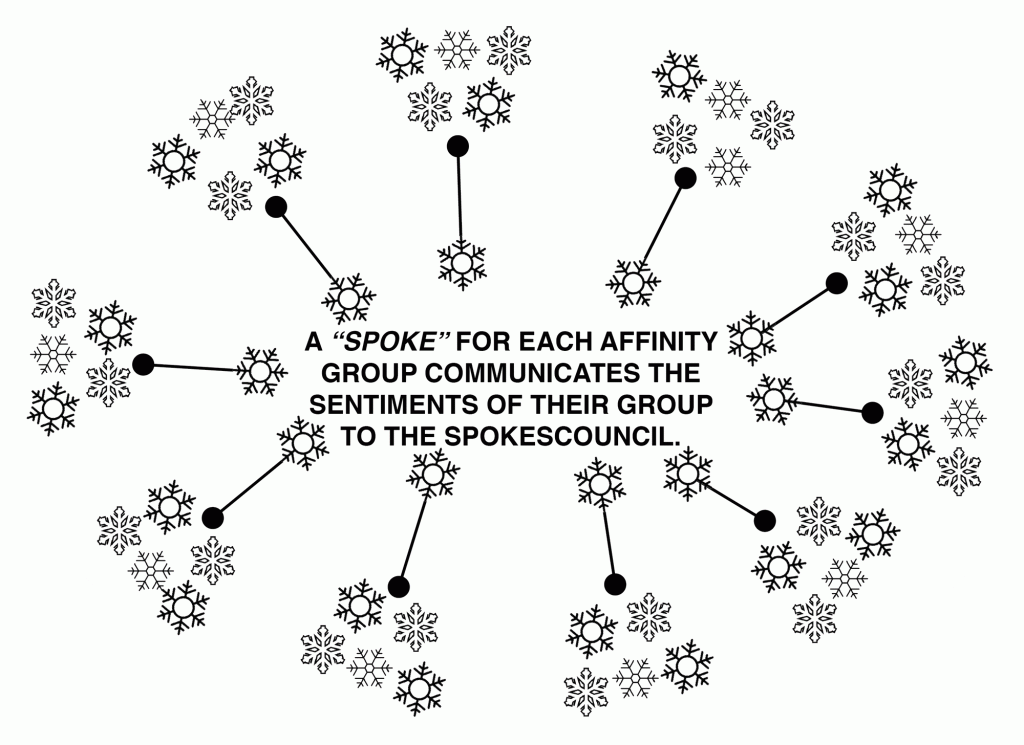
Their handbook describes “affinity groups and spokescouncils”, which are prominent in these kinds of activist spaces. Affinity groups are also popular with anarchist groupings. They are described as “small groups of people (usually between 5-15) who know each other well, and work together towards a common goal”. Crimethinc describes affinity groups as “a circle of friends who understand themselves as an autonomous political force.” It is best to describe affinity groups as friendship circles or groups of associates who come together to carry out a political aim during a protest or other action.
A “spokescouncil” is formed as affinity groups come together to make bigger decisions at protests and actions. Each affinity group appoints a representative who sits in a central circle, which their respective groups sit behind them. It is another form of consensus decision making. Participedia describes spokescouncils as having been used “by Occupy Wall Street, Occupy Portland, Occupy Vancouver, as well as the Zapatistas, the Women’s Movement, the Anti-Nuclear Movement, and the Global Justice Movement.” Spokescouncils were allegedly convened at various points during the 2023 and 2024 blockades, and will no doubt appear again this year.
Rising Tide also has caucuses, which are internal groupings based mainly around identity or shared oppressions/issues. Most prominent of these is Queer Rising, an LGBTQIA+ caucus within Rising Tide based in Newcastle. Youth Rising is another caucus within Rising Tide, made up of under 18s. Youth Rising is the result of Newcastle SS4C merging with Rising Tide in June/July 2024.
Rising Tide’s politics are populist in nature. That is, they make appeals to “the people” and “the ninety-nine percent”. They are notable for being a cross-generational movement, being made up of people of all ages, from under 18 to over 50. They are also a diverse movement, insofar as there are many women activists involved in Rising Tide, as well as non-white ones. There is subsequently a diverse range of opinions within Rising Tide. This diversity of thought is a benefit and a drawback. It is a drawback primarily because it means that anyone wearing a Rising Tide shirt is more or less a “Rising Tide activist”. This includes a minority within the environmentalist movement who hold anti-social views that border on genocidal. For example, Scientist Rebellion (part of Extinction Rebellion) has activists who endorse the views of The Population Bomb, which posits that population booms will lead to famine and mass death. Their solution? Mass sterilisation in the third world. This genocidal worldview is a minority in Rising Tide, but their loose structures make it difficult to exclude these people, who were once a significant portion of the environmentalist movement in past decades.
With a general understanding of the momentum model, it is possible to understand Rising Tide, and develop a strategy for engaging with them.



 PARTISAN!
You must be logged in to post a comment.