The Arab Spring continues to weigh on Middle Eastern politics, and the Socialist Left. Mila Volkova analyses the failure of the Egyptian revolution and how the Left oriented itself toward this spontaneous movement.
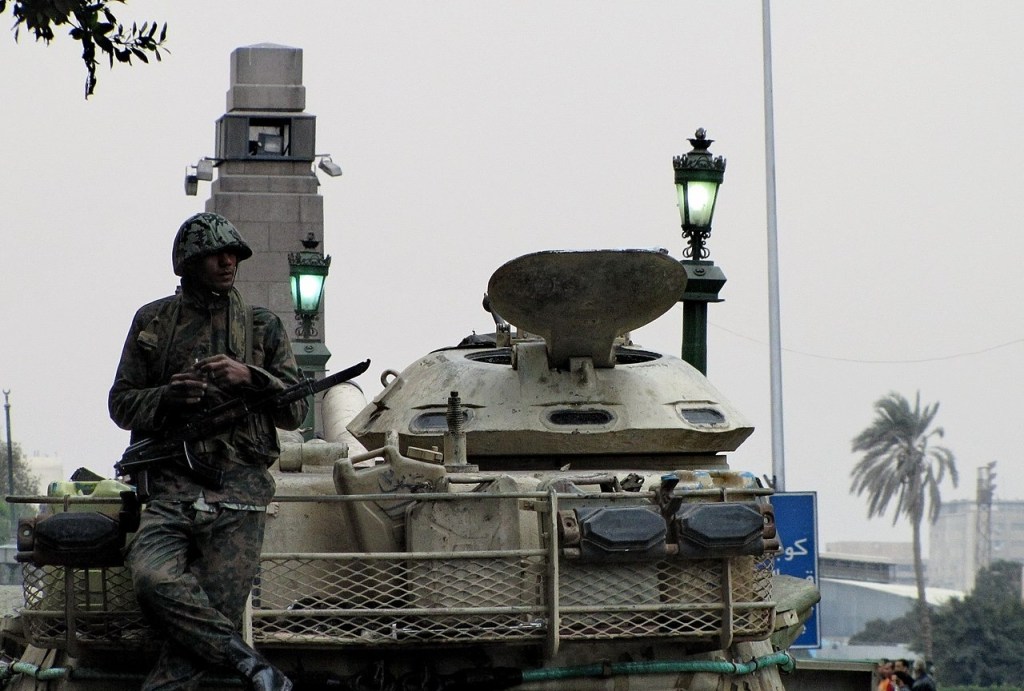
June 6, 2010, a young Egyptian man is composing music in an internet café before he is arrested by two police officers. His crime? Recording the officers selling drugs on his mobile phone and posting it to Facebook. The café owner asked that they do their business outside. The cops obliged him and beat Khaled Mohamed Saeed to death on the sidewalk instead. For the remainder of the year, protests simmered across social media and in the streets under the slogan “we are all Khaled Mohamed Saeed”. The last straw for the Egyptian masses came on 4 January 2011, when Mohamed Bouazizi, a Tunisian street vendor whose cart was shut down by police for being unable to afford a government permit, set himself on fire outside of the Governor of Sidi Bouzid’s office. Reportedly, he cried “If you don’t see me, I’ll burn myself!” before striking the match that would melt winter and ignite the Arab Spring.
Bahrain, Libya, Syria, Tunisia, Yemen – mass pro-democracy protests rocked all these countries. But most importantly for the masses of the Middle East exploited by imperialism, they reached Egypt. Due to Egypt’s size, relative economic development, and its border with both Israel and Gaza; any attempt to secure freedom in the region relies on victory in Egypt. The US’ foreign security apparatus is aware of this and worked hard to protect Israel, its regional aircraft carrier, from revolutionary threats – using all means necessary in 2011 – 2013.
Conservative estimates placed Egypt’s structural poverty in 2011 at an enormous scale: at least half of employment in Egypt was in the informal sector (thus rife with underpayment, poor conditions, and violence), the unemployment rate was at least 25%, and more than that were below the absolute poverty line (let alone relative poverty, which was a greater figure still). This was because of the failure of Gamel Abdel Nasser’s regime of national development, which collapsed in 1970. Because of the structural imposition of the US dollar as the currency of global trade, wannabe developmentalist states must ensure that their export industries are internationally competitive. Otherwise, they cannot bring in enough US dollars to fuel their import substitution strategy – where domestic agriculture is deliberately underdeveloped and food/industrial inputs are imported to prioritise industrial development. Unable to compete with western industries and their partners in South Korea, Taiwan, and Japan, Nasser’s regime suffered a current-account crisis (when there are not enough dollars to pay for all foreign debts and imports).
What followed was Infitah, or “opening up”. Beginning under Sadat but truly achieved under Mubarak, IMF and World Bank loans that gave the Egyptian government enough dollars to avoid collapse were swapped for de-regulation, privatisation, and dramatic cuts in subsidies for basic goods such as bread and petrol.
The working class responded with waves of spontaneous industrial action. In the period between 2004 and 2012, workers went on strike more times than several of the previous decades combined, with 2011 and 2012 being particularly intense. Most of these actions were organised outside of the institutionalised trade unions, which were grouped into the Egyptian Trade Union Federation (ETUF) by the government and dominated by bureaucrats or Nasserist socialists loyal to the state. Class war was not just limited to the cities. Subsistence farmers and rural workers began a defensive campaign of struggle against state-backed land commodification and monopolisation by large landowners.
A social crisis had been inevitable in Egypt since the breakdown of Nasser’s totalitarian state apparatus. All social functions had been swallowed up by the state: trade unions, private business, demographic planning, education, political parties – all were subordinated to a program of national economic development guided by the army and the bureaucracy with Nasser at the head. The inevitable contradictions of a peaceful and national road out of imperialist exploitation forced Infitah, after which the Egyptian state lost the capacity to directly mediate social conflict and legitimise itself. More and more of the work of reproducing capitalism ideologically, and providing welfare to struggling workers, was contracted out to NGOs and private business, who cared more about cutting costs to the bone than the long-term survival of capitalism. The revolt in Egypt that began in 2011 was a result of a crisis of reproduction caused by the state’s hands-off approach. It is no surprise, then, that the Muslim Brotherhood (an Islamist organisation banned by the Egyptian government and responsible for assassinating Nasser’s successor, President Sadat), Egypt’s largest service provider and the largest recipient of government funding through its front organisations, was also the largest opposition party from 2011 – 2013.
When President Mubarak announced his intention for his son to succeed him as President, tens of thousands of protestors occupied Tahrir square in Cairo. They hosted public meetings and demanded Mubarak’s resignation and a democratic civilian government. After suffering regular brutal attacks by internal security forces, they marched on the presidential palace. To pre-empt total revolution, the military stepped in and forced Mubarak to resign. They replaced him with the Supreme Council of the Armed Forces (SCAF), who promised new free elections.
The following elections (the freest in Egyptian history) for the upper and lower houses in January 2012 brought a 60% majority coalition of Islamist parties, of which the Muslim Brotherhood (through their proxy the Freedom and Justice Party) held a significant plurality. The Brotherhood and SCAF began a tug of war over the state which lasted throughout 2012. Secular opposition forces including workers’ groups, activist NGOs, and the Revolutionary Socialists (RS), were largely external to this process. The protest movement, in which the Islamist and secular groups were initially somewhat united, began to break down. Secularists preferred a continuation of military dictatorship, with a possible democratic transition later, to the increasingly likely prospect of a Sharia constitution. The uprising had effectively lost its momentum by 2013, when SCAF forcibly removed President Morsi (the Brotherhood’s candidate elected in 2012), dissolved both houses, opened fire on Tahrir Square, and placed General al-Sisi upon the presidential throne via a dubiously free referendum – with the support of the secular opposition (including RS).
The revolution is thus a tale of two cities. On the one hand, there is the conflict that took place between different factions of the Egyptian elite over the structure of the state and over their strategy towards American imperialism. This mythology is supported by its analysts and propagators in the academy: Modernisation theorists who argue that “middle class” activism and a strong “civil society” are the basis for a transition to democracy. On the other hand, there is the class struggle between the Egyptian masses and their rulers over the nature of political power, political and social freedom, support for the Palestinian struggle, and for quality of life.
The View from the Tower
The narrative of modernisation goes like this: the “middle class” – meritocratic, economical, and liberal – is the protagonist of democratic values through its impulse to create free civil society groups, which spread those values to the masses. The exact size, confidence, and influence of the middle class is dictated by economic development and, therefore, modernisation creates democracy. This middle class is usually defined vaguely and includes well-off professionals, white-collar workers, and wealthy business owners.
From this perspective, the following problems existed in Egypt: the country was a net importer of virtually all goods and services, and chronically reliant on American foreign aid which constituted most of Egypt’s strong GDP growth under Mubarak (though this did not bother the US all that much). Successive ‘rescue packages’ had forcefully undermined the Egyptian tax base, leading to a reliance on unproductive consumption taxes and rents charged on oil sales and traffic through the Suez Canal. The result was a constant budget deficit, enforcing a vicious cycle of further dependence on US loans for state liquidity.
This situation was not a problem for the Egyptian elite on the face of it, many of whom had transformed themselves into financiers profiting off corruption, state contracts, and foreign investment into speculative bubbles in tourism and the like. However, it was of particular concern to certain parties of the Egyptian elite. Firstly, to educated professionals reliant on the development of advanced industry and the public service for employment. Secondly, to the officers of the armed forces which had been systematically sidelined from their once prominent role under Nasser. But are either of these parties reliable friends of democracy?
The strong emphasis of contemporary academia on the role of educated professionals in the revolution is misguided. This category could include, at most, 5% of the Egyptian population in 2011. Though this group had some interest in Egypt’s democratisation, and plenty of influence through its mastery of social media, they played a decisively reactionary role in the revolution. If a civil society organisation, though formally separate from the state, receives funding from the state to plug gaps in state welfare provision, and is also reliant on foreign aid paid for by the USA – how can it be thought of as opposing the status quo? During the revolution, these NGOs demobilised welfare demands on the state and wage demands on businesses to ensure their own survival.
Though the Muslim Brotherhood had a large male working-class membership, it was led by educated professionals in the civil service, mosques, and in Islamic hospitals and NGOs. Following neoliberalisation, local and regional Egyptian state officials developed extensive patronage networks with Islamic mutual aid groups, on the condition that they de-politicised. The Brotherhood was effectively transformed into a para-state apparatus. Islam had also become something of a state ideology under Mubarak. Part of the Brotherhood’s success had come from the post-Infitah growth of a large informal network of remittances from Egyptian migrants to the gulf, which was largely controlled by the Brotherhood. This lead to the development of a wealthy Islamic banking class, which was officially sponsored by the government.
Summed up, this meant that the Brotherhood was not a revolutionary force in the revolution, and the Brotherhood had much to lose from democratisation and thorough social reform. Though most protestors were Muslim, the Brotherhood made no effort to properly support the revolt. Instead, it focused entirely on its election campaign. Once they had secured both houses and the presidency, they did not implement the demands of the Egyptian masses to begin a democratic transition, take a hard stance against Israel, and implement a welfare state. They did the exact opposite in every instance.
With regards to the military, many claim that the military held a dominant position in Egyptian society. Though certain ex-generals had acquired massive private wealth during Infitah, the military as an institution had been completely sidelined compared to the ballooning internal security apparatus – which had aligned itself with Mubarak’s network of civilian capitalist collaborators in the National Democratic Party. The security apparatus had some 2 million employees (an astronomical proportion of the population) compared to roughly 400,000 military staff. From the 1970s to 2011, military spending as a proportion of GDP had fallen from 33% to 2%. The military’s business portfolio only returned a small profit, and they suffered with constant equipment shortages and poor quality of troops. During the uprising itself, though the military took an indifferent attitude to street action, they tacitly supported attacks by protestors on police, and they successfully liquidated the entire civilian bourgeois elite around Mubarak. This was done not out of any genuine interest in democratisation – which they explicitly opposed for fears of opening a pandora’s box of social demands – but because they feared that Mubarak’s son would keep them in this weak position were he to succeed his father as president.
The View from the Streets
So much for the ruling class. The task of winning the battle of democracy was left to the workers themselves. They faced enormous obstacles in this quest.
Though workers had been driven to the edge by poverty and punishing state oversight, the scope of workers’ organisations from 2004 – 2013 were quite limited. Most striking workers simply requested that the state ‘investigate’ the issues – very few direct demands for the improvement of wages or conditions were made. The strikes thus tended to be apolitical in character, making no demands for democratisation even during the uprising itself. Spontaneously formed strike committees limited themselves to their workplace and dissolved immediately after the conclusion of a strike. The organisation of workers on a national scale was confined to the ETUF, which was overseen by the government, and workers found it difficult to move around or against it. As a result of all this, though the ideological hegemony of the state had basically broken down, the workers’ movement was essentially paralysed – it could not rival the military and the Brotherhood in the contest for state power.
This isolation proved deadly when soldiers liquidated the protestors in Tahrir Square. The police had tried for three days to dislodge the 60,000 protestors in the square but retreated after they became exhausted and ran out of supplies. The Egyptian workers proved that the police are nothing but a paper tiger. But the same cannot be said of the armed forces – who can deploy concentrated and overwhelming firepower. Splitting the army to either paralyse or win over portions of it are, therefore, necessary tasks during a revolution. But there had been zero organised effort prior to 2011 to link urban workers with the rural poor (which most army conscripts were) and soldiers.
Aside from the state-approved union bureaucrats in the ETUF, the working class was also chronically misled by Nasserist and Stalinist ‘socialists’. The repressive apparatuses of the state meant that many ostensibly socialist groups went through a process of de-politicisation much like the Brotherhood. The legacy of Nasserism cannot be overstated; many socialists were nostalgic for the era of national developmentalism and saw the primary revolutionary force as the army.
All these obstacles indicated the need for a vanguard party to challenge the misleadership of the class, contest the hegemony of capitalist ideology, link workers with one another, uphold the political independence of the working class from the ruling elite, and infiltrate the military to affect a split. These tasks fell to RS by default, who were the only committed socialists in Egypt during the revolution. They did not rise to the occasion.
From the early 2000s onwards, and during the revolution itself, RS pursued an alliance with the Muslim Brotherhood in opposition to Mubarak’s regime, including open support for Morsi’s presidential campaign. The claim was (and is still maintained by RS to this day) that the Brotherhood is a progressive, anti-imperialist, and pro-democratic force oppressed by the regime. Although it used to be a violent anti-communist organisation dominated by petty capitalists, it has since become a mass movement of unemployed youth, workers, and reformist professionals. According to RS, opposition to the Brotherhood is tantamount to support for Mubarak’s repressive secular regime.
This claim is dubious on the face of it. Though it’s true that the Brotherhood developed a mass membership of young male students and unemployed, its rigid internal hierarchy and bureaucratic structure ensured that it was (and continues to be) dominated by an elite clique of clerics, bankers, and wealthy professionals. The organisation thus had an undeniably bourgeois character. Furthermore, the Brotherhood was structurally reliant on the neoliberal status quo – they only entered the revolution to seek the incorporation (and empowerment) of their massive Islamic welfare network into the state apparatus via Sharia law. They had no interest in subverting the work-fare system of conditions and exploitation, only in its Islamisation. Once in power, the Brotherhood totally compromised on their opposition to Israeli colonialism to secure financial aid from the US to prop up their government. Beyond the bare fact that a Sharia constitution was obviously going to be undemocratic, authoritarianism is a necessary condition of US imperialism’s relationship with Egypt because (due to popular sentiment) any genuinely democratic Egypt would be extremely anti-Israel. Somehow, RS seems to have been taken totally by surprise when the Brotherhood made the move towards repressive Islamist rule. It is even unclear to what extent Mubarak’s regime could be described as secular. Though the regime was anti-Islamist, Mubarak appealed to Islam and his personal piety repeatedly to legitimise his authority.
But RS’ strategy in Egypt was informed by more than just a misreading. As a sister party of the Socialist Workers’ Party (SWP) in the United Kingdom set up by the late Tony Cliff, and an unofficial part of the International Socialist Organisation (ISO) centred in the US, RS displays the same tendency to be soft on Islam. This is not to suggest that Marxists should be lecturing Muslim workers on their personal faith. Rather, that communists have a duty to analyse the structural role played by all religious institutions, understand which classes are involved in them, and recognise that the movement of workers to abolish the status quo is necessarily self-interested and atheistic politically-speaking. Anti-clericalism is a basic requirement of socialist politics. Making this point to most socialists of the Cliffite tradition, including members of Socialist Alternative here in Australia, is met with the accusation of “Islamophobia”.
My intention here is not to make a sectarian attack. I have no interest in “I told you so-s”. I must assume that, as socialists, my Cliffite comrades are not stupid, and that they are aware of the nature of the Muslim Brotherhood. The purpose of this essay is to analyse the failure of the Arab Spring and entreat that my Cliffite comrades re-consider their strategy. This strategy was properly tested for the first time in the Arab Spring, and it demonstrably failed.
This strategy is that of spontaneity. Informed by Cliff’s reading of Luxemburg and Lenin, RS avoided putting forward demands or rhetoric which were assessed as ahead of the current political consciousness of the masses. In this view, workers are assumed to already possess a disjointed form of revolutionary consciousness. All that is necessary is for socialists to build the confidence of the workers to articulate themselves, seize power, and implement their vision. Socialists must therefore avoid “talking down to the masses”. “Meet them where they’re at” is a common Cliffite phrase.
Putting openly revolutionary ideas directly in front of the masses before they are “ready” is criticised as “programmatism” that isolates socialists from workers and undermines the capacity for socialists to lead the struggle when it finally becomes revolutionary. To do otherwise is simultaneously bureaucratic, reformist, and ultra-leftist – pejoratives all launched at the Revolutionary Communist Organisation (RCO) by Socialist Alternative. The vanguard organisation must maintain the purity of its revolutionary theory (proven by history to be that of Cliffite Trotskyism) so that it will chart the right path when the time comes. Therefore, only particular individuals with pre-existing, and organically developed, socialist tendencies should be recruited into the vanguard organisation.
The theory of spontaneity holds that the revolutionary situation only develops out of the unpredictable daily struggles of the masses and their innate human creativity. Clandestine organisation within the military is seen as unnecessary by Cliffites because they believe that the workers will create a dual power structure during the revolution, including armed militias, and this will be sufficient to simply displace and then replace the capitalist state. During the Egyptian revolution, RS proclaimed that “the wave of social revolution is widening every day!” simply through its own momentum.
But the masses did not spontaneously develop a revolutionary inclination. Instead, RS neglected the necessary and decades-long effort of spreading revolutionary ideology. History has proven time and time again that without the patient effort of socialists to directly challenge capitalist ideology and present a positive alternative prior to the revolt, the masses are left confused and uncoordinated when revolt must spill over to revolution.
The result was that RS did the work of the military for them by corroborating the claim that all opposition to military rule can be dismissed as Islamist. Though Cliffites may reply that they put conditions on their “critical support” for the Morsi presidency, such as democracy and freedom for trade unions from state interference, what good are conditions if one is not able to enforce them? It was inevitable that RS would rely on the military to stop the implementation of a Sharia constitution because it had not built up an alternative political structure of its own. Doing so would have necessitated the work of building up a mass party of the entire working class, independent of Islam and all other capitalist ideologies, and free to determine its own politics and strategy. Are we supposed to be impressed by the analysis, seemingly repeated by the followers of Cliff after every potentially revolutionary situation has passed, that the masses were, in fact, not ready? Well, whose fault was it that they weren’t, comrades?
This is relevant to our Australian context because Socialist Alternative, the largest socialist group in Australia today, pursues fundamentally the same failed strategy as RS. They would, however, reject this characterisation on the grounds that they were expelled from the ISO for disagreeing with their prevailing “1930s in slow motion” thesis in favour of their own view that we are in a period of “revolutionary downturn” (itself probably a correct assessment at the time). Solidarity, the ISO’s group here in Australia, sucks up to the trade union bureaucracy and the Labor party, and Socialist Alternative doesn’t. Socialist Alternative have set up the Socialists, a mass workers’ party led by hard-working revolutionaries. Who else organises all these massive protests? Who else has done all these wonderful things? Who can challenge that we are the biggest and the greatest? But opportunism is opportunism, comrades, whether it take the form of tailing the trade union leadership (as Solidarity does) or tailing the Greens/activist street movements (as Socialist Alternative does).
Revolution is not cottagecore, and revolutionary ideas cannot be spread politely. RS and the other Cliffite sects dare not criticise Islam and other hegemonic ideologies for fear of coming across as elitist. But what is more elitist than thinking that the average worker is just too stupid and immature to take even gentle criticism? What is more opportunistic than pandering to Islam, a structurally misogynistic faith run by oligarchs and capitalists?
For all Socialist Alternative’s “outrage!” and cries of “shame!” against the capitalist class and their dogs in Labor, the failure of Egypt and of the Arab Spring demonstrate what will happen if their spontaneist and opportunist strategy is carried out here in Australia: paralysis and confusion of the working class, poor organisation, compromise on the political independence of the working class, tacit support for class collaborationist leadership, and military counterrevolution. Simply put: death, immiseration, failure.
I urge my comrades of the Cliffite tradition to reconsider their dogmatic adherence to this strategy, that any major criticism of will earn you an expulsion from Socialist Alternative (it was this very reason why the RCO did not join Socialist Alternative as a faction within it). We must commit to a collective, open, and honest accounting of our 21st century and its numerous failures. What was Occupy? Why did the Arab Spring turn to autumn? Why were the meagre victories of the Movement of the Squares so easily turned back? We can only answer these questions if we are finally united into a single, democratically organised, communist party.

 PARTISAN!
You must be logged in to post a comment.