As unity talks between the RCO and the Spartacist League continues, Mila Volkova responds to ‘The Road to Party’ by asking what – if anything – does the Spartacist League seriously disagree with the RCO on.
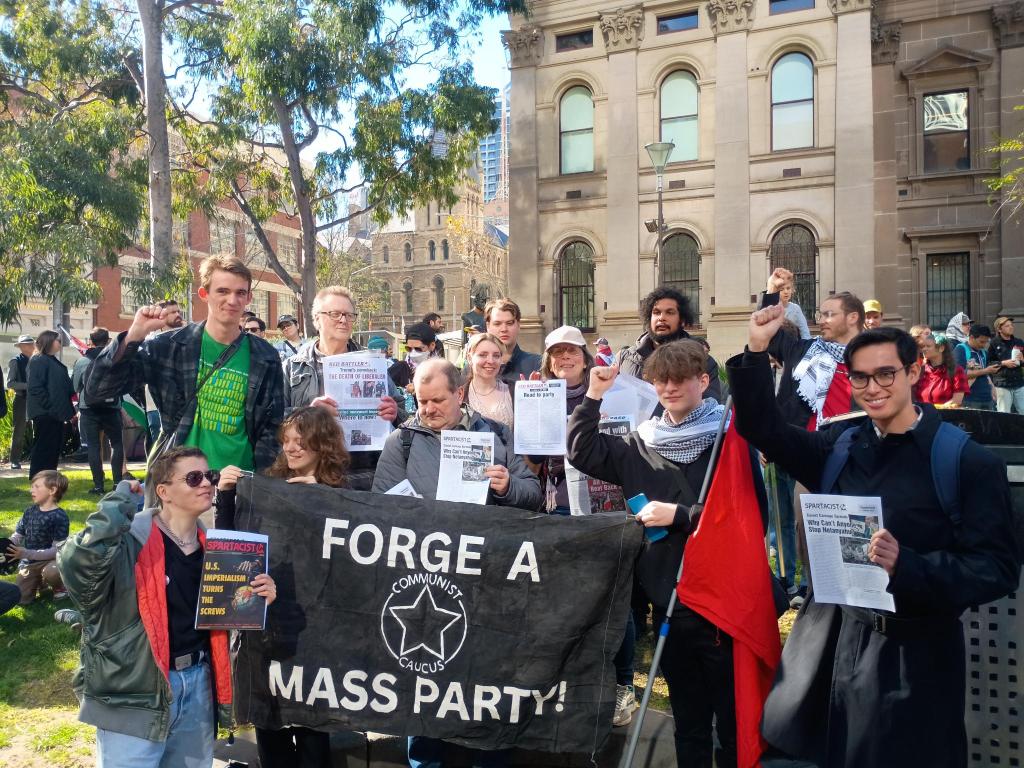
“You yourself know the difference between a sect movement and a class movement from personal experience. The sect seeks its raison d’être and its point d’honneur not in what it has in common with the class movement, but in the particular shibboleth distinguishing it from that movement.”
Marx to Schweitzer, 13 October 1868
In the Spartacist League of Australia’s (SL/A) most recent reply to Anthony of the Revolutionary Communist Organisation (RCO), The Road to Party, they made three major criticisms of the RCO:
- Our statement defending the CFMEU from federal administration was off the mark and we don’t do enough to criticise the labour bureaucracy.
- Our line during the 2025 federal election, that socialists should vote for socialist candidates where they stood and Labor where they did not, was soft on the labour bureaucracy.
- Our program is a combination of surface-level ‘ra-ra-revolutionary’ rhetoric and a “lowest-common denominator”.
These are the significant differences between the RCO and the SL/A that they believe must be clarified and fought over in the ongoing unity process. But these supposed differences are completely mystifying. The SL/A is making mountains of molehills with these critiques.
The critique of our statement on the federal government’s forced administration of the CFMEU claims that we were too soft on the union bureaucracy. The SL/A’s critique attempts to distort reality rather than confront it. Yes, the criminality of the Victorian branch and the connection with Croatian fascists was used as an excuse by the federal government, whose only intentions were to smash workers militancy and advance ‘productivity’ in the construction sector. These accusations are nonetheless true! Fascist thugs and misogynists should be ruthlessly opposed by socialists in the trade unions.
The SL/A seems to acknowledge the complicity of the union bureaucracy in general when it comes to the ACTU, who really are enemy agents inside of our camp. But the complicity of the Victorian branch of the CFMEU with fascism cannot be separated from this – both are forms of scabbing on the working class, and they feed into one another.
I am sure SL/A comrades agree with this, but this fact cannot be dismissed just by not mentioning it in a statement by a socialist sect, it must be openly fought, and the RCO was right to do so. The SL/A and the RCO completely agree on the need for militant rank-and-file union democracy, agitation for socialist politics in the unions, and for opposition to corruption, fascism, and class collaboration in union leadership. So why make such an attack out of something we agree on?
The SL/A’s claim that the RCO did not make a call for an alternative during the federal election is also bizarre. We called for socialists to vote for socialist candidates wherever they stood. In an election with compulsory voting, there is no alternative to tactically voting against the Liberals wherever there is no socialist candidate. Does the SL/A advocate abstentionism or vote spoiling?
The SL/A and RCO agree on the need for a mass communist party that uses elections as an agitational tool. So, what does this purely negative critique of the RCO aim at? It is unclear. This “prolier than thou” posturing gets us nowhere.
What to make of the claim that the RCO has a “lowest common denominator program”? Who knows. The minimum element of the RCO’s draft program alone is more comprehensive and revolutionary in its demands than any other socialist group in Australia, including the ICL’s The Breakdown of US Hegemony and the Struggle for Workers’ Power. I do not say this to score points, but to point out the SL/A’s confusion towards us. If they wanted to critique the RCO draft program for being idealist compared to a transitional program, that would at least be based in a substantive political disagreement. But the RCO’s program is, definitively, more ambitious than the SL/A’s. Does the SL/A think the program is a compromise with our least-revolutionary elements? The RCO practices majoritarian democracy internally, not consensus.
I cannot help but get the impression that the SL/A is quite confused. These disagreements are broken records of outdated sect squabbles. The SL/A must open its eyes to the actual differences between us here in the 21st century. Our program is not the program of the German Social Democratic Party which Trotsky criticised in the 30s. We are not tailing Labor and the union bureaucracy, as the official European Marxist-Leninist parties did.
The same goes for the SL/A’s exclusive focus on challenging the reformist leadership of the working class in the trade unions and the Labor party. This itself is also not a large disagreement between us, we agree totally with the SL/A’s argument that:
Like the RCO, we think that in this context it is of especial importance to engage with and cohere as many forces on the left as possible on a revolutionary basis. That struggle can only be waged in opposition to the Laborite obstacles standing in its way […] Yes, we need a communist party to split the class, but this party can only be built on the basis of fighting for this split.
Road to Party
Where our two organisations do disagree is on what the immediate tasks of socialists in Australia are. Without a doubt, we must challenge Labor, and SL/A comrades would no doubt continue their work on this front once unity with the RCO is achieved. However, the claim that this is our primary task in the coming years is wrongheaded. Trotsky was correct to argue for a focused attack on the reformist leadership of the mass workers’ parties and unions in the 1930s and 1940s. But this was in the context of a consistent and militant mass workers’ struggle. This is not the situation we find ourselves in today, and a strategy that assumes that we are would be a mistake. Our reformist class leadership is more an effect of a weak working class than a cause of that weakness.
The Question of “Leadership”
Comrades in the SL/A beat the dead horse of class leadership for an understandable reason – to avoid the mechanistic trap of Marxism-Leninism, which claims that all advances and retreats are the result of large-scale social conditions which socialist militants are unable to meaningfully affect.
But the over-emphasis on class “leadership” in the 21st century makes an error of its own. Absent the context of the mid-20th century, declaring that “leadership” is the primary issue assumes that the working class is an active, but misled, force in society. This error misreads our reality where the class is politically passive, weak, and disorganised. Misreading results in mispractice. The SL/A acts as if class struggle is a contest between small, hardened groups on the left and the right. But the working class is not ground to be taken by formations on the battlefield.
The reformist leadership of the class reflects the working class’s reformist ideology. This ideology is not just a Machiavellian scheme imposed on it by the bourgeoisie. The combined and uneven development of capital accumulation and commodity fetishism results in economistic and social chauvinistic ideologies emerging spontaneously from the class. These are embodied and reproduced by material practice and rituals of working-class life: the relative privilege of the labour aristocracy, the ghettoisation of migrants and non-white workers, the subjugation of women workers to patriarchal reproduction, and so on. These are all spontaneous processes necessary to the reproduction and valorisation of capitalist social relations. They are not imposed from outside.
But these processes can be contested! The SL/A strategy acts as if, were we to displace the workers’ reformist leadership, class struggle would bloom across the country like the sunrise on the morning after. The ideologies that arise from these practices and rituals can only be attacked by replacing those practices. This is the purpose of the theoretical education of the masses, mass trade union activity, the daily struggle with the bosses, and workers’ social clubs.
It is only possible for collaborators with the boss to lead the working class because backwards, bourgeois practices and rituals dominate the class. They have dominated the Australian working class consistently for its entire history, but especially so for the last three decades. The problem with the SL/A’s strategy is not that we should not struggle against reformist leaders, indeed we must, but that it neglects the greater task of socialist ideological struggle and working-class re-composition.
Thus, we can have a dialectical theory of the relationship between objective and subjective conditions that avoids the mechanistic trap. When pointing to the failures of the Australian workers’ movements since World War Two, we must acknowledge that racism and economism are results of objectives tendencies and pressures. We can also recognise that these pressures were able to be fought directly by socialist militants through mass ideological education, but also through working class struggle which can alter those objective conditions.
This is a small and incomplete accounting of the 60s – 80s in Australia: working class militancy was on the rise not because white workers demanded higher wages for themselves, but because they made common cause with the disabled, mothers, indigenous, and migrants to directly attack the material conditions that divided them. However, socialists were unable to turn this trend into a revolutionary movement because the Communist Party of Australia (CPA) abstained from consistent, patient, and public ideological education (due to its tailist relationship with Laborism). Though the Accords certainly had something to do with Labor’s leadership of the class; it had just as much to do with the objective pressures of globalisation, offshoring, and the ideology of economism native to the Australian workers’ movement – subjective and objective conditions combined.
Though the disunity of the socialist movement into useless sects is, to some extent, a product of the objective process of de-industrialisation, it is also a result of subjective conditions. After the correct decision by communists to split from the 2nd International, our movement learned the (wrong) lesson that splitting is the correct response to opportunism. We became addicted to unprincipled splits and expulsions. This was not helped by the denouncement culture of Red Guard-ism that predominated the 60s. Let’s not forget that the smashing of the CPA-led NSW branch of the Builders’ Labourer’s Federation was orchestrated by a member of the CPA-ML, a split which, like many others, only took place because of the total lack of democracy in the official Marxist-Leninist parties. In many ways, we are our own worst enemies, and it is wrong to blame our disunity on the bourgeoisie.
We need more productive disagreements
The question of leadership is probably linked with the SL/A’s history of sectarianism which it is now in the process of abandoning. It makes sense to be staunchly sectarian if the primary failure of the socialist movement is not having the correct line to oppose the reformists with. But this is not our primary obstacle. The problem is that we do not have a consistent sphere of working-class life in which to spread revolutionary ideology at all. The SL/A acknowledged this somewhat in The Crisis in the Marxist Left and the Tasks of the ICL and The Roots of The ISA Crisis, but this is not reflected in their orientation towards exclusively challenging Labor’s leadership. I would put it to comrades of the SL/A to consider who they are reaching with their dramatic slogans and denouncements of Labor. Is it the working class? Is it the minority of workers who attend Labor branch meetings? Is it other members of the labour bureaucracy?
Once again, I am left confused. We agree on the need to cohere and regroup socialist forces. We agree that this can only happen on the basis of opposition to reformism and social chauvinism. We agree on the need for a revolutionary socialist candidate in every electorate. We agree on the need for open democracy and factionalism within socialist groups. Though the SL/A is currently oriented exclusively towards work inside Labor, they have never claimed that RCO comrades should stop our work outside of Labor once we are unified (in fact, the small success of our work here seems to be part of the reason the SL/A even proposed unity); so we also seem to agree that it shouldn’t be our exclusive focus! What exactly do we disagree on?
It is good to see that the SL/A is struggling against their sectarian past. Perhaps the slow coming-to-terms-with this past and realignment is why these criticisms seem confused and half-hearted. But this finger-pointing ultra posturing must be completely abandoned if unity between our organisations is to be productive. Principled, democratic unity ensures the most effective strategy emerges over time, and it raises the quality of all theoretical, strategic, and tactical disagreement. But this is only possible if those involved are clear-eyed, rather than re-enacting old battles. The ‘ra-ra-revolutionary’ sloganeering of the SL/A has a place in the struggle, and the rhetoric is certainly impressive, but it is assuredly unsuited to our current moment. We need patience, open-mindedness, self-critique, and unity. We need all of that so we can begin the slow work of raising the consciousness of other workers. We cannot do any of that while chasing old phantoms.

 PARTISAN!
You must be logged in to post a comment.