2025 broadly marks the third year of the RCO producing a frequent publication. Max J, who has worked on the RCO’s publications from their beginning in 2023, reflects on the lessons and futures for the publishing wing of the organisation.
Communists have broadly recognised the importance of the press in disseminating communist ideas to the working class, as well as organising serious communist cadres. This is because the press, being publications such as leaflets, pamphlets, newsletters, newspapers and magazines, is an effective means of disseminating such ideas.
Publications are generally easy to distribute (you can hand someone a physical leaflet or magazine), don’t individually take up much space, and can usually be easy to produce (if it isn’t too sophisticated). Publications also help communists develop essential skills such as writing, reading, critical thinking, and communication in general.
There are a few reasons why publications which print are far better than digital-only publications, or simple internet posts. Mainly, a print publication can be shown to and handed to someone at a rally, or while tabling. A physical publication also provides some level of legitimacy to a group or campaign which cannot be accomplished by social media posts, blog posts, or infographics. They make the politics seem ‘real’ moreso than a purely online presence would.
Since its inception, the Revolutionary Communist Organisation (RCO) has always stressed the importance of its publications. The launch statement of the Marxist Unity Circle reads: “We see our publications, particularly Direct Action and The Militant, as being at the centre of our political work. Writing for, reading, and distributing our publications is not a secondary matter, but rather the primary task of our comrades – it is an educational tool, a means to reach sympathisers and supporters, and the means by which we will reach larger layers of socialists and militant workers and youth. As such, we support strengthening our publications, giving them dedicated editorial committees, and placing them at the centre of daily political work” (Strengthen Our Publications).
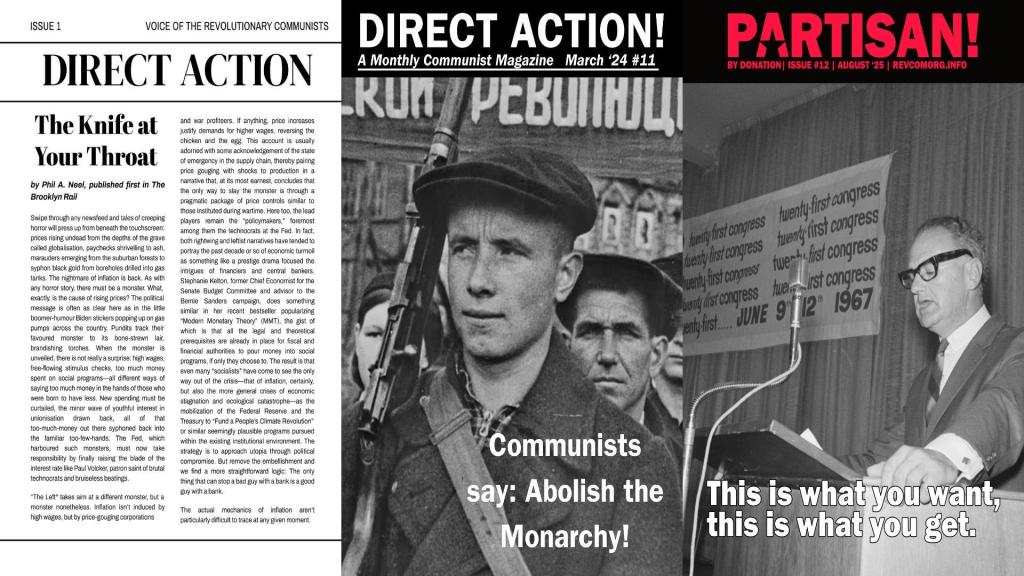
The RCO has had five main publications over its existence so far: Weapon of Critique, The Militant, Direct Action, Partisan, and Bread & Roses. These have existed to serve various purposes: some for communist analysis of news & events (Direct Action & Partisan), others to provide longer, more theoretical analysis (Weapon of Critique). Bread & Roses also existed as a publication of the Communist Women’s Front, organised by QLD-based RCO members.
Weapon of Critique to Partisan (2022 to Today)
“The role of a newspaper, however, is not limited solely to the dissemination of ideas, to political education, and to the enlistment of political allies. A newspaper is not only a collective propagandist and a collective agitator, it is also a collective organiser.”
V. I. Lenin, Where to Begin?, 1901
The RCO’s first publication was Weapon of Critique. It was intended to be a theoretical journal which would publish seasonally. Plans for Weapon of Critique were made primarily by Edith F in 2022, continuing to 2023. By early 2023, the editorial team for Weapon of Critique included: comrades Claude, Edith F, James Y, Levi P, Max J (myself), Morgan L, Nera, Roland T, and Sam. However, Weapon of Critique did not materialise. This was for a few reasons, but mainly, inexperience. Debates over the editorial content and direction of Weapon of Critique certainly bogged it down as well.
In April 2023, Weapon of Critique morphed into Direct Action. Direct Action was launched originally as a collection of essays and articles republished and packaged for RCO members and sympathisers. Direct Action released monthly. Each issue had a general theme. For example, Direct Action 3, Womanhood and other Misfortunes, was focused on women’s liberation and feminism. Direct Action was mainly edited and produced by Edith F and myself. Edith would provide the copy, while I would format it into each issue.
Direct Action was a modest success. It did not, however, develop a distinct identity, until Direct Action 5 (September 2023). By this point, Direct Action began the slow transition away from simply republishing essays and articles, and toward publishing written material from RCO comrades. It also shifted design-wise: while the first four Direct Actions were put together in Google Slides (an object of great shame), the remaining eleven were put together using Canva (an object of lesser shame).
Design-wise, Direct Action looks abysmal in hindsight. Text boxes are unevenly placed. Boxes are outlined not using strokes, but using other boxes placed underneath them, leading to wildly uneven and inconsistent dimensions. Images are inconsistently sized and placed. It was a very amateur magazine. In spite of this, our commitment to iterating on design and editorial direction, and commitment to consistently producing an issue each month, demonstrated our willingness to learn more and develop our skills.
And so Direct Action continued for all of 2023. It even managed to survive the Newcastle schism that took place in August/September. By Direct Action 8, we began publishing action reports from RCO comrades – these were mostly written reports about protests and rallies that comrades went to. Direct Action 8 also featured a lengthy ‘feature’ (what we called smashing 3-4 articles together into one themed section) about the People’s Blockade that Rising Tide hosted at Newcastle.
Direct Action became exciting by Issue 13, when the Palestine student movement kicked into gear with encampments across Australia. Issues 13 and 14 are both concerned with these encampments, and feature in-depth reports on protests and rallies that took place as part of this campaign. They also featured a new visual look and relatively improved design, though the earlier quirks remained.
The last issue of Direct Action was Issue 15, released in July of 2024. This issue coincided with the RCO’s 2024 conference, which instituted various changes to the RCO, that also impacted the publications. Two motions raised at this conference addressed Direct Action and publications in general:
Motion #E02 – Building Our Publications
MOTION: This congress acknowledges the centrality of the communist publication to the establishment of a revolutionary socialist movement and the creation of a mass socialist workers party. In our context, this means building Direct Action (DA) into an invaluable publication of the socialist movement in Australia.
That the Publications Committee, the editors of Direct Action, and the incoming Central Committee be tasked with making our organisational publication the centre of our political work. That this task include:
• strengthening DA through a dedicated editorial committee.
• ensuring regular original content for the online and print editions of DA.
• building a pool of staff writers for DA, producing at least an article a month.
• organising reprints of relevant articles for the print edition of DA.
• increasing the readership of DA, as well as establishing a subscription system to
• distribute physical copies around the country.
• establishing a coherent style and identity for DA, both in form and in content
Motion #E03 – The Partisan
MOTION: In light of the clarification of our organisational tasks, the organisation shall change the name of its central organ to The Partisan.
That the name Direct Action be reserved for a future workers bulletin.
The Marxist Unity Circle, a faction which existed for the duration of the 2024 conference, stated the following in their internal statement:
Strengthen Our Publications. We see our publications, particularly Direct Action and The Militant, as being at the centre of our political work. Writing for, reading, and distributing our publications is not a secondary matter, but rather the primary task of our comrades – it is an educational tool, a means to reach sympathisers and supporters, and the means by which we will reach larger layers of socialists and militant workers and youth. As such, we support strengthening our publications, giving them dedicated editorial committees, and placing them at the centre of daily political work.
Both motions passed. And so, after fifteen months, Direct Action became Partisan. Partisan was the culmination of the last fifteen months of experience and developments. It was the first step toward developing a more professional publication suited to the tasks and aims of the RCO.
Partisan certainly improved on what Direct Action had produced. For example, while the design of the early Partisans was spotty, it was far better than Direct Action. While Direct Action was produced using Canva, Partisan is now produced using professional publishing software (Affinity Publisher).
Partisan’s incumbent staff team included myself, Brunhilda O, Sylvia R, and Luca. Partisan was benefited by the introduction of Luca, the first of two dedicated graphic designers to enter the Partisan team.
Partisan developed a more clear editorial line. The stated purpose and aim of Partisan is to act as a “platform for open polemic in and amongst the Left”. Since August 2024, we have certainly tried to live up to this purpose, and I believe we hit the mark as best we can.
Partisan also developed two things that Direct Action really should’ve had: a dedicated website/social media wing, and a subscription system. Partisan’s website was originally cobbled together on wordpress, and it took a while to develop a more professional looking site (it still needs some work). However, our social media side (Twitter & Instagram) were a positive development. Social media outreach has been one of many means by which we disseminate Partisan and find new readers. As of writing, our Instagram has 176 followers, while our Twitter has 160.
Partisan continued to publish monthly. It is currently a monthly magazine. With the exception of January 2025, Partisan has released an issue monthly since August 2024. We currently handle subscriptions via the Patreon platform, though the team is working on a way to transition away from Patreon to handle subscriptions internally.
Partisan’s finances have been a recurring issue. Currently, we distribute Partisans “by donation” – generally, it is a “pay what you can” system. Initially, we listed Partisans as having a $5 cost, but found that this limited our audience. Partisan is primarily funded by the RCO directly.
By Partisan 6 (February 2025), the team had changed again. This is broadly the current composition of Partisan’s editorial team: Myself, Mila V, Luca, Jason B, Edith F, and V. Alice, formerly of Militant (the RCO’s former internal bulletin), was also added to the team in April-May.
In July-August, Partisan has started the process of restructuring. This is mainly to formalise the editorial team, establish a coherent workflow, and set the stage for any future expansions.
Who is Partisan’s audience?
Partisan is aimed at the Australian Left, as well as militants and sympathisers. It is not intended for a broad, mass audience. For this reason, Partisan skips around the troubles most sect papers have, of trying to make niche politics appeals to a broad, mass audience. Instead, Partisan aims to promote the politics of the RCO to people who are already more or less amenable to something resembling socialist politics.
What makes Partisan different?
Every sect has their own paper. This is a non-exhaustive list of left-publications in Australia: Solidarity (Solidarity), Red Flag (Socialist Alternative), Marxist Left Review (Socialist Alternative), Vanguard (CPA-ML), Guardian (CPA), Australian Left Review (CPA), Militant Monthly (ACP), Red Battler (SLA), GreenLeft (Socialist Alliance).
Why do people read Partisan? Because Partisan does what the other sect papers (with perhaps the exception of Red Battler) don’t do: it reports openly and transparently on the rest of the left and what it does. This has earned Partisan the label of “tabloid” and “gossip rag” by sectarian detractors.
Such denunciations of Partisan demonstrate, primarily, that Partisan is doing a good job at what it sets out to do. Our transparent and open reporting on the Left, unrestrained by bureaucratic busybodies, upsets the sensibilities of those on the Left who would prefer the working class to be totally clueless about what they’re doing.
How on earth are we meant to win the working class over to communism if the working class has no clue what communists are doing or believe in? This is why Partisan is important: at our best, we do “public interest journalism”. It is within the public interest, insofar as the working class benefits from knowing this information.
Partisan sets itself apart from the rest of the Left’s publications in a few ways. Mainly, it is the public interest journalism. Other sect papers generally exist to only espouse the positions of the sects that publish it. This makes them only valuable insofar as they are the main way workers and militants can learn about what these sects believe about any given issue.
Communists must be journalists. They must work constantly to provide information to the working class in such a way that is informative and beneficial, and in their interests. Journalistic skills, such as writing, critical thinking, research, etc, are themselves beneficial to communists, and easily transferable to other endeavours. Writing for Partisan trains comrades to be journalists.
By focusing on our role as journalists, Partisan can become an “agenda-setter” on the Left. Agenda setting in Journalism broadly means that the news determines what the overall discourse is based on what its reporting, and how it reports on it.
The CPA once had two big publications: Tribune and Arena. Tribune was a goliath on the Australian Left. Partisan can very well become the next Tribune, becoming the dominant publication on the Australian Left, through taking up and upholding the journalism angle.
Partisan is not a theory journal, nor is it aimed toward an academically inclined audience. It is aimed at the broad Left and sympathisers in general. This doesn’t preclude Partisan from publishing complicated theoretical texts, but these should be minimal.
What do people read Partisan for? Communist journalism. People read Partisan to learn about the Left, what the Left is doing, and for Partisan’s partyist perspective (reflecting the politics of the RCO). People tend to read Partisan not for the Marxism 101s, but for the communist journalism. These are things like reporting on splits in the Left, as well as coverage of rallies and other events.
Partisan fills a clear niche in left publishing.
For this reason, Partisan should focus on the communist journalism and analysis of the news, the main thing setting it apart from Red Flag or GreenLeft. Partisan should not aim to do something that another publication does better – though the RCO should consider establishing its own separate theoretical journal (if it is deemed necessary, but this task should not be handed to Partisan).
Partisan is also open to the views of other militants, including those with views opposed to the RCO. This is also a rarity in left publishing, since most sect papers exist solely to promote the views of the particular sect.
Many on the Left debate over whether or not print media is worth engaging with. This is a silly and backwards argument. Digital-only media, while having a broader appeal, is totally incapable of having the same impact on society as print media does. It abandons the working class to anti-literacy and anti-critical thinking. It is detrimental to radical politics, most of all communist politics.
Lessons & Futures
Some lessons can be taken from Partisan: mainly, that if you consistently produce a quality magazine with content that isn’t too esoteric, you won’t have the hardest time finding some kind of audience. Partisan’s current audience is predominantly RCO members and sympathisers. However, Partisan is also read by sections of the Australian Left, including members of Socialist Alternative, the Communist Party, Red Ant, the Spartacist League (who has engaged intellectually with Partisan), and others. Partisan is not aimed at a broad, working-class audience, so it is currently reaching the layers that it is aimed at.
Throughout three years of publishing, Partisan and the RCO have learned crucial lessons which have sharpened and developed our skills. While there is much progress to be made, I believe we are well on track to developing Partisan into a professionally produced magazine capable of competing with historical mastheads such as the CPA’s Tribune or Arena. In fact, Partisan should aim to take the role of Tribune or Arena as the dominant organ of the organised socialist Left in Australia – and do it better than they did.


 PARTISAN!
You must be logged in to post a comment.