After smashing the Liberal-National Coalition in the 2025 federal election, Labor is poised to take its place as the dominant party of Capital in Australia. James Eisen writes on Labor’s victory and the myth-making around its leader, Anthony Albanese.
An adoring crowd screams with joy as a well-dressed woman takes the stand. “Thank you for believing in the power of this great nation,” she says. The crowd continues to build in libidinal frenzy before she reaches the climax of her speech. “And friends, our Australian story is embodied in our Australian Prime Minister, Anthony Albanese!”1
As the embodiment of the Australian volksgeist took the stage, articles were hastily written about the “historic” victory of Anthony Albanese. After the dust had settled, the leaders of both the Greens and the Liberals had lost their seats. The Labor party seems well prepared to rule for the rest of the decade. But just what does Labor represent? In order to answer this question, which has troubled the Australian Left for so long, it is necessary to return to the history of Australian capitalism and the Labor Party.
After the long catastrophe of 1914-1945, Australia emerged stronger under Ben Chifley’s Labor Party. Chifley implemented national infrastructure projects, like the Snowy Hydro Scheme, and increased migration to relieve post-war labour shortages. He saw the total mobilisation required to win two World Wars as something to be learned from, using the administrative state to bring about prosperity and class harmony. However, his push for national control of banking, repeated conflicts with private banks and state governments, and refusal to end unpopular wartime rationing led to his defeat to Robert Menzies in 1949. Labor would not win again until 1972.
Menzies however, did not bring about a return to the laissez-faire economics of the pre-war Gilded Age, instead, what is remarkable about Menzies is how little he challenged Labor’s core economic achievements. Both parties agreed that high tariffs, centralised wage fixing, and financial regulation were the necessary foundations of a prosperous Australia. To quote Menzies himself, he recognised that the government had the responsibility to implement “social and industrial legislation to provide a high degree of economic security and justice for all its citizens”.2 The situation Australia found itself in going into the stagflation crisis of the 70s was one of remarkable bipartisan consensus.
After over two decades of coalition rule, Gough Whitlam came to power in 1972. This was short lived. Whitlam is interesting only as a tragic figure, a man out of time, whose efforts to reconstitute Fordism proved to be in vain. The economic crisis of the 70s buried the Whitlam government, but once the treasury had returned to Liberal oversight, the political situation left behind made any sort of sweeping changes regarding the status of labour impracticable. Nonetheless, something had to be done to restore profitability and dynamism in a stagnating economy. It was in this time of impasse that Bob Hawke came to lead Labor, a man who saw both the necessity of drastic reform, and that he was uniquely positioned to carry it out. After his victory in 1983, he was able to do just that.
The Hawke government, followed by the Keating government, implemented deregulation and privatization across the whole of the economy, restoring the profitability of the ailing Fordist machine. Hawke’s masterpiece was, of course, ‘The Accords’, which has been a punching bag on the Australian Left since they were implemented. By taking advantage of the weakening position of organised labour in a deindustrialising economy, as well as economist tendencies within the union movement, Hawke was able to usher in a uniquely corporatist form of neoliberalism. As Elizabeth Humphreys has rightly pointed out, this corporatist model of industrial policy does not make the Hawke government any less neoliberal, but rather shows how the Left’s Fordist nostalgia often blinds us to the fact that neoliberalism was not anti-Fordist but post-Fordist.3 In each crisis, it has been Labor, not the Liberals, that has broken from orthodoxy to rescue Australian capitalism from itself, a precedent that would resurface in the 2020s.
The next three decades of Australian politics were less a break than a consolidation. Howard tried in vain to take Australian unionism off life support. Rudd and Gillard tried to weather the storm of 2008, but spent more time weathering the storm of caucus votes. All the while, the Liberal Party managed to become a successively less responsible steward of Australian capitalism, degenerating from Abbott, to Turnbull, to Scott Morrison. Over the course of the early 21st century, the Liberal Party began to lose both the basic competence required to govern, and its enduring relationship with capital, as Guy Rundle has eloquently explained.4 It was in this context that Anthony Albanese was elected Prime Minister. As is so often the case in capitalist politics, it is the grotesque mediocrity who plays the hero’s part.
Albanese quickly disappointed the Left. Far from the neo-social democracy that the Millennial Left hoped his election would bring, Albanese merely lifted the crown of Australian capital from the gutter and placed it on his head, without even taking the effort to clean it first. The Australian Left was starved of a moment a la Corbyn or Bernie where they could choose to liquidate into capitalist politics or not, in many ways that decision was made for them. You either join Labor, and become a philanthropic technocrat, or join the Greens, and ask the philanthropic technocrats to be more philanthropic. The question of working class self organization, of the distinction between proletarian socialism and progressive reformism, were abdicated in favour of more pressing concerns.
So if Albanese’s Labor isn’t the neo-social democracy the Left wanted it to be, what is it? We could hear from him ourselves. Even from his “first day” as party leader, he wanted Labor to be “the natural party of government”. He wants Labor to be able to represent “working people”, but also engage with “business” and “civil society”.5 To “get this decade right”, to “set up Australia for the many decades ahead”, Albanese has achieved his dream of making Labor the natural party of government. Does he realise what it means to govern? What does it mean to be a “natural party government”, in the era of capitalism?
To govern is to direct the capitalist state, which consists of the police, the military and the titanic bureaucracy and administrative state that assists them in maintaining order. Lenin called the state “special bodies of armed men placed above society and alienating themselves from it”.6 But this self-alienation was not always the case, the state was not always towering above society. The state was once torn from the heavens in the great bourgeois revolutions of the 18th and 19th century, where the role of government was defined as being subservient to civil society, the realm of free exchange and free association. But in the crisis of post-1848 capitalism, the state is transformed. Marx observed the polarisation of society into two great classes, one of labour and one of capital, the result of a contradiction between bourgeois social relations and industrial forces of production. In order to manage this class divide and prevent dissent and class struggle, the state must now raise itself above society. It must provide welfare, it must prevent crime, it must now choose the winners and losers.
This form of governance is what Marx gave the name “Bonapartism”, not as was commonly used to refer to the supporters of Napoleon Bonaparte or his nephew Louis Bonaparte, but to characterise the new form of government that emerged with the advent of industrial capitalism, coming out of the crisis of the 1848 revolutions. This phenomenon was expressed perfectly in the rule of Louis Bonaparte. Louis Bonaparte was elected the first president of France in 1848, appealing to the disorganised masses of peasants and small producers while positioning himself as above the class conflict. He oversaw the crisis of the Third Republic, and eventually resolved it with his coup of 1851. He proclaimed himself as Emperor, with universal male suffrage as his mandate. The original Bonaparte once remarked that “in fifty years Europe would be Republican or Cossack”. His nephew fulfilled this prophecy, by bringing about the “Cossack Republic”.7 It is just that Cossack Republic that Albanese now rules.
Louis Bonaparte called himself a socialist, as does Albanese. Of course, they are both right in some sense. Labor will use the state to discipline both capital and labour, to bring about a new era of compromise and collaboration. In some instances it may be that the interests of one section of the bourgeoisie may be at odds with the continuation of capital. It may be necessary that bourgeois fanatics for order be shot down in the name of order.8 When it comes to the preservation of capital accumulation, it’s as Tony Burke says, “no one’s above the law”.9 Student debt may have to be cut, Palestine may have to be recognised. The banner of “socialism” will be unfurled, joyfully by the progressives, derisively by the conservatives. But the result is the same. Such is the way of reformism. Means become ends, and the rhetoric of class struggle is replaced by the administration of class harmony. We are left wearing the “uniform of order, in red breeches”.10
The dictates of order are subject to change. Hawke saw the necessity of neoliberalism, today Albanese sees the necessity of post-neoliberalism. During the campaign, Labor accused Dutton of being the Australian incarnation of Trump, the original post-neoliberal. Neoliberalism, fanatic privatisation and free trade have run their course. Trump wants to reorganise global capital to America’s benefit, decouple from dependence on China, reassert national sovereignty, and bring about a new industrial base to ensure national security. Albanese has pursued much the same ends. He has reasserted Australian nationalism and sovereignty, under his banner of “progressive patriotism”.11 He is aiming to build up Australia’s industrial base through his “Future Made in Australia”. When it comes to picking sides between America and China, he has been coy, but his ultimate intention is to remain loyal to the US, as his commitment to AUKUS has shown. Labor is once again proudly leading Australia into a new era of capitalism. Perhaps it was not Dutton, but Albanese, that was Australia’s “Temu Trump”?
What can there be apart from Bonapartism? Marx had an answer, it was the “Dictatorship of the Proletariat”. The Dictatorship of the Proletariat is not just control of the state by the working class, but the working class using the state to bring about its own self-abolition. Under Bonapartism, the state manages the crisis of capitalism, and this continues in the Dictatorship of the Proletariat, in one instance to service capitalism’s continuation, in another to service capitalism’s overcoming.12 Is there still an opportunity for the overcoming of capitalism? Perhaps there was, in the crisis of Fordism or in the crisis of neoliberalism. However, both times the Left was immobilised by ideological spectres, unable and unwilling to build working class self-organisation, and ultimately abdicated the task of socialism in favour of the task of progressive capitalism. Will we behave any differently next time?
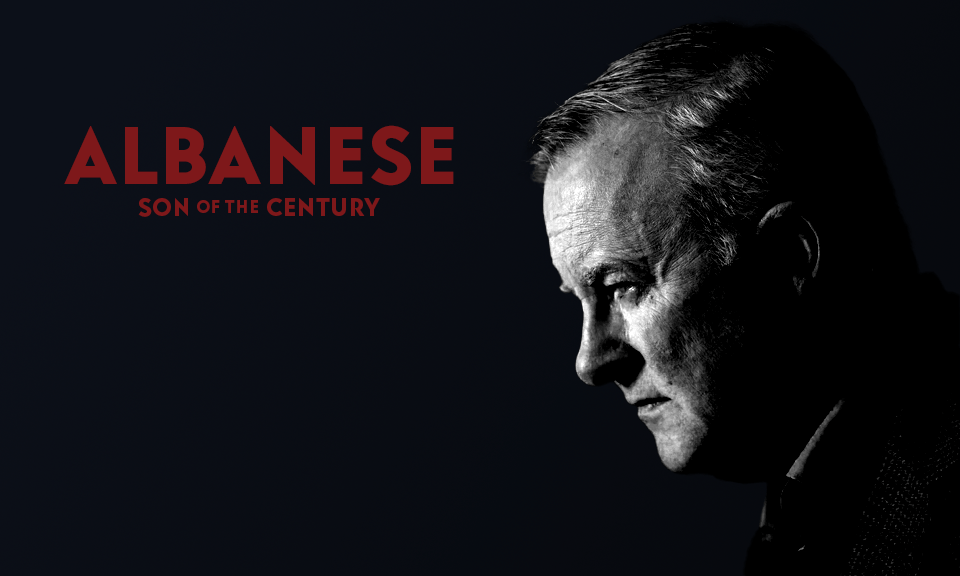
So, what is the Labor Party? It is Bonapartist, that is all it can be, and no one embodies that more than Anthony Albanese. Bonapartism may be expressed more or less clearly, from fascism to liberalism, but the ends are the same. The fleeting moment the Left failed to grasp has now fallen into Albanese’s hands. Will there be a future for socialism in Australia? That remains to be seen. But until then, if such a day may come, Anthony Albanese will be the undisputed Son of the Century.
Bibliography
Albanese, Anthony. 2025. “Press Conference – Canberra.” Prime Minister of Australia. May 5, 2025. https://www.pm.gov.au/media/press-conference-canberra-23.
Aly, Waleed, Scott Stephens, and Sinead Lee. 2025. “‘Progressive Patriotism’ — Is It an Idea Whose Time Has Come?” ABC Listen. May 27, 2025. https://www.abc.net.au/listen/programs/theminefield/progressive-patriotism-idea-whose-time-has-come/105304364.
Cutrone, Chris. 2025. “Bonapartism Is Not Bonaparte.” Platypus1917.org. 2025. https://platypus1917.org/2025/06/01/bonapartism-is-not-bonaparte/.
Godsell, Oscar. 2025. “‘Nobody Is above the Law’: Labor Reacts to Former Greens Candidate Injured in Protest.” Skynews.com.au. Sky News Australia. June 29, 2025. https://www.skynews.com.au/australia-news/politics/home-affairs-minister-tony-burke-warns-no-one-is-above-the-law-after-former-greens-candidate-injured-at-protest/news-story/4df679a89e30a66f421051e8cc9ca628.
Humphrys, Elizabeth. 2012. “Still Stuck in the 1980s? The Unions and the Accord.” An Integral State. October 14, 2012. https://anintegralstate.net/2012/10/14/still-stuck-in-the-1980s-the-unions-and-the-accord/.
Lenin, Vladimir, and Robert Service. 1992. The State and Revolution. London ; New York: Penguin.
Marx, Karl. 1852. “18th Brumaire of Louis Bonaparte.” Marxists.org. 1852. https://www.marxists.org/archive/marx/works/1852/18th-brumaire/ch01.htm.
———. 2010. “The Eighteenth Brumaire of Louis Bonaparte.” In Surveys from Exile. Verso.
Rundle, Guy. 2025. “Australia’s Right Tried to Copy Trump. It’s Been a Disaster.” Jacobin.com. 2025. https://jacobin.com/2025/04/australia-liberal-party-dutton-trump.
Switzer, Tom. 2023. “Liberalism Applied? Policy Shifts in the Transition from Chifley to Menzies.” The Centre for Independent Studies. November 16, 2023. https://www.cis.org.au/publication/liberalism-applied-policy-shifts-in-the-transition-from-chifley-to-menzies/.
Wong, Penny. 2025. “Speech Introducing Anthony Albanese: Federal Election 2025 Victory – Canterbury-Hurlstone Park RSL Club – 03/05/2025.” Pennywong.com.au. 2025. https://www.pennywong.com.au/media-hub/speeches/speech-introducing-anthony-albanese-federal-election-2025-victory-canterbury-hurlstone-park-rsl-club-03-05-2025/.
1 Wong, Penny. 2025. “Speech Introducing Anthony Albanese: Federal Election 2025 Victory – Canterbury-Hurlstone Park RSL Club – 03/05/2025.” Pennywong.com.au. 2025. https://www.pennywong.com.au/media-hub/speeches/speech-introducing-anthony-albanese-federal-election-2025-victory-canterbury-hurlstone-park-rsl-club-03-05-2025/.
2 Switzer, Tom. 2023. “Liberalism Applied? Policy Shifts in the Transition from Chifley to Menzies.” The Centre for Independent Studies. November 16, 2023. https://www.cis.org.au/publication/liberalism-applied-policy-shifts-in-the-transition-from-chifley-to-menzies/
3 Humphrys, Elizabeth. 2012. “Still Stuck in the 1980s? The Unions and the Accord.” An Integral State. October 14, 2012. https://anintegralstate.net/2012/10/14/still-stuck-in-the-1980s-the-unions-and-the-accord/.
4 Rundle, Guy. 2025. “Australia’s Right Tried to Copy Trump. It’s Been a Disaster.” Jacobin.com. 2025. https://jacobin.com/2025/04/australia-liberal-party-dutton-trump.
5 Albanese, Anthony. 2025. “Press Conference – Canberra.” Prime Minister of Australia. May 5, 2025. https://www.pm.gov.au/media/press-conference-canberra-23.
6 Lenin, Vladimir, and Robert Service. 1992. The State and Revolution. London ; New York: Penguin.
7 Marx, Karl. 2010. “The Eighteenth Brumaire of Louis Bonaparte.” In Surveys from Exile. Verso, p 235.
8 Marx, Karl. 1852. “18th Brumaire of Louis Bonaparte.” Marxists.org. 1852. https://www.marxists.org/archive/marx/works/1852/18th-brumaire/.
9 Godsell, Oscar. 2025. “‘Nobody Is above the Law’: Labor Reacts to Former Greens Candidate Injured in Protest.” Skynews.com.au. Sky News Australia. June 29, 2025. https://www.skynews.com.au/australia-news/politics/home-affairs-minister-tony-burke-warns-no-one-is-above-the-law-after-former-greens-candidate-injured-at-protest/news-story/4df679a89e30a66f421051e8cc9ca628.
10 Op cit. Marx. 2010. p 171.
11 Aly, Waleed, Scott Stephens, and Sinead Lee. 2025. “‘Progressive Patriotism’ — Is It an Idea Whose Time Has Come?” ABC Listen. May 27, 2025. https://www.abc.net.au/listen/programs/theminefield/progressive-patriotism-idea-whose-time-has-come/105304364.
12 Cutrone, Chris. 2025. “Bonapartism Is Not Bonaparte.” Platypus1917.org. 2025. https://platypus1917.org/2025/06/01/bonapartism-is-not-bonaparte/.

 PARTISAN!
You must be logged in to post a comment.