Communist caucus member and RCO comrade Alice reports on the 2025 Victorian Socialists member’s conference, and the caucus’s engagement within it.
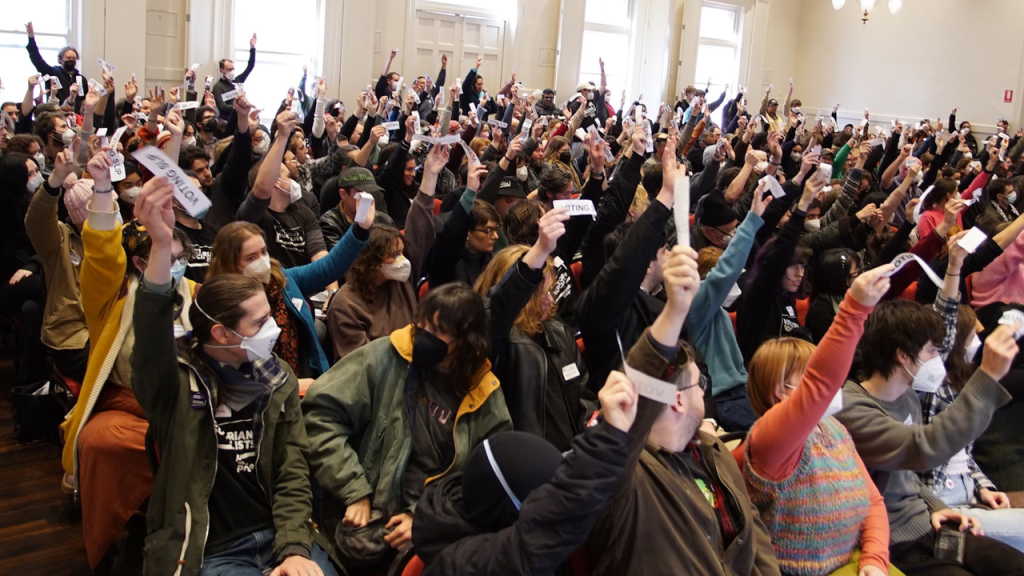
The 2025 Victorian Socialists (VS) Members’ Conference was held on the 14th and 15th of June, with a registered attendance of 430 members. This year’s conference was particularly significant as it followed the decision of the VS executive to expand the party nationally.
This was also the first VS Members’ Conference attended by the Communist Caucus, which was formally launched in May this year. The Communist Caucus’s initial draft points of unity were published in April, and included a call for the national expansion of VS. Whilst the caucus is critical of the undemocratic, closed-door nature of the decision to expand nationally before the Members’ Conference, we are eager to nurture the embryonic potential of VS, now The Socialists, to become a revolutionary mass party.
The caucus presented multiple constitutional and non-constitutional amendments, as well as independent motions across the two days of conference. Additionally, we ran a slate of candidates for all positions on the Executive Council, including officers and ordinary members. As anticipated, none of the Communist Caucus amendments or motions were passed, and none of our candidates were elected.
Nonetheless, the Communist Caucus’ experience of the 2025 VS Members’ Conference proved a successful opportunity for us to present our politics as a disciplined minority, and to measure their support amongst VS members.
June 14th
The first day of the conference kicked-off with an opening statement by Corey Oakley, secretary of VS. A sentiment which would be echoed by many speakers that weekend, Oakley described growing “distrust in politicians” and “disillusion with politics” amongst workers. He voiced concerns over this political instability lending itself to the emergence of the contemporary “far-right”, and disavowed current electoral alternatives to the status-quo as “no better than the ALP [Labor Party] or the LNP [Liberal-National Party]”. These comments were uplifted by a reflection on the successes of the Victorian Socialists in the recent federal election, and the massive influx of financial members outside of Victoria since expansion. Although The Socialists, and socialist politics more generally, remain a small minority, these successes inspire hope for the growth of a systematic alternative to capitalism: a socialist party alternative. The unasked question, it seems, is what kind of party do we need?
At the beginning of the first session, the caucus became aware that the amendments we proposed would be voted on bloc. Although each section was expressly marked as relating to separate components of the executive motion, they should have been submitted as separate motions with different movers and seconders. This posed a significant challenge to our ability to present a comprehensive case for all four of our amendments, including a complex, 5-part proposal for the convening of a national conference and establishment of a delegate system and branch structure.
The speaking order compounded these challenges. Speakers for and against each motion were preceded by thirty minutes of general discussion. This essentially functioned as time for speakers against the caucus’s motions to speak. Communist Caucus comrades were selected to speak during this time at best twice, and in some circumstances not at all. It should be noted that there was a time limit of three minutes per speaker, leaving the caucus with a maximum of six of the thirty minutes allocated to this general discussion. During formal debate, we aimed to present a disciplined argument for our proposals, in the face of myriad critiques, some of which appeared wilfully misinformed. This is not to say that all discussion was in bad faith, as parts of it prompted valuable debate on the political and strategic orientation of the VS. However, the structure of the speaking order left caucus members having to judiciously select the few words we had to present and clarify our proposals, and to not get dragged down by arguments in opposition which substituted politics for semantics.
After lunch, we reconvened to discuss VS’s strategic orientation and priorities for the 2026 Victorian State election. Whilst a significant portion of discussion seemed to reflect the caucus’s proposed amendments, they were nevertheless voted down. Many speakers spoke about the need to accompany electoral campaigning with non-electoral work to expand the mass base of the party, and establish VS as a force for socialist politics outside of election periods. Members spoke in favour of more work with unions, tenant groups, and the unemployed, as well as socialist intervention into political issues as they arise, such as the recent rally organised by VS Darebin in response to the rally by National Socialist Network members outside Northland Shopping Centre in Preston on June 1st.
Our amendments sought to clarify that whilst we maintain a firm support for socialist electoral strategy as a key priority of VS, this should not be the sole focus of the party. Explicitly including this on paper has consequences for the allocation of time and resources going forwards, and it is disheartening that despite a clear appetite for conducting both electoral and non-electoral work during the 2026 Victorian state election period, these amendments were shot down. Because the amendments were voted on in bloc, those which were explicitly related to our strategic orientation were in part overshadowed by a more controversial discussion of preference deals and the VS relationship to Socialist Alliance.
Here, the Communist Caucus put forth arguments against binding VS to preference deals and deferential positioning towards Socialist Alliance. The Communist Caucus amendment was represented as a blanket ban on preference deals, which is not the case. Current circumstances leave VS with little bargaining power in preference deals, as left-to-right preferencing (the principled approach promised by VS executive members) will take place irrespective of the specifics of any preference deal. In terms of the VS relationship with Socialist Alliance, caucus amendments which aimed to orient VS towards becoming a hegemonic, mass socialist party were construed as needlessly undiplomatic and aggressive. The non-confrontational approach put forward by the executive guarantees Socialist Alliance the uncontested opportunity to run candidates in elections, and support from VS in preferences and joint-campaign work. Yet binding the hands of VS electorally and securing the future of an otherwise moribund sect is unproductive, and in of itself antithetical to the establishment of a single socialist party.
An independent motion was brought forwards for discussion on day one to support the activity of the VS Socialist Workers caucus, whose primary focus is workplace and union organising. The motion was carried without dissent.
June 15th
Day two of the conference began with voting on a series of constitutional amendments relating to organisational structures, as well as candidate pre-selection. The debate centred around the executive’s proposal for a local coordinator system, and the branch structure approach presented by the Communist Caucus. Speakers against caucus amendments voiced lexical concerns surrounding the terms “immediately” (in reference to tasking the executive with the organisation of inaugural branch meetings), and the specific number of thirty members as the minimum amount required to establish a branch. Debate around the term “immediately” was also a sticking point of our amendment for the convening of a national conference and establishment of a delegate system.
The caucus made efforts to clarify that we were amenable to changing the semantic and logistic content of our proposal, so long as the underlying political and structural content was not compromised. Nevertheless, the amendments for a branch structure system failed, leaving VS with a local coordinator system which emboldens members of the executive to override democratic decisions on the pre-selection of candidates by members of local districts. One speaker in favour of this motion appealed to a “right to veto in case of emergency”. It is concerning to think that in the situation where a candidate who has been pre-selected by members of their district is performing in an unsatisfactory manner, they are not responsible to, and recallable by, the workers they are said to represent, but by members of the executive.
The treasurer then provided a report which was carried without dissent, and a “No Bosses” motion which precludes anyone who “extracts a profit from the exploitation of workers” or “[is] tasked with the hiring and firing of workers” from pre-selection as a candidate was passed. A motion on the establishment of a Policy Committee (whose members are appointed by the executive) was also passed, which although significantly lacking in transparency and democratic decision-making, was an improvement on the policy strategy of VS, as it allows members to submit draft policy proposals and inquiries for consideration.
Having learned from experience the day prior, we submitted a procedural motion to request our independent motions, which had also been submitted as one document, be voted on separately for day two of the conference. This motion failed, although some non-Communist Caucus members were sympathetic to our assertion that the motion contained a highly varied collection of proposals which would have differing levels of support from conference attendees. The argument made by Oakley was that the Communist Caucus independent motions collectively represented a complete overturning of the strategic and political orientation of VS as it stood, consequently, should be voted on as one motion.
Arguments against the caucus motion largely revolved around the idea that socialists should “meet the workers where they’re at”, and a refusal to engage in political debate around the implementation of a minimum-maximum program, beyond dismissing it as irrelevant or too confusing and inaccessible for the average worker. Speakers against did not address the actual political content of the draft program, nor the aspiration to transform VS into a hegemonic, revolutionary mass party.
A motion titled “To Affirm Victorian Socialist’s position against Imperialism and Militarism” was preceded by a procedural motion for an additional fifteen minutes of general discussion prior to formal debate. It was surprising that such a procedural motion could be put forward, considering the page outlining conference procedures on the VS website did not outline the 30 minutes of general discussion prior to formal debate, let alone the capacity to request additional time for general discussion. Caucus comrades refrained from participating in the discussion on this motion as we anticipated it as being largely unproductive. Interestingly, the Revolutionary Communist Organisation (RCO) was specifically named at one point, denounced as Stalinists whose politics are incompatible with Victorian Socialists! A later statement made by Mick Armstrong essentially conveyed an Ecumenical socialist position; arguing that we may have disagreement on questions including, for example, whether China is a socialist state, but that a position can be democratically decided, and as long as democratic decision is accepted, difference in opinion should not preclude VS membership.
The final session began with a communications report which detailed the successes of the 2025 Australian federal election, highlighting Pingers4Parliament as a key aspect of the media strategy. The desire to reach young people through social media and short-form content was emphasised, and receiving attention from the mainstream media was discussed as a challenge which could be overcome by continuing to put forward attention-grabbing and entertaining young people like van den Lamb. This report presented the success of VS as bolstered by a media and communications strategy that is “readily comprehensible, but also relatable and appealing.” Parts of the report were squarely aimed at distinguishing the approach of the executive from that of the CC, in preparation for the elections later that day. It was argued that communists are not “operating on a modern basis” and that an explicitly communist program would be dismissed by workers. The caucus is under no illusion that we are in a period of revolutionary activity, or that class consciousness is not at an historic low, but we disdain to conceal our views and aims.
Caucus members running for office positions made clear that we were contesting the elections on a political basis. Candidates for Ordinary Member of the Executive Council did not have an opportunity to speak. As anticipated, no members of the Communist Caucus were elected. Olga K., our number one candidate for the Executive Council, received 5.7% of the vote; just over half of the 10% needed to be elected. A slate was put together by Socialist Alternative, containing nine Socialist Alternative members, a member of the Socialist Workers’ Caucus, and independents Daniel Lopez and Jordan Van Den Lamb. This slate was followed exactly by approximately 60% of voters.
The 2025 VS Members’ Conference was an exciting chance for the Communist Caucus to test our politics and make the case for an unapologetically communist orientation. We are keen to continue working as a disciplined and principled minority, and if you’re involved in The Socialists, you’ll be seeing us at conference next year, and involved in local VS organising in the meantime!
Join the Communist Caucus here. Membership is only open to current The Socialists members (Victorian Socialists, NSW Socialists, SA Socialists, WA Socialists & QLD Socialists).
 PARTISAN!
You must be logged in to post a comment.