May saw the shocking murder of two Aboriginal men in the Northern Territory. This has led to a cyclical outpouring of grief from Indigenous peoples in Australia, who are the targets of killer, racist police. Sylvia Ruhl writes.
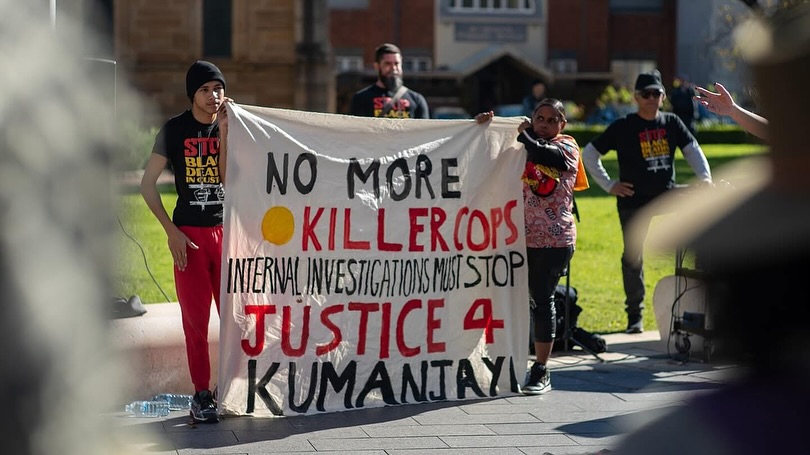
Two separate Indigenous deaths in custody took place in the Northern Territory within days of each other in late May. This has brought the yearly total of Indigenous deaths in custody up to 13 since the beginning of 2025. In total, there have been 598 deaths since the Royal Commission into Aboriginal Deaths in Custody concluded in 1991. If reforms enacting additional oversight and consulting were able to end this national disgrace, they would have at least begun to show progress long before now. The killing has not ceased, and high politics always appears confused and lacking in direction whenever news of another death in custody emerges.
This was clearly the case following the death in custody of disabled, Warlpiri man Kumanjayi White on the 27th of May. The Northern Territory government and police have both repeatedly ruled out allowing the automatic inquest into his death be handled by an interstate third-party, which is instead to automatically be entrusted to the NT police. There is, of course, no clear means by which an independent investigation can be enforced, as the federal government has not stepped in to do so. Regardless, the simple fact that there is uncertainty in whether the inquest will be directed by an independent body should highlight quite clearly the unreliability of the bourgeois class in granting redress for their own crimes. We cannot rely on a bureaucratic solution to end deaths in custody.
Worse still, the small-capitalist, right-wing of capital regularly agitates for the state to take more punitive measures in response to anti-social tendencies stemming from recurring social crises in impoverished Aboriginal communities. These crises are the result of racism, displacement, and the physical and cultural genocide of Indigenous peoples dating back to 1788. The ongoing anti-youth reaction in Australia, masked as being “tough on crime”, is largely the result of this social crisis unleashed on Indigenous peoples, worsened now by the cost-of-living crisis. The Crisafulli LNP state government in Queensland was brought to power on the back of this anti-youth wave. Despite previously seeming to emphasise their focus on home invasions and shopfront vandalism, the government has indicated a willingness to re-criminalise public drunkenness and public urination. The government seems to be testing the waters by claiming that residents from across the state have asked for the laws to be reinstated, with Townsville MP Adam Baillie (LNP) claiming that decriminalisation of these acts is “significantly impacting livability in our beautiful part of the world.”
Clearly, this campaign is not primarily concerned with the safety of the masses, but merely with improving the aesthetic appeal of regional commercial centres and main streets. It is disinterested in the crises of poverty and trauma that afflict Indigenous communities and the working class, beyond its most obvious symptoms that periodically erupt into the lives and profits of the regional small business-owner class. The small capitalists think these actions, including public drunkenness and urination, are done by a minority of individuals who are inherently “bad”, and therefore can only be dealt with through the iron hand of the law. Removing someone and placing them in police custody is desirable as it makes the “problem” invisible, in spite of the well-known risks to life police custody entails.
Yet, the Indigenous working-class continues to feel the pain of every death. The small number of socialists in Australia that side with the rural bourgeoisie by condoning “tough-on-crime” politics should be made aware that they are entrenching a bloodied, racial divide within the working-class that makes unity impossible as long as it remains ignored (see: Eureka Initiative, Eureka Collective, others).
Socialists more broadly, however, denounce the recurring deaths in custody crisis for what it is: part of an ongoing genocide against Indigenous peoples. We recognise capitalism in Australia as being built on the genocide of Indigenous peoples, and that the present situation in Aboriginal communities of constant social crises; generational poverty, the health outcomes gap, over-policing, over-incarceration, the cycles of violence, is the logical outcome of this world-historic destruction. Whilst liberal progressives may push for the full implementation of the recommendations of the Royal Commission into Aboriginal Deaths in Custody, the reforms proposed do not threaten to overturn the capitalist system that causes this crisis in the first place. Socialists must go beyond this, but we ourselves remain bleary as to what demands we need to put forward. Our demands need to be centred on heightening the Indigenous struggle, in delivering real sovereignty and an end to Indigenous oppression, which can only be done through redistributions enabled by the active dismantlement of capitalism and the realisation of socialism.
Socialists must demand the prosecution of killer cops, and that the entire police force be disarmed and disbanded. In recognising that the crises affecting Indigenous communities are a large part of the material basis for their over-criminalisation, we must demand a Treaty enshrining cultural, linguistic and land rights, and for reparations to be paid through increases in the living conditions and social services. Indigenous-run health clinics, schools and social centres must be expanded. We must demand Indigenous control over Indigenous affairs, and we must openly call for a policy against Australian chauvinism and patriotism. It is only through combatting this material basis that this genocide can end, and that we can collectively move forward towards a single, global brotherhood.
 PARTISAN!
You must be logged in to post a comment.