Siggle-Corp, Online
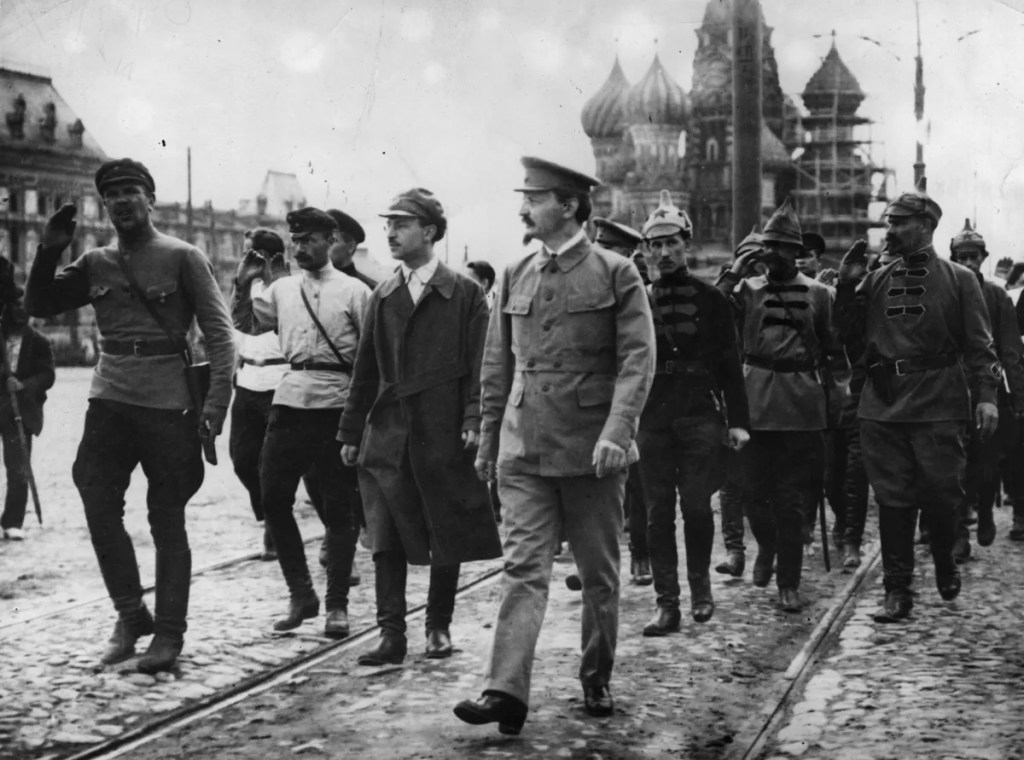
While there are extreme ideological differences between the swamp of anarchists and the sects of Stalinism, they remain firmly united in their undying hate for Leon Trotsky and his theories, especially that of permanent revolution, which they attack with a seething concoction of caricature, hysteria and historical falsification.
The anarchists hate Trotsky, the authoritarian imperialist who crushed Kronstadt, the Green Armies, and the Makhnovshchina; Trotsky was a traitor to the revolution.
The Stalinists hate Trotsky, the petty-bourgeois Menshevik saboteur who conspired with the fascists to undermine Stalin, an opportunist despised even by Lenin himself; Trotsky was a traitor to the revolution.
Both of these views diverge in critique, although the anarchist view is more true to reality as Trotsky was the head of the military organisation which fought against all sorts of anarchist-peasant uprisings during the civil war. However, there is no historical evidence that Trotsky worked with fascists to undermine Stalin beyond the works of Grover Fur, who famously states, “the lack of evidence is evidence.” Similarly, there exists no evidence of the alleged rivalry between Trotsky and Lenin. Would you appoint your arch-nemesis as commissar of war? In contrast, Lenin repeatedly said in speeches that there was “no better Bolshevik” than Trotsky. Most of these lies come from Stalin’s revision of history in order to reduce the role of Trotsky in the October Revolution and to elevate his own. But something both sides take from his school of falsification is the distorted view of permanent revolution.
Both will often say something along the lines of permanent revolution being permanent war against all capitalist nations, even to the point of land invasions and installing socialism from above. This often leads to claims of Trotsky and his ism being expansionist and imperialist. It’s worth noting that Trotsky never said this. Permanent revolution was not a policy of expansionism; it is a theory of revolutionary strategy in conditions of combined and uneven development. Trotsky argued that in countries with delayed capitalist development, the national bourgeoisie was too weak and dependent on imperialism to lead a democratic revolution. This task then must fall to the burgeoning proletariat. But the working class, in leading the democratic revolution, cannot simply stop its movement, as the very act of fulfilling the task of the bourgeoisie under proletarian leadership negates their historical role. The revolution must unfold into socialism. This is not a matter of will but of necessity; the dialectic of history compels the democratic beyond its limits. The revolution becomes permanent: an ongoing process that refuses to stagnate.
In line with this theory, Trotsky correctly states that socialism could not be built in a single country. Capitalism is and always has been a global system. Any socialist revolution confined within national borders is doomed to face external imperialist threats and internal dangers of isolation, degeneration, and eventual reintegration into capitalism. While the revolution may begin in a single country, its survival depends on the extension of the struggle beyond national borders. This is no call for military conquest but for internationalism. This is in opposition to Stalin and Bukharin, who posited that socialism could actually be realised within the borders of a single nation-state regardless of the state of the socialist movement internationally. They also promoted the idea of a two-stage revolution in colonial and backward countries, where the first stage would be a democratic revolution led by the bourgeoisie, much like that of France, and the second being the socialist revolution. History has shown us this is a doomed road.
While there now exist no countries with delayed capitalist development, many communists such as in the Communist Party of Australia (CPA) or CPA-ML still posit the two-stage revolution, promoting a “government of peoples unity” made up of representatives from “progressive, democratic and patriotic forces.” It should not need to be stated that this idea is ridiculous in a country like Australia where capitalism is fully developed, and that an alliance with “patriotic” forces would only lead to them betraying us and us betraying communism. It is worrying that in a world where capitalism has been in its global imperialist stage for over a century and become ever more moribund and decayed, so many communists wish to realise a nicer version of capitalism before fighting for socialism out of some vague notion of realpolitik or pragmatism.
It is worth noting the hypocrisy of many Stalinists who attack Trotsky on the basis he wished to invade other countries and impose socialism yet uphold Stalin, who did this very thing! It seems that all Stalin did was fulfill the program of the Trotskyites without the Trotskyites.
There are plenty of critiques against Trotskyism; this is not one of them. The theory of permanent revolution does not call for military conquest, but for the recognition that in the epoch of imperialism, the struggle for democracy, national liberation, and socialism are inseparable and only the working class can carry it through to the end.
 PARTISAN!
You must be logged in to post a comment.