Labor won an unexpected landslide victory during the May 3rd Federal election. Despite this, Labor doesn’t quite have the “mandate” it claims to have, and this victory has done little to suppress the mounting tensions both within the Labor Party and the labor movement overall. Claire S writes on the Labor victory and prospects for militant organising in the unions.
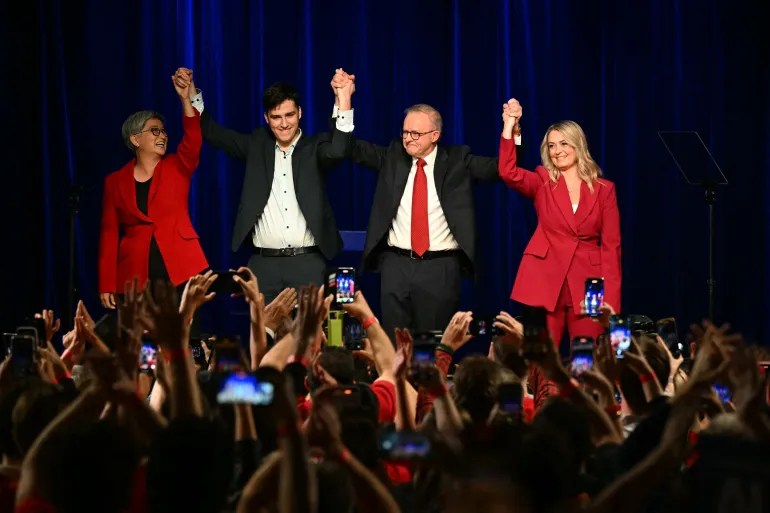
During the May 3rd Federal election, the Australian Labor Party (ALP) won an unexpected and historic landslide victory against the Coalition. Following this, the Liberal-National Coalition (LNP) has been relegated to largely rural seats, and the Nationals seem poised to overtake an ever more conservative-trending Liberal Party as the leaders of the Coalition.
Expecting only a narrow majority at best or a minority government at worst, the broad liberal-progressive milieu in Australia was elated at the success of Labor in the election. Now, says the petit-bourgeois progressive, now the ALP have been granted the full mandate of the Australian population. They may now push through a swathe of “progressive legislation” they have had to keep hidden.
These liberal-progressive types like to forget Labor’s poor history of “progressivism,” especially in the realm of industrial relations (wage suppression through the Prices and Income Accords, their iron-fisted judiciary absolutism in the face of blatantly illegal union-busting by Patrick Stevedores in 1998, and so on). This delusion stems from the fact these petit-bourgeois progressives are just that; petit-bourgeois, or, more simply, not the usual subjects of Labor’s committed managerialism and quest for total union corporatism.
These progressive types, whether they be members of Labor, the Greens, or even some lonely rank-and-file Teal voters (presumably the ones that are smart enough to know the word “bureaucracy” does not mean “a room with more than ten people in it”) seem to truly believe that the ALP has had its hands tied, and now the gloves are coming off. What this fabled progressive legislation actually entails remains to be seen. What is rather easy to see, however, is that there is a growing fissure between the ALP and its more assertive union donors and unionised supporters, and this fissure is growing wider and more intense with recent escalations that are likely to continue with the ALP’s landslide election victory.
Labor’s strategy of passive appeal to state power and the law to keep the unions in line while maintaining their mutual relationship has been thrown to the wayside, and now (not in quite the same way) the gloves are really coming off. While its true the ALP is definitely going somewhere, perhaps even somewhere new, that place is not the iron-clad worker’s utopia the malaise of petit-bourgeois careerists and loyalist Labor Left tome-thumpers seem to want to assure us of.
The calcified bureaucracy of the ALP has lashed out with increasing hostility at the union movement, which the ALP has courted for political donations and legitimacy since its founding. The right-most sectors of the party seem eager to poison the roots that bind the unions’ mutual ties to the ALP, and the ALP’s own arbitration regime enforced by the Fair Work Commission (FWC) and the Australian Council of Trade Unions (ACTU). In contrast, they have made extraordinary efforts to expand the security apparatus of the state and to strengthen Australia’s status as an eager participant in US-aligned imperialist projects.
The NSW Labor Government under Premier Chris Minns—a devout catholic and a member of Labor’s Right faction—has repeatedly refused to negotiate with representatives from the Rail, Bus and Tram Union (RBTU) and the Australian Salaried Medical Officers’ Federation (ASMOF). Opting not to show up to scheduled negotiations in order to drag any finalisation of already pitiful enterprise agreements through the mud for as long as possible, telling outright lies to the media, and—in the case of ASMOF—has been complicit in intimidation of unionised doctors and nurses by security officers at public hospitals harassing staff under threats of removal from hospital grounds if they fail to remove union pins, posters, and other union symbolism.
The Minns government, of course, had their excuses for their anti-union crusade. Slinging everything from tried-and-true neoliberal budget-hawking; claiming a pay rise for both the RBTU and ASMOF workers in line with inflation would “bankrupt” the entire state, to Minns’ commitment to “not bow to unions”. However, Minns was more than happy to discard his pious commitment to the sanctity of a budget surplus to grant the notoriously corrupt NSW Police Force a 39% pay rise over the next four years without so much as verbal pushback.
On the federal level, Labor has taken similar steps to curtail working class power, most notably by pushing through ‘emergency’ legislation in lockstep with the LNP in order to unilaterally place the CFMEU into administration and sidestep any existing legal processes, which the ALP claimed would take “too long” to resolve. Not only that, the ALP has turned its vigour toward aiding and abetting Israel’s genocidal war in Gaza, ensuring the strength of the AUKUS deal by making closed-door assurances to the US and UK, paying lip service to the Queensland LNP’s inquisition against trans care for juveniles, and granting ASIO the status of an independent agency by decoupling it from the Department of Home Affairs (and whatever paper-thin institutional oversight that may have come with it) and placing it alongside the Federal Police under the sole oversight of the Attorney General’s office.
Outside of the heights of state and federal politics, the friction between the ALP, the national union bureaucracy of the ACTU, and the more militant sections of the union movement can be seen even in the most immediate spheres of politics. On May 1st, in front of NSW Parliament in Sydney, sacked CFMEU delegate Dennis McNamara delivered a fiery speech; decrying war, imperialism, and the attacks against the CFMEU by the ALP (primarily on the basis of administration being an attack on the rank-and-file, instead of falling back on defending CFMEU secretaries who have now pled guilty to corruption charges, which was a breath of fresh air). McNamara called for global working class solidarity, political independence from the ACTU and FWC, unity in the face of incoming “fascist attacks,” and solidarity with the Palestinian struggle.
McNamara’s speech attracted widespread applause from the crowd, which contrasted massively with the speaker who came to the stage immediately after; Vanessa Seagrove. Seagrove, who is the Assistant Secretary of Unions NSW and a member of Labor Left, ran blatant apologia for Labor; finger-wagging in the rain to the now silent crowd that while “Labor might be doing things you may not like” the ALP is still “a party for the working class”. Instead of lambasting the ALP for their attacks on workers (which Seagrove would like you to think of as “things you may not like”) the focus of the short speech fell to on Labor’s ‘Same Job, Same Wage’ amendments to the Fair Work Act; the very same act that cemented the modern ACTU-FWC arbitration framework, and the same act the ALP amended in order to force the CFMEU into administration.
Before the next speaker stepped up (Secretary of the Maritime Union of Australia (MUA), Paul Keating)—who in stark contrast to Seagrove called for the outright abolition of the Fair Work Act, and an end to the oppressive arbitration arrangement unions are welded to—the MC made sure to announce to the crowd that “Vanessa [Seagrove] supports the workers’ struggle,” as if Seagrove herself had not demonstrated the opposite quite openly.
The contrast between each speakers’ rhetoric and loyalties is a microcosm of modern Laborism; the internal factions within the ALP itself are presently incapable or uninterested in mending the fissures between large sections of their union support base and the party itself. With the right wing of Labor moving toward a policy of outwardly undermining already heavily diminished union power and legitimacy, and Labor Left (which the CFMEU has traditionally been firmly aligned with) offering nothing more than deflection and lectures to the union rank-and-file, it is clear not only that the current state of affairs cannot continue forever, but that Labor is, if anything, trending away from any sort of “liberal-progressive” platform or full reconciliation with their militant union base.
What should communists do if the militant unions—whether it be their rank-and-file or sections of the union bureaucracy—politically separate themselves from the ALP? Are Labor internally committed to risking such a political upset? If the current tensions continue to escalate, what should we do in the extraordinary event that sections of the union movement not only politically split from the ALP, but also seek to truly decouple themselves from the ACTU? What would it look like? Is it even remotely possible? While the desire within the workers’ movement for a political divorce with Labor alongside the abolition of the FWA is palpable, we must be careful not to fall into promoting a split between the ACTU and their constituent unions.
This is not to say the ACTU presently acts for the furtherance of working class political power, but the cleavage of a centralised union movement into a myriad of squabbling industry interests groups without any overarching organisational infrastructure to coordinate joint action will most certainly greatly weaken the working class in the long run. All active attempts to split the union movement between the most militant unions and the rest are to be avoided at all costs. Agitation within unions controlled by a politically backward union bureaucracy is just as important as action alongside the most politically advanced members of the proletariat.
With the unity of the workers’ movement in mind, we must face the unfortunate reality that—while these tensions represent great potential for working class political independence—if this cleavage between Labor and the conscious worker occurs in the immediate future, communists will not have the strength or cohesion necessary to be able to make any sort of successful intervention at a desirable scale into the unions where the conscious worker at large resides and organises. While the sects remain divided, and act only on their most primal reflexes of appealing to mass political spontaneity, the present moment will be relegated to a historical status of periodic remembrance in the sect papers, who will write for years to come about the “lessons learned” from the “great union split from Labor”. We have time for now, we best make as much use of it as we possibly can to re-consolidate the infrastructure for a united communist movement.
 PARTISAN!
You must be logged in to post a comment.