Billed as the biggest conference of anticapitalist ideas in Australia, Socialist Alternative’s Marxism 2025 brings hundreds of people together to discuss Socialist Alternative’s conception of socialism and Marxism. Porco reports on their experience attending the conference, and how it demonstrates major flaws in Socialist Alternative’s “megachurch socialism”.
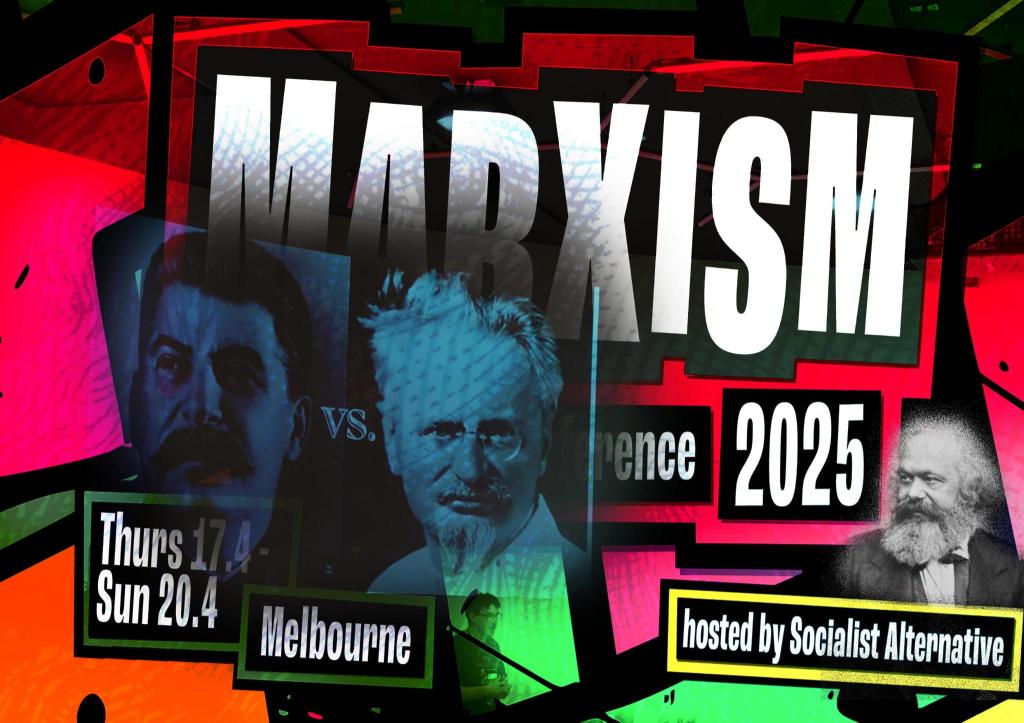
Socialist Alternative’s MARXISM 2025 is advertised as “the biggest socialist conference in Australia”. It was an endearing spectacle to see more than five hundred people who identify with the idea of “revolutionary socialism” sharing meals, discussing politics over coffee, going on adventures into Melbourne’s CBD and traveling around the country for this event.
There was an admirable level of organisation, and tight scheduling surrounding the event. SAlt has been doing this for years now. They run a tight ship. The sessions were always on time, and I never noticed massive technical issues. The conference ran as smoothly as you could want it to.
But engaging with a conference about socialism requires engaging with its content. For the sessions I attended, the content was disappointing. I have not engaged with Socialist Alternative for almost seven years. Returning to their forum-style of political education this year did not leave me with any sense their political style had developed much. At least, it hadn’t on the beginner sessions I attended. I didn’t attend “higher” level discussions, partially because I needed to get a sense of the historiography Socialist Alternative presents to newcomers. An organisation can be judged on how it treats its new recruits. So I attended the selection of classes entitled “Marxism and the Party”.
In the first session, “Marx and the working class party”, we were bombarded primarily with the idea that “Marx was not an intellectual! He was a revolutionary”. This is a strange conception of Marx, given that he was very clear that revolutionary theory, published for the consumption of the masses, was an inherently revolutionary act.
This rejection of “being a mere theorist” is in line with the long history of anti-intellectualism within the Cliffite tradition (Tony Cliff used to implore SWP members to intentionally fail their university degrees). If Marx was just an intellectual, regardless of the nature of his revolutionary theory, he would have to be condemned like all the passive “theorists” and “armchair activists” that Socialist Alternative members often feel the need to decry.
It was not worth mentioning in this talk that Bakunin often goaded Marx for this very reason. Bakunin would not let Marx forget that he did not fight on the barricades in 1848 when they worked together in the International Workingmen’s Association.
The second session I attended was “Lenin and the vanguard party”. This session’s main focus was the idea that the Bolsheviks were a tiny organisation, and had only Lenin’s prophetic understanding of the nature of revolutionary vanguardism to persist through decades of repression and struggle. While it is true that Lenin and the Bolsheviks were ruthlessly repressed in Russia (Lenin being forced to flee and remain in exile), this framing was clearly meant to draw a parallel between the Bolsheviks and Socialist Alternative.
Lenin consistently argued that the Bolsheviks were a revolutionary faction of the RSDLP. Even in 1917 the Bolsheviks welcomed a Menshevik Internationalist, Iurii Larinm to the 6th Party Congress. Bukharin said of Larin after finishing his speech:
“I greet with special warmth his declaration about the necessity of a break with the defencists, that ulcer that is eating into not only the party, but all the democratic forces of the country. In order to combat this ulcer, it is necessary to unite all social democrat internationalists. In this hall there is not a single individual that does not feel the necessity of uniting all the living forces of social democracy.”
The narrative that Lenin came from somehow outside of the socialist movement to rid it of reformists and opportunists was clear in this session. It seemed to rub against the fact that we had another session later where we discussed the Victorian Socialists, a “socialist party” with a reformist platform less radical than that of the SPD in the 1900s.
These contradictions and historical inadequacies were never acknowledged publicly, and in private would either be totally ignored or explained as “simplifying for the audience”. Socialist Alternative presenters and leadership don’t hold the general attendance of their conference in high regard. This is unfortunate since most of the attendance is the membership of the organisation.
An organisation that views its members as ignoramuses who must prove themselves in organising and theoretical discourse does not bode well for an organisation planning to rebuild a mass workers party. The last session I attended on this topic was “Luxembourg: a libertarian alternative to Lenin?”. The presenter recounted a fairytale, where Rosa and Lenin, despite having some disagreements, were basically the same kind of revolutionaries as Socialist Alternative members, with Rosa being a little too spontaneous for her own good. Her gruesome death was totally minimised, and her critique of reformism was conveyed as a transhistorical critique, an almost spiritual conflict between the salvation of revolutionary politics and the metaphysical sin of reformism.
It was not mentioned that Luxembourg lived in a context where the SPD actually controlled a plurality of the seats in the Reichstag. While anti-capitalist reformism is still a naive delusion of many Social Democrats and left Liberals, the critique Luxembourg and Lenin were making in 1914 was far more concrete than our critique today. It was a critique of a socialist movement that had millions of members across multiple countries in Europe, and where the European powers were gearing up for what would become the first world war.
I was disappointed in the discussion that took place, so I decided to speak to the presenter afterwards. I pointed out that millions of people were socialists in the early 20th century, that these factions were much larger than we like to admit, and that Luxembourg and Lenin understood themselves not to be separate from social democracy but rather the truest representatives of that political tradition.
I was told by an older SAlt member something to the effect of “when you only have 30 minutes to present, and your audience is not very knowledgeable, you have to make difficult choices about what you dwell on.” I thought this was a nicer way of saying “our audience won’t care whether we tell them the truth or not.”
My criticisms of these sessions are not just issues with the way Socialist Alternative understands the history of socialism. We all have our own conceptions of what happened, what went wrong, what did and didn’t work. My issue is that when these narratives are taken together, they create an eschatological story that places Socialist Alternative at the centre of a world historical battle for socialism.
Socialism is equated with human dignity, the abolition of all alienation and suffering, and a heavenly future world where no one ever needs to want. And SAlt will be the cadre that is ready to receive the Australian workers when their confidence has developed and they are in the midst of a revolutionary upsurge.
This is not scientific socialism, though the phrase was used once or twice in the conference. This is megachurch socialism. It is a cute activity for a certain kind of first year university student, and a practice in being a propagandist for the more long-term organisers. If you speak to some of the leadership of SAlt, they will concede that this conference, and SAlt as an organisation, is not the revolutionary party, nor is it the ideal organisational form. So why does that come across so strongly during the sessions?
Coming into the opening night, I had no idea what we were about to witness in the cinema downstairs. I sat down and had to explain “partyism” to two SAlt people who were trying to recruit me. Suddenly the lights dimmed. We all quietened down. A movie came on the big screen that showed Donald Trump, Elon Musk, and some other archons of that decrepit imperialist state known as the USA.
Albanese and Dutton were also beamed into the brains of everyone in attendance. As this began, people started booing, hooting, declaring “shame” and sighing and huffing. I was surprised by the collective grief session we all were participating in. Interspersed between the decaying masks of the capitalist world order were videos of migrants in cages, buildings bombed in Gaza, and fascists riots. The world was ending and we would condemn it for it’s inadequacy.
But then the screen cut to black. The word “RESISTANCE” appeared. Videos of pro-Palestine protesters amd speeches by Socialist Alternative members intercut between video of massive rallies in the US, Europe, the Middle East and everywhere else came through at a dizzying pace. People began to cheer. If I was being honest, I picked the vibe of the entire conference from that moment. We were here to consume socialism. Not build it. That would have to be left to the workers councils at an undetermined moment in the future.
MARXISM 2025 suffers from a trap all too common in the modern capitalist economy. Socialist Alternative has successfully marketed a commodity that is easily digestible and non-invasive, while being mildly entertaining and informative. It is a Marxism that has learned all the right lessons from modern mass media, marketing, televangelism and social media trends. And of course, this kind of megachurch socialism needs its original sin.
The last session I attended was called “Stalinism and its impact”. Stalin is of course the great villain of Trotskyism, so it felt necessary to see how a Trotskyist sect understood this villain in 2025. Basically, Stalinism was reduced to two aspects; the rank and file Bolsheviks and radical working class who could’ve stopped Stalin died in the civil war.
Secondly, the professionals, the military establishment, the terrible middle class, were waiting for the chance to become Bolshevik apparatchiks and take over the USSR. Stalin allowed this to happen because he was a cynical authoritarian who wanted to consolidate power. It was not mentioned that he had been organising in the RSDLP for most of his entire adult life.
A phenomenal slide was used at one point that made me think of the narrative presented in Orwell’s Nineteen Eighty-Four: where mytho-historic narratives are weaponised by a cynical state to win over the support of the people it rules (Big Brother vs Emmanuel Goldstein). However, Socialist Alternative is no Big Brother. They instead present themselves as a kind of Goldsteinist insurgency.
I have heard the many smears and slanders of Socialist Alternative. I heard them from two frustrated students who I interacted with in a totally unpolitical context during the week I was in Melbourne. But I don’t agree with most of the hysteria around Socialist Alternative. They are not a cult. They are far less interesting. They are an organisation that has admirably marketed socialism through a period in Australia when the concept was quite difficult to maintain an audience for. But at what cost? This period is ending and Socialist Alternative are clearly thinking about new ways to expand their political strategy. I think Victorian Socialists is a great development.
But if socialists in Australia ever want to have broad appeal, they will need to learn to work together. Factions are not parties, intellectuals are not evil. Reformists will exist in any mass workers organisation and must be combated through debate and democracy. They must be fought with politics, not through dogmatic lectures on the psychic danger of thinking reformist thoughts.
I left the conference feeling disappointed. I didn’t really learn anything except that there are a lot of university students that lap this stuff up. The RCO’s “Marxism Fringe” was the next day, and it felt like a small development to the institution of the MARXISM conference, by hosting a dissenting conference after Socialist Alternative’s megachurch socialism.
I hope that we can develop a productive discourse with SAlt members who are willing to attend. The RCO wants to work with Socialist Alternative. We do not see them as enemies. But they are nevertheless a sect which portrays themselves as the beginnings of a party. The RCO views a much broader base as the beginnings of the party.
The socialist movement as a whole, Stalinists and Third Worldists, Trotskyists and Left-communists are welcomed given they accept a democratic structure and minimum/maximum program. We are not scared of thought taboos – we believe they must be engaged with in open debate to be understood and moved beyond. We cannot wait for the workers to rise up. If we are fragmented when they do, we will just be swept along in a tailist fantasy of spontaneity and revolutionary putsch attempts.
The party is our task as revolutionaries. Let us not forget that.


 PARTISAN!
You must be logged in to post a comment.