Criticism and counter-criticism is dime a dozen in the communist movement. But, Anthony Furia writes, it is a necessary step toward building a principled communist organisation capable of leading the workers movement to power.
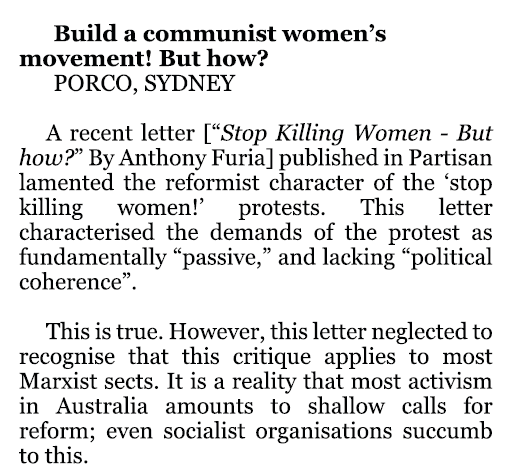
Recently, a letter was published as a response to my own on the ‘stop killing women’ rallies (LETTER: Let’s build a women’s movement! But how?). Composed by comrade Porco, this article highlights disagreements with several aspects of my own short letter, some of which I believe are highly constructive; and others which represent serious political errors. I will keep this response-to-a-response brief, although I believe some of the issues raised by Porco are in fact due to the brevity of my initial letter, so here I will attempt to be more thorough in my approach. It should also be noted here that comrade Porco and I attended different rallies, in different cities, and thus likely came away with different political experiences altogether. Perhaps the lack of a cohered national messaging or political project of such protests is itself a point of critique.
To turn comrade Porco’s reply on its head, and address the final substantial arguments first, I agree with the assessment that the political content1 of spontaneous movements or struggles is in fact a damning indictment of the sect model and the failure of communists to present a structural, total political alternative in the form of a communist party. This is an indisputable fact; it is a significant aspect of the necessity for the construction of such a party, and the unification of the socialist movement behind it. The communist movement has failed, currently lies fractured and disparate, and our job is to change this.
To acknowledge this, however, is not to accept the notion that “these articles [referring to both my letter and comrade Edith’s article on the need for a communist women’s movement] are for a later date”. Here we approach the second element of comrade Porco’s critique; that the critical evaluation of these spontaneous struggles proffered by letters such as mine is ‘finger wagging.’ That putting forward the necessity of a communist movement for these struggles, as is done in articles such as comrade Edith’s, is ‘shouting from the rafters.’
I will not step through, moment for moment, comrade Porco’s article. I recommend comrades read it in full, if they have not already. Finger wagging, according to comrade Porco, is “belittling and self-congratulatory” when conducted without the already established importance and involvement of communists in other political tendencies (those subjects of critique). Without pre-existing discussion between the RCO and “grassroots feminist organisations,” such finger-wagging is allegedly politically pointless and unproductive. This extends to ‘shouting from the rafters’, that is, positing alternative organisational forms with regards to struggles, which is, according to comrade Porco, meaningless when confronted with the reality of socialist disorganisation and fragmentation.
What the article thus seems to suggest with regards to the ‘stop killing women’ protests and the red heart campaign behind them, is that communists should withhold their critique of such forms until they represent a serious, cohered alternative to them. That, until the formation of a communist party (or to be more sympathetic, a formidable, militant, pre-party organisation), communists should not critique the apolitical, sometimes downright reactionary, demands and politics of such movements. Through holding our collective tongue, through concealing our differences so as to not stifle these seeds of struggle, communists can engage with such struggles, and with the organisations leading them, more effectively.
There are a few problems with such an argument. Somewhat alarmingly, the central thrust of my (perhaps too brief) letter was that, when practical political demands were raised by this ‘movement’, at the very least its manifestation in Melbourne, these demands were in the main manifestly right-wing. They centred punitive measures such as incarceration, harsher centering, and greater surveillance. These are not demands that are in any capacity conducive to women’s liberation, nor are they demands of communists. Are we to ignore this until the emergence of a communist party? Until the ‘masses’ are provided a viable alternative? Surely not. Putting this aside for a moment, we can move to a grander issue with the argument presented; that is, the diminishing representation of criticism of a non-communist organisation as ‘finger wagging’ only suited to existing engagement with political tendencies or movements. This only partially portrays the practical political benefits of mounting such a critique.
Communists must have a basis on which to intervene in or to assess these movements. A negative criticism, in lockstep with a positive communist program, a communist alternative, is the extremely basic basis on which militant engagement into ‘mass struggle’ must necessarily take place. Of course, we can recognise the limited capacity for such engagement in the present, given the fragmentation of the socialist movement, but herein lies the second purpose of such critique.
Putting aside the extremely broad generalisation comrade Porco makes of the “majority of people” being apolitical or right-leaning (whatever that may imply), we should recognise that the audience for the RCO, as a partyist organisation, is not the “majority of people.” It is precisely the socialist movement, in all its deficiencies, flaws, and limitations. To mount a criticism of a non-communist ‘movement’, or the seeds of such a movement, is to demonstrate the importance of cohered communist intervention, of a communist women’s movement, to this ‘socialist left’.
Furthermore, we as the RCO, and any communist party in the future, do not build our audience by concealing our political beliefs, our criticisms, our very politics, until there is some spontaneous ‘radicalisation’ of the masses to draw them to us. Any audience for a communist party, for a communist movement, is built upon the critical unity of theory and practice. Of course we must engage in these struggles, of course we must help (in the highly limited capacity that we are able to) in cultivating these seeds. But this cannot be separate from a consistent, disciplined critique of the direction in which these struggles develop, or the blatant rot that threatens to suffocate the seeds themselves.
Porco argues that articles such as these are for a “later date” when there is a communist movement. Putting aside that there is a communist movement (as neutered as it may be), I argue that these articles are the seeds for that later date. Just as the anti-femicide rallies may present the beginning of a broader movement, so too does consistent criticism, coupled with engagement and struggle, present the potential for something greater. For a communist women’s movement, mobilised and cohered around a communist party. We cannot wait until the mass party to foster a culture and structure of criticism alongside struggle, of a unity of theory and practice, of the unrelenting, systematic application of a communist program.
1 I say content as opposed to nature here, as the Red Heart Campaign responsible for organising them is, it cannot be emphasised enough, an expressly memorial project, whose external political content appears to come not from embedded aims but from individuals as speakers



 PARTISAN!
You must be logged in to post a comment.