Australia’s federal election has been called for May 3rd, 2025. Every election is a competition for power, though the Left is split on what orientation we should take to them. Edith Fischer analyses the electoral parties at play and makes the call to vote socialist.
Lucky Country’s Luck Runs Out
This is a cost of living election, and everyone knows it. Australian workers have been hit hard by rising prices in everything from housing to rents to food on the shelves. Even the middle classes are feeling the bite as their savings are ground down by month on month price rises and skyrocketing housing costs. Despite the Albanese government claiming victory over inflation, prices have not fallen – year on year inflation continues, while wages systematically fail to catch up. Last year, workers took a 6% pay cut. After decades of relative economic stability brought on by a long mineral boom, the ‘Lucky Country’s’ luck has seemingly run out.
As Australian workers count their cents and line up at food banks, the major parties of Australian capitalism prepare to parade their programs in front of the masses. All in all, it is a weak showing. Australian politics is not an energetic game, and it rests on swinging a relatively small layer of swing voters in key seats rather than winning mass support behind popular programs. The sluggishness and lack of creativity in the political arena mirrors the sluggishness of the broader economic conditions, and the deep unease that now permeates Australia’s political and cultural life. It also mirrors the fundamental problem that faces Australian capitalism: nobody has a plan or a mandate to address the ongoing problems of capital accumulation.
Labor: Capital’s Worker’s Party
The Albanese government came to government on an ambitious neoliberal platform: a new accord on jobs and skills would lift productivity and raise wages, while the government would work to address domestic violence, the housing crisis, living costs, and integrating indigenous Australians into the state through the Voice to Parliament referendum. In many ways, Albanese’s government sought to revive the flagging spirit of Keatingism – a neoliberal program to overcome social inequality and poverty through rising living standards and market reforms. In this he has not been successful.
The Albanese government has been a farce. The flagship economic program of the government has failed to materialise, while they have presided over attacks on the CFMEU that are broadly unpopular amongst trade union members. The failure of the Voice to Parliament referendum put dampers on any serious consideration of social reform, and left the Albanese government with two policies, both inherited from the Coalition government of Scott Morrison – the controversial AUKUS military alliance and the Stage-3 Tax Cuts.
Now, with the United States imposing tariffs on Australian goods, and Canada and Europe both raising their doubts about the long-term stability of the US-NATO axis, the AUKUS agreement is looking more and more shaky – not to mention the fact that we may never get those submarines. Meanwhile, extensive tax cuts have only harmed the attempt to suppress inflation by increasing the money supply, and kept interest rates higher for longer. All of this is in the context of what many economists are predicting is an imminent global recession emanating from the United States.
Workers cannot put any faith in the manager’s of the capitalist system. While the Labor Party is indeed rooted in the trade unions, it remains a bourgeois party in program. It is for this reason that V.I. Lenin labelled them a “bourgeois-liberal workers party” – an analysis that remains salient to this day. Even if the party claims to stand up for “ordinary Australians” and represent the interests of the working class, they only represent the interests of trade union bureaucrats, super-fund managers, and executives in the public service – that is, the apparatus that connects workers to the state.
The Greens: Progressive Fantasies and Middle Class Delusions
Many in the socialist movement, especially amongst young people, see their struggles bound up with the electoral fortunes of the progressive Australian Greens. Primarily rooted in the progressive middle class (mainly urban, well educated, and professional) and reform-minded intellectuals, the Greens have an appeal to many workers. At best, they serve as a reformist wing of the Labor Party, attempting to influence Labor policy from outside of its ranks. At worst, it is a clearing house for Quaker moralism, middle class fantasies, and progressive delusions.
The Greens policy is a grab-bag of social reforms which appeal to many progressives and workers. However, the question of how to achieve any of these reforms, outside of voting for the Greens, is left entirely unanswered. Some of these reforms are positive, and would benefit workers. Others, such as a massive program of housing development, are simply utopian in the context of the advanced capitalist crisis. Still others are objectively reactionary – breaking up large firms and promoting small business is an objectively reactionary demand that breaks these capitalist firms into smaller, less efficient pieces. In their popular messaging about expanding medicare and building public housing, the Greens capture a lot of progressive and even socialist sentiment. What they do not talk about at all is the question of democracy, and workers power. The Green party will offer the youth of this country everything except political power.
We reply that everything is illusory except power.
What Way for the Working Class?
How should workers proceed? There is no party in Australia today that can offer a working class, socialist program at the national level. The Labor Party is the party of the trade union movement, but it has a liberal-bourgeois political program to manage capitalist society. The Greens, despite utopian rhetoric, are a party of middle class reformers. The socialist movement, without a party of its own, can only offer its program in a handful of seats. Absent a unified workers party with a socialist program, the working class will have no unified voice in political life, and no chance of cohereing itself as a political force.
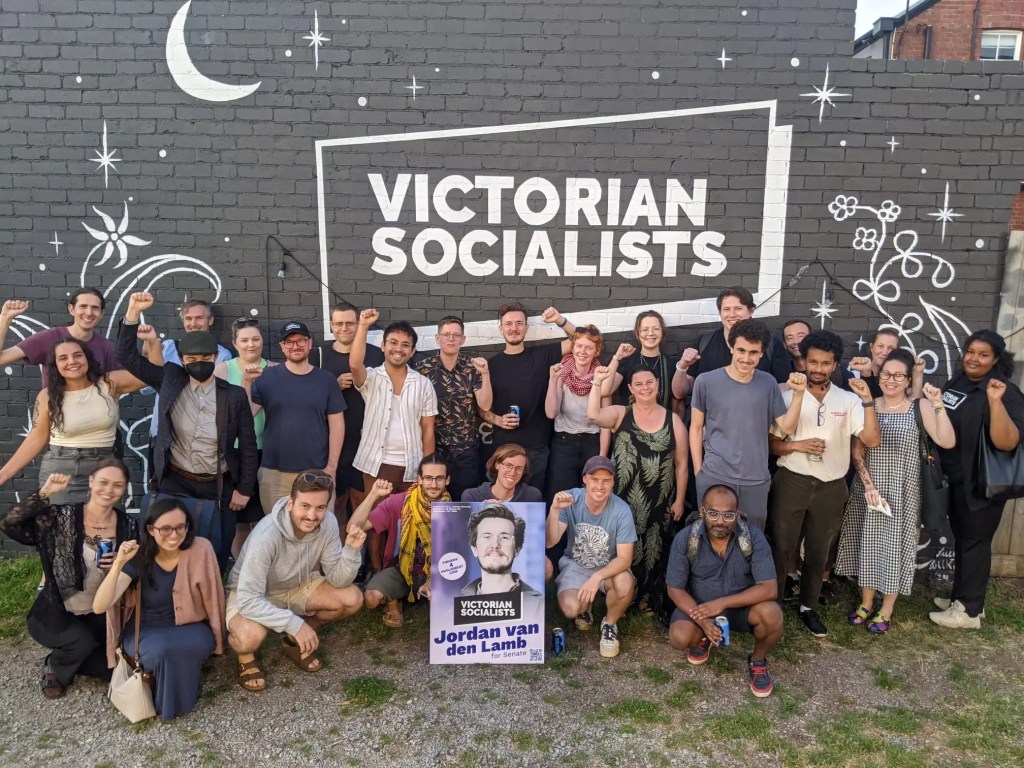
Instead the socialist forces are divided. Socialists run on two separate tickets – Socialist Alliance and Victorian Socialists. These two platforms are nearly indistinguishable, and the sectarian differences that divide the movement are totally inscrutable to the working class – especially when these differences are not elaborated upon. It is not clear even to many socialists what reasons Socialist Alliance and Victorian Socialists have for running on separate and distinct platforms! Of course we want workers to vote socialist – but the socialists need to take themselves seriously to earn workers votes!
The platforms themselves totally elude the key questions. A heap of economic and social reforms are offered, but the key questions – the democratic republic, the establishment of a popular militia, the abolition of the standing army and police, and the expropriation of the commanding heights of the economy – are left unresolved. Practically, these platforms are not necessarily more radical than that of the Greens – albeit one has the word “socialist” plastered above it.
In the socialist and workers movement, it is vital that we fight for a communist platform in these elections. To the Labor Party, in the Greens, in the socialist sects and electoral fronts, we need to fight for a working class minimum-maximum program – a democratic republic and socialism. At a minimum, it must include the following:
- A fully democratic republic which abolishes senatorial power, monarchism, and the presidential system.
- Abolition of the standing army.
- A Treaty with First Nations.
- An end to AUKUS and ANZUS.
- The abolition of the Fair Work Act and the opposition to state intervention in the trade unions.
- An emergency program of renewable energy without job losses.
- A massive expansion of government housing and fixing of rents.
- Fixing of prices for groceries and the establishment of state and cooperative grocery stores.
- Nationalisation of banking and utilities.
- A living minimum wage, with benefits set at the minimum wage.
Ultimately, elections will continue to be a barren ground for workers while we lack a party of our own. The working class needs a party, one that offers a working class program of democracy and socialism. This can only be achieved through the reforging of the Communist Party in Australia. Then, and only then, can the working class conquer politics, and win the battle for democracy.
Vote Socialist! Fight to Reforge the Communist Party in Australia!
Respond on our letters page: partisanmagazine@proton.me

 PARTISAN!
You must be logged in to post a comment.