The University of Melbourne chapter of the Platypus Affiliated Society held a panel on March 12th, discussing the topic of what capitalism is and why people should oppose it. We publish here an abridged version of the talk given by Anthony Furia, a panelist on behalf of the RCO. Jacob Andrewartha (Socialist Alliance) and Brendan Duncan-Shah (Red Ant) were also on the panel.
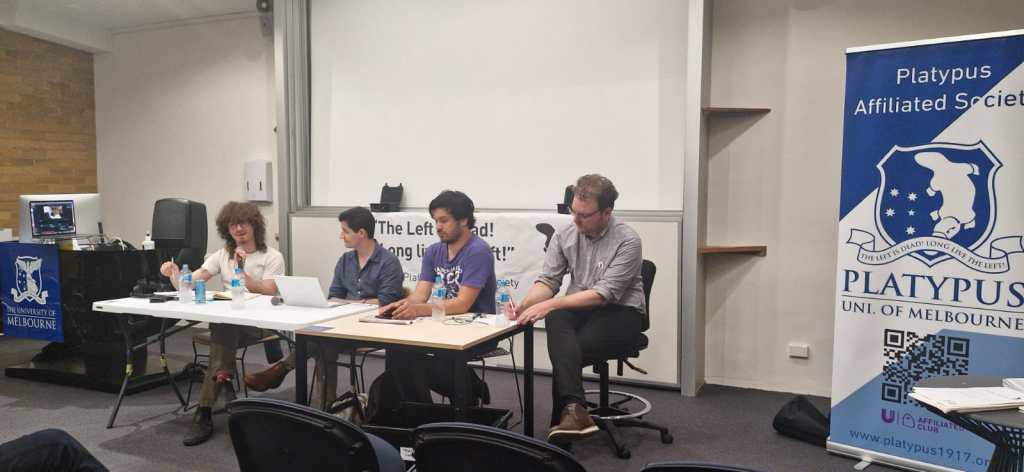
Good evening comrades – Platypus has prepared an excellent panel for all of you today, if I do say so myself, and I would like to thank my fellow panelists for their presentations. As part of such a panel, Platypus sent us all several sub-questions under the primary two of today, and I have, in my speech, addressed each in the order that made most sense to me. Rather boring, I know, but I prefer to keep things systematic; and pray I can add enough to the conversation to keep you all from falling asleep.
The first question was the shortest, and the shortest to answer; what is capitalism? Capitalism is, put extremely simply, a mode of production. A specific way of organising society, its production, reproduction, and distribution, predicated on a vast array of social relations of production, and their associated/accompanying means of production. More specifically, capitalist production (and thus capitalism) is defined by generalised commodity production, wage labour, the division and dominance of abstract value, and thus the extensive, continued, and ever-increasing self-valorisation of “capital” itself. Accompanying these defining features of capitalism are a range of other tendencies, developments, and historical features of capitalism that have defined its contemporary state as a totalising world-system constantly attempting to arrest history as it cannibalises upon nature, people, and ultimately itself.
The next question is whether capitalism is contradictory. There can be no response other than a resounding “yes”. Yes, capitalism is contradictory. The very basis of communism is the most politically important contradiction of capitalism – one that continues to haunt social organisation, political struggle, and life itself – the contradiction between labour and capital. This contradiction, the existential distinction between those reliant on the wage fund (the proletariat) and those who embody the interests of capital (capitalists) in their ownership, often speculatively or abstractly, over means and relations of production, is of existential importance for communist politics. It is wholly responsible for the revolutionary subject of communism – the international working class – without which communism is not only impossible but entirely unimaginable. The implicit and innate contradictions between the interests of this global working class and the interests of capital as embodied in both international and national capitalists are the very core of class struggle, and thus of the potential for class victory – for a different world, shaped by a global working class striving for its own abolition, determined to end the very system of social organisation which gave life to its revolutionary potential.
How does capitalism being contradictory pertain to “left politics?” It is its essence, its foundation, its light and air. It is the ultimate basis of such a politics, and the only consistently scientific motivation and comprehensive political understanding for communism. Not only is communism theoretically nonsensical without the contradiction between labour and capital, and thus between their embodiments in the working and capitalist classes, but it is wholly politically impossible.
This is not to say that capitalism does not possess several other and related tendencies and contradictions. Without the consistent, constant mediation of these tendencies by state and class forces both indirectly and directly, they may lead to capital’s extinction. But such an extinction will be an extinction of life, not the victory of communism. The only immanently viable alternative to capitalist production, to the totalising, vampiric yet ouroboric self-valorisation of capital, is communism. A conscious project of proletarian self-emancipation and abolition.
Platypus asks how capitalism has changed overtime, and what these changes mean politically for “the left.” Here I will substitute “the left” with communists – we are expressly excluding contemporary ‘social democrats’, ‘progressives’ and ‘anti-capitalists,’ as the origins and nature of their strategies are entirely distinct from ours and thus are shaped by changes in capitalism differently.
One of the primary features of capitalism I neglected to mention earlier was its tendency for constant innovation. Capital must reinvent itself and the world around it in an almost constant, furious, and irrational motion in an attempt to expand, consolidate, and expand again. Similarly, capital’s penetration across the entire globe has facilitated major shifts in its organisation and concentration. This is epitomised particularly in imperialism as a world system of superexploitation and unequal exchange, able to ensure and maintain superprofits for multinational corporations based in the imperial core which have outsourced much of production to the global periphery.
This expansion of capitalism provided the means for capital’s continued “Innovation,” producing differing types of production, unique in content if not in fundamental form, such as the global relations of production responsible for commodities ranging from iPhones to Coca-Cola, the rapid, extreme expansion of international financial and fictitious capital, and the shift to service work and unproductive labour in the imperial core.
Alongside these developments, and as a critical extension of them, is capital’s ongoing and total war against its own old order. Against the grand compromise with an organised working class, and an extensive management of capital by the state in an attempt to stave off the worst of its own excesses. The Trump administration’s struggle against the last remnants of the victories of the working class and concessions granted by capital for the sake of combating such a class at least partially embodies further attempts to privatise, financialise, and strip back nonprofitable state structure, in an embodiment of venture capital and a backwards, reactionary American petty bourgeois.
But before we address the implications of these developments for communists, we should aim to answer a few other questions Platypus has asked us. The first is whether class struggle takes place today, if so, how, and what role the ‘left’ should play in it. My answer to this should be quite clear from earlier discussion. It absolutely does take place today, as the contradiction that drives it forward, that between labour and capital, continues to overdetermine capitalist production.
However, contemporary class struggle is two things; disorganised and relatively one-sided. Disorganised, in that in the imperial core the moments of sincere ‘resistance’ by collective labour against capital are either spontaneous outbursts in the form of protests, demonstrations, and riots, or heavily choreographed instances of strikes and pickets, often mediated by a hesitant, conciliatory union bureaucracy quick to capitulate when politically viable. One-sided, as epitomised in the ongoing stripping back of any and all concessions granted by capital to labour in the imperial core, it is almost always capital on the offensive and organised labour in the retreat – routed, embattled, and encircled.
Platypus further asks us whether capital is in crisis. Maybe! The distinction between capitalism in crisis and capitalism operating in a ‘functional’ capacity is increasingly difficult to pinpoint. Is capitalism at risk of immanent, spontaneous collapse? Certainly not – but it is certainly not particularly healthy either. Increasing financialisation, speculation, and debt prop up production and exchange, and the fragility of such an arrangement seems to consistently teeter at the precipice, at the whim of increasingly abstracted, volatile market forces. Capital appears to be in a long, managed decline. Crises of social reproduction and of the total rupture of a metabolism between society and nature may not immediately concern capitalism but remain potentially existential threats.
Platypus then asks if a new era of global capitalism is emerging, and what it may look like. I think we must interrogate what we mean here by a new “era” of global capitalism. A new distribution of capital globally, reflected in and shaped by altered political allegiances and the return of inter-imperialist ‘spheres of influence’ competition? That now seems to be almost guaranteed. But a new ‘era’ in the same sense that the logistics revolution or the communications revolution have heralded? That remains to be seen. One could point to a multitude of developments; increasingly enclosed, monetised digital spaces, the explosive growth of speculative digital currencies, the casualisation and gig-ification of swathes of work, and the potentials of generative AI technology.
But to see any of these as indicative of a truly ‘new’ era and not an extension of processes and prior technologies would be unwise. The trends remain the same; monopolisation, financialisation, valorisation. If such developments are indicative of a new era, it is an era of increasing chaos for capital. A frantic scrambling to maintain and increase self-valorisation, to expand beyond and break every limit now established. It is an era that will be marked by an insanity, by the irrationality of capital, as it further breaks out of, and consumes, a world of its own creation. Rather than any coherent point of reference for such an era, its point of reference will be the lack of such a reference; a desperate search for productivity increases, and the violent suppression of wages.
Throughout the questions I have addressed, I have intentionally avoided answering three subsections raised by Platypus that I believe can be holistically summarised in a single question; what does this all mean for communists? Such a question is far from easy to answer, but there are two primary points that are particularly important to emphasise.
The first is that, in communist organisations, some of the age-old sins of the past – economism, workerism, and chauvinism, are not only taking on new life and forms but are more politically corrosive than ever. We cannot, for example, rely solely on the imminent economic interests of sections of the working class (such as those of the Australian working class) for political guidance, when expressions of those interests may at times contradict proletarian internationalism; the recognition of the class as an international whole with collective interests. We cannot give one inch to the interests of the Australian state, whether nationally or abroad, as some communists have done with their position on the inter-imperialist war in Ukraine. Now, more than ever, must we combat these spontaneous, natural opportunistic tendencies that spread like weeds through a spirited and constant uprooting. Through passionate, public, and expansive debate and argumentation against them and the positions they produce.
Capital’s current relentless war against the victories of the working class and the safeguards against its own irrationality should produce a rude and much needed political awakening for communists; we are weak. We are divided. And we are, currently, totally unable to mount meaningful resistance to the whims of even an increasingly fractured capitalist class. It is embarrassing, but unexpected – and this time of shock, of horror, should be a time for political reflection. For introspection. How have we ended up in the state we are, particularly in the imperial core, and how can we get ourselves out of it?
The answer the RCO provides to this question, and I, of course, think is most pertinent, centres on the question of the communist party. In the wake of the collapse of the Soviet Union and the failures of spontaneism, horizontalist organising, and prefigurative politics, the importance of a mass, democratic, militant working-class organisation – a political party – is utterly clear. In the face of hapless resistance, of a communist left hopelessly divided and split upon theoretical minutiae and embarrassingly minor historical differences, the necessity of a united communist movement – of a communist party – is paramount. The revival of partyism, of the conscious construction of a communist party, is the political consequence of capitalism’s one-sided class struggle.
 PARTISAN!
You must be logged in to post a comment.