Why did Omar Hassan opt to not run for the Victorian Socialists in Calwell? Anthony Furia explains.
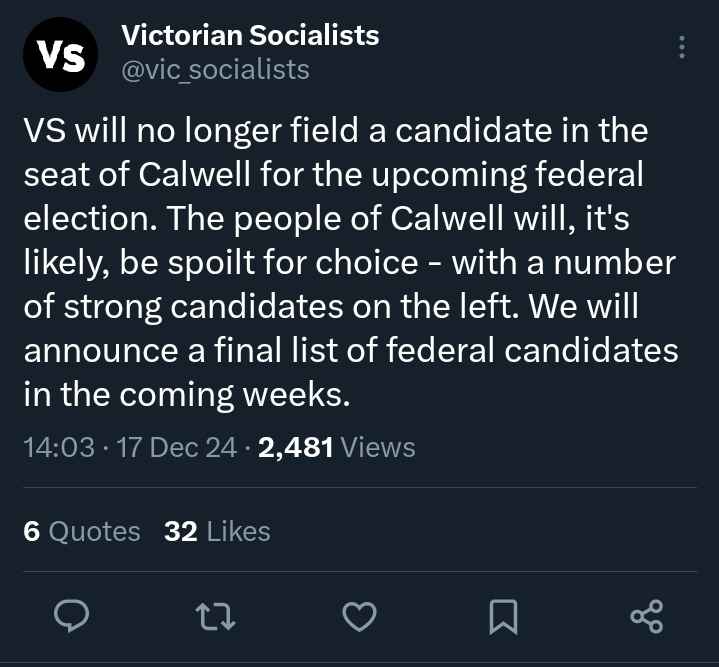
In December, the Victorian Socialists (VS) announced on Twitter the withdrawal of their candidate Omar Hassan from the Calwell region for the upcoming federal election [see above] – moving him instead to Scullin. In Calwell, a region in which VS has previously achieved strong results amongst a working class population, this came as somewhat of a surprise to both VS members and others amongst the socialist left. The immediate question was: why?
What could motivate such a withdrawal, seeming to sacrifice the gains made by VS as a project in such a region? The official response by VS was two-pronged; it stated that Omar, the candidate – “a Lebanese Australian socialist and long-time Palestine solidarity activist – advocated for this largely out of respect for Mohamed El-Masri, who is running in Calwell with the Greens.” Yet the VS statement also argued that “The people of Calwell will, it’s likely, be spoilt for choice – with a number of strong candidates on the left.” and a “small party” such as VS thus needed to “consider carefully how to best focus our resources.”
In essence, the decision by the VS executive seems to be motivated in part by the wishes of the candidate themselves (with an emphasis on identity in the VS statement), and in part by the issue of resource allocation. There are two problems that we are immediately confronted with from this explanation: democratic control over candidacy, and the VS platform (and program, or lack thereof). It seems unusual that a self-acknowledged “small party” would have candidate placement determined and managed by an executive committee, and subject to the whims of the candidate itself – rather than the organisation as a whole.
Granted, VS stated plainly that Omar “advocated”, not ‘decided’, the withdrawal from Calwell – and this is important. Potential elected representatives must be held under party control strategically, not subject to their independent whims. However, if this is indeed the case, it seems odd to focus much of the explanation for this withdrawal on individual candidates and their feelings towards one another. Charitably, we can assume this was due to questions from VS members and put it to the side for now – with the cautious reminder of the importance of centralised electoral operations.
The other issue, on the determination of candidacy by an executive, can in part be argued from the position that democratically determining the position of each candidate is inflexible and bureaucratic – to which I would agree – however, it seems as if the withdrawal of such a candidate should be something that requires at least some sort of consultative, if not expressly democratic, process. Of course, the stakes in this instance are relatively low – but we must plan for the future in our conduct, and ensure processes are in place for candidate withdrawal, and transparency in doing so.
The second issue raised by the VS statements on the withdrawal is more pressing – namely, the VS platform and lack of a cohered program. If it is truly a problem of resource allocation; reasoned through a belief that the Calwell electoral field is “spoilt for choice” with multiple left-of-labor independents, and thus VS running is an unnecessary drain on resources, then perhaps the problem is the platform that VS is running on. There should be a substantial difference between a socialist, running on a socialist platform, and any left-of-labor independent or Greens candidate.
Our platform should be informed by a minimum program, by a road to workers power and the demands we believe are necessary parts of that road. It should not be an attempt to tail or appeal to vague left sympathies or a ‘progressive’ youth vote. It should be, in form, a platform for workers power. This does not mean we must run on the immediate and singular cry of “world socialism now.” Indeed, it is entirely possible to run a generally ‘left-populist’ appearing campaign using the demands of a minimum program – demands for democracy, housing, rent control, price control, wage benefits, and against militarism and war. All such things are necessary for workers’ power and can be used to formulate an appropriate communist political platform for electoral campaigns.
In this instance, the gap between the politics of a Greens candidate, of a soft social democrat independent, and the politics of a socialist candidate, would be insurmountable. Electoral agitation surrounding our demands would be agitation explicitly surrounding aspects of workers power, and consciousness raising work would be direct and explicit, instead of the ‘consciousness raising’ of VS today, which clings to transitional nonsense and the repetition that workers must be “met where they’re at” (apparently the workers are all supporters of the Greens and social democracy – a surprise to the workers themselves).
Of course, the problem with running such a platform for VS is that they do not have a minimum program yet. They have a constitution, a somewhat confused mix of minimum and maximum demands, and they have their varying electoral platforms. This is an embarrassing display of reformism, but there is no coherent program. Thus, the ever-present danger of parliamentary opportunism; without a program, VS understands that its platform is a platform which can be contested by, can be equated with, and can lose ground to, a particularly strong Greens campaign, or a trade unionist, activist independent.
Are we making much hay out of something with minimal immediate impacts? In some ways, yes. The withdrawal of a single VS candidate from a single region in a period of communist organisation without a party, without unity, and without heightened struggle is unlikely to have significant consequences, directly speaking. Yet it is a decision which is symptomatic of bad strategy, which betrays a certain orientation towards electoral work in VS. One that, if maintained, will serve only to weaken communist organisation across Australia. The important thing here is not the direct consequences of this decision (although these seem to be negative in of themselves), but the underlying motivations for this decision – the strategic orientation of VS demonstrated by tactical maneuvers such as this.


 PARTISAN!
You must be logged in to post a comment.