In the aftermath of the Setka affair and forced administration on the CFMEU, dissident union leaders have come together to host a ‘Unions for Democracy’ summit, stirring fears of a split in the ACTU. Some on the socialist left have supported this move. On the contrary, argues Martin Greenfield, the socialist left should reject attempts to split the union movement.
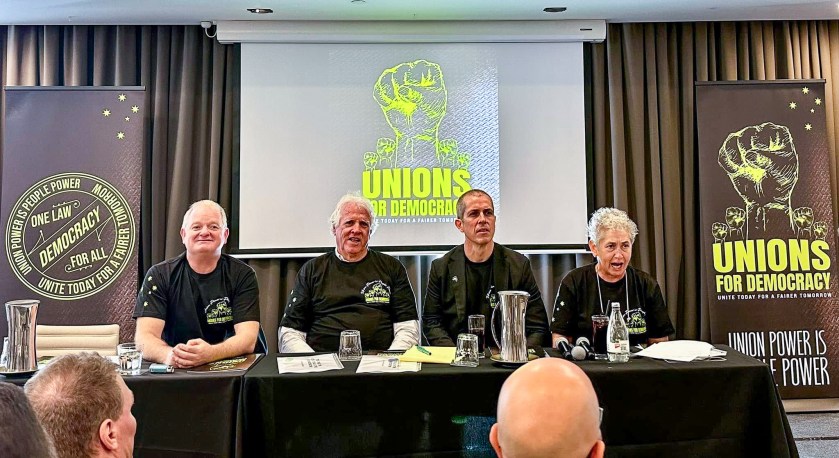
In December, nine Australian unions held a summit in Canberra, ostensibly to discuss trade union democracy and the need for working class militancy. It was not a mass meeting and was attended by select delegates by invitation only – not an auspicious sign.
The Trade Unions for Democracy Summit was called in response to the enforced administration of the CFMEU construction division by the Albanese Labor Government, with the support of the ACTU, the peak union body. Supposedly to remove the criminal elements within the NSW and Victorian leaderships of the union, but also to dampen the militancy still within the ranks of the union.
For nearly a decade, the ACTU and the managerial class in the unions initially denied there was a problem in the CFMEU, or turned a blind eye, saying it could be handled internally. And when it finally recognised there was criminality, rather than turn to the membership and the broader working-class movement, it turned to the blunt and hostile tool of the capitalist state to try to cut the head off the snake.
This approach has not and cannot provide a solution. But neither can splitting the union movement, especially when this is not the act of a resurgent militant rank-and-file, but due to schisms within the bureaucracy itself. We must outline a strategy of transformation for the unions as part of the reemergence of a communist party and militant leadership for the working class.
While the ALP government – and the ACTU in support – has crossed a class line by using state power to send the lawyers and hacks in to run a union, those organising the December summit act as if there are no issues of democracy and corruption in the CFMEU itself, which has been infiltrated by organised crime in at least two states.
Communists oppose state interference in unions, but we also oppose connivance with criminals, itself a form of class collaboration. The encroachment of criminal elements into the CFMEU had led to the severe curbing of union democracy in parts of the union: the effective suspension of delegate election on most jobs; the imposition of ‘enforcers’ for the leadership on sites; the nepotistic appointment of officials with no building industry experience. All of this points to a union that has gone off the rails of democracy.
Organisers of the summit and other supporters of the disgraced CFMEU leadership in exile cry bourgeois ‘natural justice’. But communists and other working-class militants must hold our union leaders to a higher standard than that.
Even if we ignored the assistance given to drug-dealing and money-laundering crooks, the fact that union secretaries have their own children appointed to union leadership positions is enough to move them on. But only the membership, supported by working-class militants and democrats, can force out both the administrators and the criminal elements.
For the ACTU, they see no way but to rely on the state and its courts to clear out corruption and criminality. This is a result of how low the unions have fallen, corporatised in the 1980s through the Accord process and completely disarmed by the Fair Work Act. Union officials are in many cases Laborite careerists, not rank-and-file activists elected and employed to do the job.
It is no wonder the union membership has slumped to record lows in the private sector. Neither the ACTU connivance with the Albanese government, nor the syndicalists who want us to ‘turn a blind eye’ to criminality offer a way forward. CFMEU members need their union back – from the lawyers, from the crooks.
DEMOCRACY: sounds like a good idea
The ‘Union Democracy’ summit on 9 December follows a decision in September by the CEPU unions, the largest of which is the ETU electrical trades union, to disaffiliate from the ACTU, Australia’s peak union body. It is worth noting the CEPU did not disaffiliate from the Australian Labor Party.
If this move was a genuine call for a mass militant campaign for democracy across the entire labour movement it could be worth supporting. But it is no such thing. It is a schism within laborism and the union bureaucracy, not a break from it.
And even if it were a radical and socialist movement to establish a separate peak union body from the ACTU, this would also be a mistake. Communists do not want to carve off ‘perfectly formed’ unions but look to organise and transform the working class and its organisations – united – against the capitalist class and its state.
Unity is strength, disunity is death. The fact that so many leftists are cheering on this schism displays their bankrupt syndicalist politics – and it reveals their complete isolation from the working class itself, their enthusiasm displaying a vicarious proletarian role-playing instead.
Leading up to the December summit, it was reported that ‘everything is on the table’. A media release in October from the Building Industry Group of unions said the meeting would consider “the creation of an alternate democratic union body to advocate on behalf of all workers”, “future political funding, including supporting union political candidates” and “a campaign to restore union democracy”.
It said this was based “on a broad groundswell of support” to establish such a body. However, the initial support shown to CFMEU rallies immediately after administration has dwindled. For these ‘left’ bureaucrats, all now hangs on the outcome of the unlikely High Court challenge to the administration (and the fate of former CFMEU NSW secretary Darren Greenfield – no relation – who, with his son, face bribery charges).
So much for reliance on the rank-and-file. While the ‘Trade Union Democracy’ summit talked a big game, the meeting was a fizzer. Eighty hand-picked senior officials and delegates issued a statement after the meeting highlighting four ‘achievements’:
- Formation of a Unions for Democracy organising committee
- Endorsement of annual summits. The next planned for early this year
- Condemnation of the CFMEU forced administration
- A democracy charter ‘outlining shared values of democracy, growing the union movement while addressing challenges in industrial relations laws.
Of course, union democracy would an excellent idea. But this body has shown it is not interested in unleashing the democratic power of the membership. Hand-picked delegates, a closed session, no invitation for rank-and-file unionists to engage.
The make-up of the organising committee was not announced, nor the union democracy charter published anywhere. In none of the official statements from the summit, was there any declaration of the need to break the Fair Work Act. No nod to the need for mass political action to resist the attacks on working-class living standards and address the housing crisis.
There was nothing about removing the chauvinistic hyper-masculine thuggish culture that seems to have blossomed under Setka and his crew. And nothing about the democratic-republican principles of electing all officials, for officials to take no more than a skilled wage, for all delegates to be elected. There was no call to democratise and politicise the link with the ALP through the election of delegates to party conferences.
The current practice is for union secretaries to hand-pick delegates to ALP conference, centralising their bureaucratic power, and disempowering the rank and file. Of course, the ETU and others point to severe shortfalls in the campaigning militancy of the ACTU. ETU Victoria Secretary, Troy Gray, told the Guardian that “time and time again” after Labor wins government, the union movement is given “crumbs”.
This is a truism as old as the ALP itself. While the ACTU and ALP dismiss the divisions, it points to working-class dissatisfaction with cost-of-living pressures ahead of the federal election, due by May. ETU Victoria Secretary, Troy Gray, told the Australian newspaper in September: “There’s a real ‘fuck Labor, pay back Labor’ feeling among a lot of blue-collar workers that I have never seen before,” he said. “That’s Labor’s biggest problem at the next election. They will never, ever, ever win the vote back of those blue-collar workers.”
If that is the case, what political leadership and direction are these union leaders outlining for such disaffected workers? Trade unions are a shell of what they could be and are dominated by a careerist layer. While union membership pipped upwards from an historic low for the first time in many years in December (from 12.5% to 13.1% of the workforce), this was all in the public sector – with private sector unionisation actually falling from 8.3% to 7.9%. An entire generation of workers has no lived reality of being unionised.
The Left
On the Trotskyist left there was a frisson of excitement that this summit might lead to a breakaway federation of militant unions. Wrong and misguided. In reality, this is a factional play within the existing trade union bureaucracy between those aligned with the exiled CFMEU leadership and those who in the ACTU who have supported the Albanese government installing state administrators to run that union.
Independent working-class politics, union democracy and widespread militancy in pursuit of political and economic demands are not on the table from either of these factional groups. Devoid of a political program for the working class to take power, most of the Trotskyite and Stalinite left has called for strikes to defeat the administration as strategy or merely repeated support for the exiled and disgraced CFMEU leaderships in NSW and Victoria.
While no doubt strikes could be a tactical weapon in a political campaign to transform the unions and defeat state interference – not just the administration of the CFMEU but the Fair Work Act, which is a straitjacket on union independence – to elevate strikes to the level of strategy is a dead end. But we should expect this from the existing far-left, most of it informed by radical syndicalism rather than Marxism. Syndicalists raise the economic and union struggle as the height of working-class action. They paint all such actions with socialistic colours.
Should communists work in reactionary unions?
The short answer is yes, yes, and yes. The communist program for the working class is not a syndicalist response to capitalist oppression, but a political response for working-class democratic rule and general human emancipation. Even in the most reactionary and bureaucratised of unions, communists should organise where they can – not to split hundreds or even thousands of workers away into ‘red unions’, but to transform the entire working-class movement into a weapon for socialism and workers’ power.
As abhorrent as the SDA leadership is, it was an error to have formed the RAFFWU fast food union; a syndicalist dead end. While we need a mass political party of the working class organised around a clear and separate democratic-republican and revolutionary program, our aim is not to slice off bits of the unions to chemically pure left organisations. That is narrow syndicalism.
Russian revolutionary Vladimir Lenin wrote on this in the early days of the Russian Revolution, addressing radicalised workers and communists in Western Europe who wanted to split from reactionaries in the unions.
In his famous pamphlet ‘Left Wing Communism’ (1920), Lenin wrote: “Because of the reactionary and counter-revolutionary character of the trade union top leadership, they [the German Left Communists] jump to the conclusion that … we must withdraw from the trade unions, refuse to work in them, and create new and artificial forms of labour organisation! This is so unpardonable a blunder that it is tantamount to the greatest service Communists could render the bourgeoisie.”
Further he writes: “To refuse to work in the reactionary trade unions means leaving the insufficiently developed or backward masses of workers under the influence of the reactionary leaders, the agents of the bourgeoisie, the labour aristocrats, or [quoting Engels on the British unions] ‘workers who have become completely bourgeois’.”
Of course, this was within living memory of the foundation of many unions. Our syndicalist friends today will no doubt argue that (some of) the unions have transformed completely, such as the SDA retail union, and are so reactionary, and ‘artificial’ that splitting small numbers away into Red Unions is the best way forward.
This is as rubbish now as it was a century ago. The most pressing missing element is a united communist party: only by organising serious Marxist trends into a single militant political party can we even start to do useful and sustainable fraction work in the unions against the reactionaries and the bureaucrats.
Even during Mussolini’s Fascist dictatorship in Italy, the underground Communist Party organised in the fascist ‘union’ organisations. Communists need to organise a communist party – and we need a program that seeks to transform the unions, not foster syndicalist illusions in breakaway grouplets.
The workers’ movements in Spain and France are historically weakened through a multitude of union confederations that are loyal to different political parties and trends. We do not need that in Australia.
 PARTISAN!
You must be logged in to post a comment.