Surviving a rainy late-night cinema trip, Max J reviews and ruminates on Robert Eggers’s latest film, Nosferatu (2024).
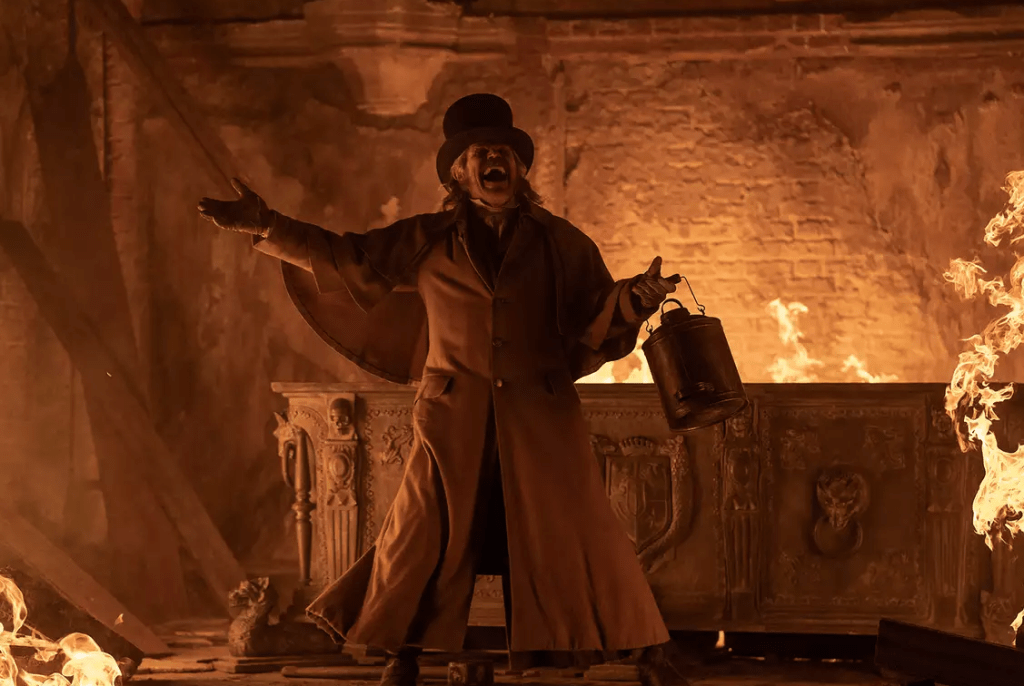
Late 2024 blessed us with Robert Eggers’s (of The Lighthouse and The VVitch fame) adaption of the 1922 classic Nosferatu, though Australians did not get to see it until this month (Jan 2025). It is a ‘gothic horror’ revival taking us back to the good old days of ugly vampires living in coffins in Eastern Europe. Maybe we will finally get a[nother] World of Darkness adaptation after this. No holds are barred in Nosferatu as even the children fall victim to Count Orlok’s satanic mysticism.
It is trite these days to point out that vampires are a metaphor for something. Or more like an allegory. In Nosferatu, Orlok (Bill Skarsgard) is a literal personification of feudalism, slumbering in his ancient castle feasting on the blood and flesh of antique village people. Spending years grooming Ellen Hutter (Lily-Rose Depp) into being his lover, he springs his plan to wage a campaign of psycho-sexual revenge against modernity and to claim Ellen as his sexual property.
Nosferatu is a dark film, in that darkness constantly envelops the setting. As Thomas Hutter approaches Orlok’s carpathian castle, he must travel through a dark, ominous forest. Orlok’s castle, as one would expect, devoid of any light. It is a non-naturalist film, which is more or less in line with Robert Eggers’s style (see: The Lighthouse, 2019). In a sense, Nosferatu is a Protestant counterpart to The Exorcist (1973): a young woman is possessed by a demon (Ellen is possessed and is often a proxy of Orlok’s magic) which must be expelled from her by a rationalist sceptic (Nicholas Hoult’s Thomas Hutter) paired with an eccentric crank who asserts a realm beyond material science (Willem Dafoe’s Prof. Albin Franz). Superficially, Ellen Hutter’s possession by Orlok resembles Regan MacNiel’s possession by the demon Pazuzu.
Eggers’s pattern of psycho-sexual references continues in Nosferatu, where Thomas Hutter is cuckholded by Orlok who is in turn cuckholded by Thomas. Orlok’s sexuality pervades the film, and ultimately he is slain by his own lust turned against him by Ellen. Friedrich Harding dies in a fit of mania while having strange, necrophilic sex with his recently dead wife. When Orlok sucks the blood from the chest of his victims, his nude body writhes on top of them skin-to-skin. Orlok is a vampire that fucks.
Nosferatu is a rare(ish) film for the 2020s: it is a competently made film with a modest budget (only USD$50M). While Nosferatu is not an original film (it is an adaptation of the 1922 Nosferatu film which itself is an adaptation of Bram Stroker’s Dracula turned knockoff), it nonetheless stands out in a line up of glitzy sequels (Indiana Jones and the Dial of Destiny, 2023), licensed tie-ins, and streaming originals with inflated budgets (see: Red One, dir. Jake Kasdan).
Nosferatu is an eccentric, harrowing film which is a breath of fresh air for a decade of otherwise mediocre releases.


 PARTISAN!
You must be logged in to post a comment.