Comrade Miki bemoans the lack of direction in the climate movement, asserting that it needs to come to terms with the necessity of socialism and a planned economy if it wishes to ensure a sustainable future.
The Australian climate movement is yearning for an answer to the environmental predicament haunting humanity. There’s just one problem.
We don’t have an answer to rally behind yet.
Capitalism, colonialism, consumerism, industrialisation, corruption, lying and narcissism are all blamed as the root causes of the climate crisis. Yet, the strategies for moving forward struggle to find mass appeal. We say we want ‘climate action.’ But what does that really mean to us?
The strange thing about the politics of Climate COPout was that the attendees clearly wish for a swift, democratic and egalitarian transition. But this desire is easily lost in the exhibition of rage and discontent at the apathy of the global capitalist leadership.
Blocking intersections isn’t climate action.
When we lack a notion of utopia to strive for, the best we can do is prepare for a ‘soft landing.’ This is why ‘degrowth’ comes up a lot, along with fetishised indigenous mythologies and even cruder reactionary fantasies of an anarcho-primitivist decline in these environmental spaces. Our comrades are sincerely concerned. They want freedom and security. Can we really blame them for not trusting the messianic fantasy of a communist state that abolishes itself?
Australians generally find the prospect of communism to be absurd. This is only partially due to the domination the economy and our media impose on us.
The ineffective and often self-marginalising politics of the ‘socialist’ left are symptoms of the same problem. We don’t believe in ourselves or each other. This often means that even though we like to pose as revolutionaries, we find ourselves begging the ruling class to just throw money at the problem.
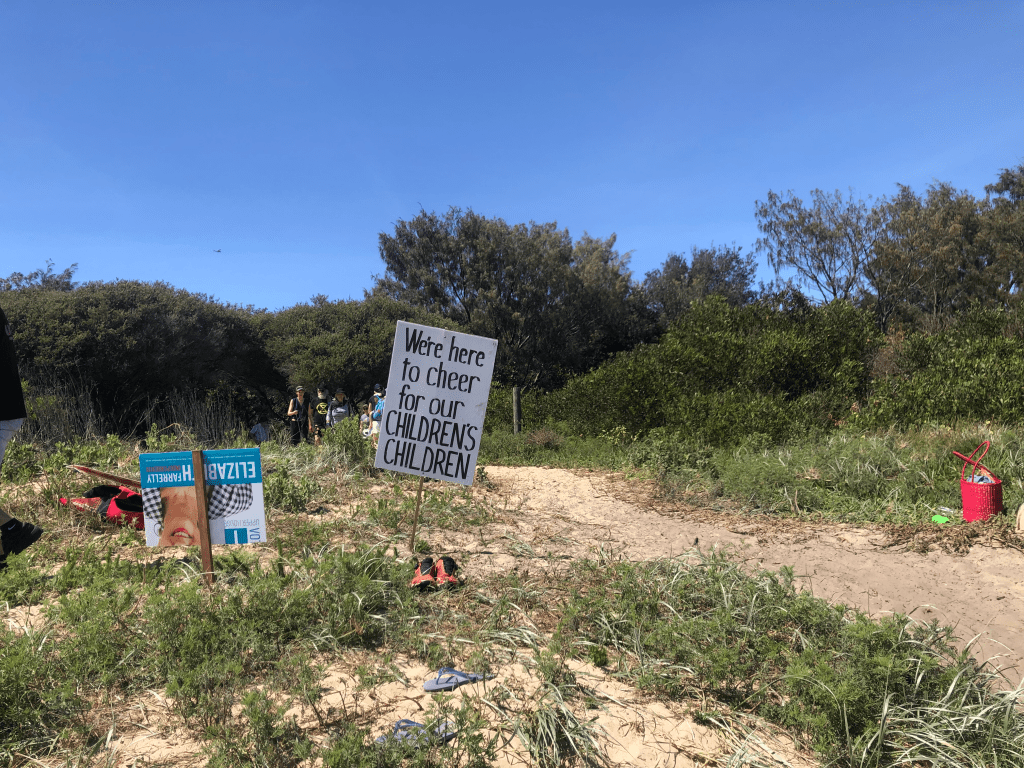
The People’s Blockade appeals to a larger section of the Australian public than COPout. The attendees are mostly older and middle class. Or they’re younger, fresher activists. Both demographics are scared and angry. Unfortunately this particular ‘protestival’ would not assuage our fears. It was unclear what its politics actually were.
When we talk about climate change, we’re really talking about a ‘symptom’ of capitalism. When we engage in disruptive climate activism we are petitioning for a global movement that is willing to radically transform society.
Rising Tide has demands; like many climate organisations, it sees them as common sense. Yet the cancellation of all new fossil fuel projects and a 78% tax on export profits would be a revolution itself. We will never be able to petition our petro-state to abolish itself. Australia is no different than Azerbaijan or Saudi Arabia. We may be marginally more ‘liberal.’ But we are still just a banana republic; the bananas are coal.
The People’s Blockade was a hodge podge of political perspectives. The four socialist stalls were separated either because of interpersonal weirdness and grudges or alternatively: different styles of badge. Then there was a stall for Palestine, the scientists’ rebellion, and a marquee where friendly indigenous guys cooked steak sandwiches for themselves and whoever else was tired of the vegan meals organised by Rising Tide in reusable plastic bowls. This movement is diverse. At the same time, it falls short of engaging with what needs to be done. We need to take matters into our own hands.
The channel the coal ships glide through was blocked briefly on Sunday and 170 people were arrested. The whole thing felt like a media stunt with a festival next to it. It was not an example of unsilenceable rage at Australia’s baffling level of inaction. And it pointed to a worrying trend I’m noticing within climate activism.
As it stands the climate movement is going to continue being dominated by a ‘managerial elite’ until it can actually realise a political program that regular people can help to implement. If regular people are just there to get arrested, they will inevitably be cajoled by savvy organisers who develop the skills of getting people arrested. This isn’t good enough, nor is it what most people want. We want climate action.
‘Climate action’ necessitates a planned economy on a global scale. The climate movement needs to come to terms with this if it wants to succeed. The people on the ground, attending these events and petitioning for a faster transition want this even more than the organisers. It is clear to me that most people who are seriously engaged with “climate politics,” whether they know it or not, desire a ‘communist’ revolution. I say revolution in the sense that this kind of climate transition is necessarily revolutionary. If it isn’t communist it will be fascist. Unfortunately, I do see the potential for some of these groups in the climate movement to fall towards ecofascism. But until they do, we have to find a better way of communicating with them about the necessity for a mass movement that can actually steer the global economy. There is no one running the economic system right now.
I think there are three main points we need the climate movement to internalise:
The ruling class won’t implement a ‘just transition.’ They couldn’t even if they wanted to.
A just climate transition, in this late stage of history, must be centrally planned and democratically administered by the global working class.
This transition will transform all of our institutions. It will look like a communist revolution even if it is totally ‘nonviolent.’
The great lie that we must reject, is that the capitalist class, their political lackeys, and their media fixers, can actually solve this predicament. The ecological predicament is capitalism. That is all it is. This means that as much as the capitalists might like to help, as much as they might empathise, they cannot resist the incentives of the system they benefit from. We cannot get them to abolish themselves.
We can only abolish capitalism, and fix the planet’s biosphere by exerting our collective power on the world and the political system. Power doesn’t come from slogans or chants or getting arrested. It comes from hard work, cooperation and serious planning. It comes from having difficult conversations with people you don’t know very well and finding a task you can both work towards completing. It requires politics.
If we allow history to be something violently imposed upon us, we will be denying our role in creating it. The climate movement whether it likes it or not implicitly imposes this powerlessness on itself. We are all scared of change. But change is coming whether we like it or not. Let us beckon in a new system, rather than a dead planet, that prioritises the political authority of the working class.
Marx called this system the “dictatorship of the proletariat,” and what he meant was the dictation of society, by the majority — the workers. It would be a process of the whole of humanity coming into consciousness of itself. A realisation of our collective potential. A transition into history. We could conceivably solve all ecological problems, end war, and provide the necessities of life for everyone so that they can develop into the people they want to be and leave the world better than they found it for their children.
This is what the climate movement yearns for.

 PARTISAN!
You must be logged in to post a comment.