An Anonymous contributor recounts the events of November’s Climate COP-Out, a multi-day protest against the COP 29 Conference.

This month, the 29th annual United Nations Conference of the Parties (COP29) climate summit brought world leaders to Baku, Azerbaijan for climate talks.
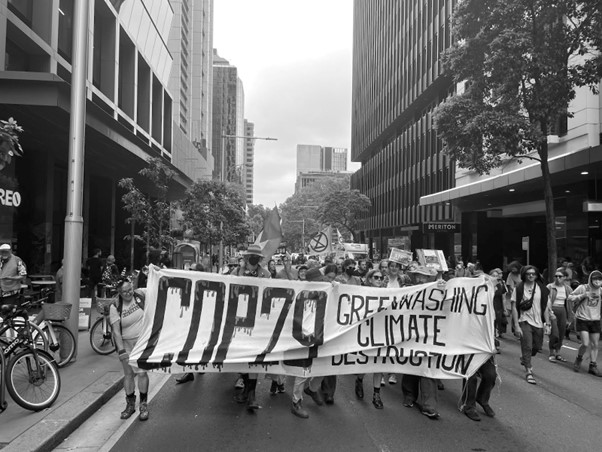
In the same week, grassroots activists from around this continent held Climate Cop-Out, a four-day event on Gadigal Land, so-called Sydney, indicting COP as a greenwashing mechanism masquerading as climate action, used to subdue the populace and continue business as usual.
This year in Azerbaijan, a senior official at COP29 was secretly filmed agreeing to facilitate fossil fuel deals during the summit in exchange for sponsorship. Days later, the nation’s president told the summit that oil and gas are a ‘gift of god’. The conference’s chairman, Azerbaijan’s minister for ecology and natural resources, is a former oil executive, and towards the end of the conference, a Saudi Arabian official was accused of editing an official COP29 negotiating text.
We have seen a clear pattern of the COP summits being held in petrostates, and scandals like these occur each year.
Last year, when the summit was held in Dubai, major outlets reported on leaked documents which revealed the United Arab Emirates planned to use its position as the COP28 host to pursue oil and gas deals with other governments. The summit’s president was quoted saying there is “no science” to support that phasing out fossil fuels is necessary to prevent global heating to 1.5ºC.
COP27, held in Egypt, was accused of greenwashing while holding an estimated 60,000 political prisoners behind bars, and saw over 600 fossil fuel lobbyists in attendance.
It’s no surprise that this year Papua New Guinea boycotted the climate talks, labelling it a “waste of time” where all the world’s biggest polluters get together to make empty promises.
Now Australia and the Pacific are locked in a bidding war with Türkiye over who gets to play host in 2026.
I travelled down from the north of this continent to Gadigal Land to set up for and participate in Climate Cop-Out, to call out our world’s governments and corporations for copping out of the urgent climate action we so desperately need.
It was my first time entering the grassroots landscape in so-called Sydney and it felt like an entirely different environment to our activist community back home. I’d travelled down with my housemates who’ve been active in New South Wales as a part of Blockade Australia, and already had established networks around the continent.
When we arrived on Saturday night, five days before Climate Cop-Out was set to begin, our first stop was an apartment block in a neighbourhood a fair ways away from the CBD. In true activist fashion, the small two-bedroom apartment housed five people, and took the four of us in for the next two nights. Some of the tenants were my friends, and others I’d met for the first time, but the space was as warm and welcoming as you can expect from the grassroots community.
Sunday morning would be when we’d start setting up for the event. After a breakfast of dumpster dived vegan sausages, zucchini and homemade sauerkraut, we headed down to the Addison Road Community Centre to get to work.
“This used to be an army depot,” my housemate told me as we joined a long queue of vehicles driving into the gates.
I could see market stalls set up straight ahead as we wound through the carpark and around the back of the lot where a long line of marketgoers queued for the Hospo for Palestine bake sale.
Nestled in the suburb of Marrickville, the centre hosts more than just Sunday farmers’ markets, with a strong focus on human rights and community support, offering services of all kinds for marginalised members of the community. From a food pantry, community radio station, and a re-use and repair cooperative to disability services, art exhibition spaces, and community legal centres, this place encompasses what it is to build community.
Addi Road had given us an old drill hall to use for our event, with its only current occupants being the pigeons nesting in the rafters.
That afternoon, I went on my first dumpster dive in Gadigal Land with a new friend, and the haul was far more fruitful than anything we’d usually find back home.
Early on Tuesday morning, I set off with a friend with brooms and cleaning supplies to the squat that others had checked out weeks earlier, one that was used last year by the out-of-state crew during the COP28 protests. We stopped at a broken fence on a narrow neighbourhood street, and he ducked through the hole, holding open for me the cardboard that concealed it. We weaved through the long, overgrown backyard, dodging spiderwebs and branches, eventually reaching the townhouse. He reached through an empty window frame to unlock the dusty back door, revealing what would soon become home for about a dozen activists over the next week.
“It looks like no one’s been here since last year,” my friend said as we walked inside.
The large back room still housed the makeshift benches, kitchen and hangout spaces that had been put together last year using milk crates, wooden planks, and rugs. Colourful graffiti of varying styles adorned the walls of every room, and as we walked down the narrow hallway, I noticed that none had doors on their hinges anymore. Electricity still powered the house, and the plumbing was still working and intact. That night, we moved in.
The next few days were much of the same kind of work: cleaning up, finding furniture and supplies, setting up the space, dumpster diving for food and cooking for the group, and pasting posters for the event around town.
DAY 1
By Thursday, the old, decrepit drill hall at Addi Road had been transformed into a warm and welcoming space for the event to begin.
We were kicking off the event at 1pm, with banner making and bicycle repair on the schedule to prepare for our bike rally early the following day. At 6pm, we received a beautiful Welcome to Country from Aunty Rhonda Dixon-Grovenor who yarned with us about country and her family. After dinner, the first workshop and perhaps one of the most important workshops of Climate Cop-Out began: What is COP, and why is it a climate cop-out?
To understand what COP truly is, we have to look at it in the context of the United Nations, a state-based system that operates under global capitalism.
UN climate change conferences began in 1992 with the Earth Summit hosted in Brazil. Its aim was to address stabilising greenhouse gas emissions, and it led to the creation of the annual COP summits which then began in 1995.
COP3 in Japan in 1997 saw the creation of the Kyoto Protocol, the first international treaty to set targets for the reduction of greenhouse gas emissions that contribute to climate change, and it went in force in 2005. Emissions of course continued to rise, and at COP21 in France, 196 countries pledged to prevent global temperatures from rising above 2ºC under the Paris Agreement. Last year’s COP28 marked the most significant stocktake of progress since the Paris Agreement. Some of the key outcomes of this summit were calls for a transition away from fossil fuels, the establishment of a “loss and damage” fund, a pledge to triple renewable energy capacity and double the global rate of energy efficiency, net zero emissions by 2030, and the admission that the goal of the 1.5ºC global warming limit was at risk.
COP frames the climate crisis as an economic problem to be solved by market mechanisms, rather than a systemic problem caused by the domination of an extractive capitalist system. It mirrors modern capitalism’s centreless nature and its inability to assign any one party responsibility for it. All players have agreed on what a ‘safe level’ of climate change is based on how it affects GDP growth, and every solution put forward is framed around this. Every scandal that’s come out of COP summits should not be considered a failure, but rather a function of a capitalist system.
These discussions were grim but necessary to understand how an organ of capitalism like the UN and its COP conferences aren’t broken and needing to be fixed to properly combat the climate crisis. They’re functioning exactly the way they’re supposed to.
DAY 2
Friday morning kicked off at 8am with a bike rally through the CBD. I was a little nervous, having not ridden a bike since I was about eleven years old, and I definitely wasn’t prepared for how difficult it is to ride slowly. Nevertheless, the rally went off without a hitch, and we brought the city’s traffic down to a crawl.
Then came workshops on extreme weather systems and how they work, and threat, grief and collective preservation. In the evening, we gathered in Martin Place for a speakout, urging anybody who wished to speak to step up to the microphone and share their thoughts on climate change and the COP summits. We held space despite the rain and listened to a range of speakers and perspectives.
For Friday’s film night, we screened Power Lands, where Navajo filmmaker Ivey Camille Manybeads Tso explores how Indigenous people have been displaced and environments have been destroyed by extractive corporate practices around the world, including the land on which she was born. It shows us how resistance and solutions come from the grassroots, and it serves as a reminder that we simply cannot rely on those who are making this planet sick to heal it.
DAY 3
On Saturday morning, we held the main rally of the Climate Cop-Out event at Town Hall. We weren’t sure how it would go, having not obtained a Notice of Intention to Hold a Public Assembly.
After hearing from speakers, we set out on a short march to Hyde Park where we vastly outnumbered the six or so police officers that weren’t expecting our traffic disruption. I don’t think I’ve ever marched with so few police around. We used our power to hold space at the final intersection, bringing traffic to a total halt, only to be pushed off by a newly-arrived riot police line. By then, we were gathered by the edge of the park, well off the road, thinking we were in the clear of anything going wrong, when one of the larger officers began walking through the group, back and forth, throwing out agitating comments at protesters. One protester approached the officer, telling him to leave. I couldn’t see the interaction, but things quickly became heated and suddenly my friend was on the ground, being held down by at least four really big men. Other friends were being pushed over, trying to intervene in the violent arrest, but our friend was quickly lifted and taken away in a police vehicle.
Emotions were high at this moment. Her arrest was unexpected and unnecessarily violent, brought on by provocation and agitation from the police themselves after we’d already ended our rally. It’s something that never gets any easier to watch happen to your friends.
I spent most of the rest of the day sitting on the warm concrete across the road from Surry Hills Police Station waiting for our friend to be released and missed the afternoon’s workshops on craftivism and the Australian electoral system.
When we finally returned to Addi Road, we were just in time for dinner and the evening’s open mic and music night, where we heard from some of the grassroots groups operating on Gadigal Land and saw performances by local musicians.
DAY 4
By Sunday, most of us were feeling the exhaustion of the week. The morning started off with a pretty relaxed environment, where those who were in attendance sat around on cushions and couches writing letters to imprisoned climate activists around the world.
I chose to write to Fran Thompson, a woman imprisoned in Nebraska, United States for killing her ex-partner after he broke into her home and threatened her life on a Sunday evening in 1991. Before her arrest, she’d been a pre-law student and a campaigner for environmental and animal rights and was previously at odds with her county’s prosecutor for her work. She’s now over 70 years old and still behind bars 30 years later.
In the afternoon, we heard about acting on the climate crisis from a panel of speakers including marine researcher Professor David Booth, Kiribati Climate Action Network’s National Coordinator Robert Karoro, former NSW Senator Lee Rhiannon, and Blockade Australia activist Max Curmi.
Then finally, to wrap up the four-day event, we sat around a whiteboard and contemplated where to go from here for future Climate Cop-Out mobilisations, and activists pondered a key message Karoro left us with on the possibility that COP comes to Australia in 2026: make COP31 the last COP.
 PARTISAN!
You must be logged in to post a comment.