Maya Kaufmann describes the form and content of the Democratic Republic, and how it differs from that of the Bourgeois Republic.
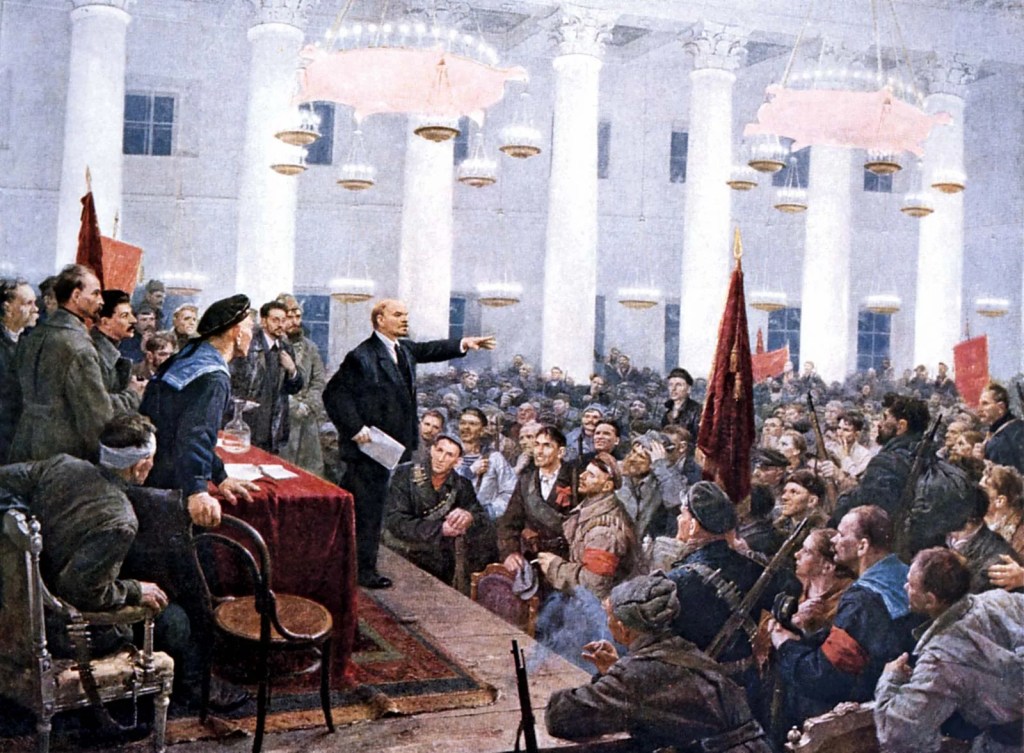
On the dawn of March 18, Paris arose to the thunder-burst of “Vive la Commune!” What is the Commune, that sphynx so tantalising to the bourgeois mind?… It was essentially a working class government, the product of the struggle of the producing against the appropriating class, the political form at last discovered under which to work out the economical emancipation of labour.
History does not offer the proletariat a choice of ways. The first task of the working class is to elevate itself to the position of ruling class – that is, it must win the battle of democracy. To win this battle, the proletariat must establish for itself a working class government that represents in both form and content the historical task of the proletariat. However, as Marx so clearly elucidates, the proletariat cannot simply seize the existing apparatus of government and furnish it for its own means. What then, is the political form through which the working class can rule?
The Modern State
The origins of the modern state lie in the development of capitalist society, and the social crises that broke through the morass of feudalism. As is often the case, the final form of a given social order presages the coming transformation of society. In the case of feudalism, the final form of feudal society prefigured the form that the bourgeois state would take: Absolutism.
Traditionally, feudal states were necessarily decentralised and based upon powerful blocs of local nobility. In this state the King was understood as being the first amongst an entire class of aristocrats who possessed traditional rights over the lands they held. However, the crises of the 15th Century drove this system into crisis. A crisis in European agriculture brought on by the limitations of feudal relations saw the relative productivity of marginal lands fall and grain yields drop. This process was hastened by a string of famines, plagues and wars. Soon, Europe would be ravaged by peasant uprisings, and the growing power of both the urban and rural poor threatened the powers of Crown and Church. In Western Europe, where serfdom had collapsed, the solution was to consolidate the feudal state into a centralised monarchy presided over by a powerful monarch. Perry Anderson explains:
Absolutism was essentially just this: a redeployed and recharged apparatus of feudal domination, designed to clamp the peasant masses back into their traditional social position – despite and against the gains they had won by the widespread commutation of dues. – Lineages of the Absolutist State
With the centralisation of the state, many of the elements of the modern state emerge: the standing army, the military-bureaucracy, and the emergence of a notion of national sovereignty following the end of the Thirty Years War. It was this form of state that the nascent bourgeois would go on to perfect with their ascent to political power in Western Europe over the course of the 17th and 18th Century.
The Bourgeois Republic; or, The Constitutional Oligarchy
Rather than popular rule, what predominates today in even the most “democratic” of the bourgeois republics is a constitutional oligarchy. This reflects the contradictions of bourgeois society in general. Capitalist society is a society in which the appearance of formal equality in the free exchange of commodities, masks real inequality and domination (between labour and capital, between industry and finance, between debtor and creditor). As such, formal freedom and equality before the law and formally democratic political institutions in the Bourgeois Republic mask a state that remains, at its core, undemocratic.
The form of the Bourgeois Republic reflects this reality. Constitutionalism, which limits democratic control over the organisation and order of government by making a legal document sacred in the functioning of government, grants political power to the legal class, and functions as a dictatorship of the dead over the living. The division of powers, which maintains elements of monarchy (in the executive) and aristocratic (in the judiciary and the undemocratic upper houses) government, limits popular control on government. The unrepresentative electoral systems allow a gang of powerful bourgeois parties to maintain their stranglehold on government. Most of all, the unaccountable military and bureaucratic strata rule without democratic mandate over a state that is theirs to command. All of these elements reflect the fundamentally undemocratic nature of the Bourgeois Republic – it is a democracy for the slave owner, for the ruling class, in which the proletariat is systematically excluded from independent political activity.
The Commune-Republic
How does the Commune-Republic differ from the Republic of the Bourgeois? While both are republican in the abstract, the Bourgeois Republic is a form of minority-class rule that defends the rule of the exploiters. In every Bourgeois Republic, the form of the Absolutist State is preserved with the special bodies of armed men, the military-bureaucratic state, and the limitations on democratic rule. The Democratic Republic, on the other hand, represents the exact alternative to the Bourgeois Republic in terms of historical development – both the perfection of the Republican form, and the negation of its bourgeois character.
For Marx and Lenin, the limited experience of the Paris Commune provided the immediate model of the Democratic Republic – the Commune-State. In the Commune Constitution, the division of powers would be abolished, and all power placed in the hands of an elected assembly. This assembly would be made up of popular representatives – servants of the people that would be elected yearly and bound by popular mandate under threat of recall. They would be paid the wages of a skilled worker, and expected to be both representative and political organiser – carrying out political decisions and voting on them. All revolutionary factions – that is, those who upheld the new Commune and its mandate – would be free to publish, agitate, and organise for their political views. In every neighbourhood and workshop, the real power of the Commune was in the mass meetings that elected delegates, and in the armed masses – the expanded National Guard that served as the bulwark to defend the revolution.
In our own program, we further elaborate on this model. The Democratic Republic must eliminate the federal systems that give rise to local privileges and protect powerful rural elites. It must eliminate the cabinet system, and government must be undertaken by committees directly subordinate to the popular assembly. It must establish a revolutionary militia to serve as the basis of a Red Army. And it must establish powerful organs of local government, organs of popular power that allow for proletarian protagonism in every sphere of political life from the factory to the neighbourhood, all united under the central organ of the republican government.
For us, the Commune appears as a mirage – so distant from us, almost hallucinatory. This could not be further from the reality. The Commune provides an immediate model in our own times – the political form through which we may work out the economic and social emancipation of humanity. The bourgeois republican movement promises only a reformed form of monarchical rule – the preservation of the Constitutional Oligarchy. As an alternative, we need to fight for a Democratic Republic – for the Commune in Brisbane, Sydney, Melbourne, and Perth.
 PARTISAN!
You must be logged in to post a comment.