Anthony Furia criticises the Australian Left’s view of the Eureka Stockade, and puts the rebellion into historical context.

There is a historical tendency, from both the Australian Labor Party (ALP) and the ‘revolutionary’ left, to fetishise and glorify the Eureka rebellion as a shining light in their respective ‘movement’s’ history. This tendency holds weight even today – behold the Australian Communist Party’s (ACP) incorporation of the Eureka flag onto their various pieces of sect memorabilia, or the use of the flag by union officials wedded to the very state which the miners of Eureka rebelled against.
Unfortunately for both, the real history of the Eureka rebellion is far less glamorous, and far more nonconformist to the ideological goals of both the ALP and the varying revolutionary sects. On the 30th of November (1854), after the Ballarat Reform League Charter was rejected by Governor Charles Hotham, a coalition of proletarianising petty bourgeois miners – independent producers increasingly working for large mining firms – swore an oath to the Southern Cross “to stand truly by each other and fight to defend our rights and liberties,” and entered open rebellion against the Victorian colony. Over the next three days, they built a stockade – which lasted for a grand total of fifteen minutes under the advance of the colonial military police force on the 3rd of December. The fighting produced perhaps 27 total casualties (it’s difficult to know, due to the inaccuracy of death registries in this period), and the rebellion was swiftly dismantled completely. Not the most historically awe-inspiring sequence of events – yet, in fairness, it is the demands of the Ballarat Reform League that attract the most political attention.
The changes proposed by the League were as follows;
- A full and fair representation
- Manhood suffrage
- No property qualification of Members for the Legislative Council
- Payment of Members
- Short duration of Parliament
Immediate objects of the Reform League:
An immediate change in the management of the Gold Fields, by disbanding the Commissioners.
The total abolition of the Diggers’ and Storekeepers licence tax, and a thorough and organised agitation of the Gold Fields and the Towns.
That to carry out the forgoing objects there should be a large tent erected in which to meet and conduct the business of the Reform League. Cards of membership will be issued in a few days and Ballarat divided into districts.
What do these demands signify for those so neurotically attached to the Eureka movement? Well, for those of us vested so deeply into communist politics today, they’re not particularly breathtakingly radical. However, their historical importance for any movement which proclaims itself loyal to the truly democratic (and thus to communism) is certainly clear. Yet even in acknowledging this particular historical legacy, the place of the Eureka stockade in the cobweb-ridden minds of many Australian communists remains utterly baffling. Does this resemble our minimum program? Certainly not! Was it an expression of proletarian political independence and uprising? Not unless you believe in the ultimate revolutionary potential of disgruntled small business owners.
Was it, by any metric, any measure or subjectivity, a success in revolutionary action? Absolutely not. Every communist worth their salt will repeat ad nauseam that the “traditions of dead generations weigh like a nightmare on the brains of the living”, yet when we are confronted with this in reality, we seem entirely incapable of overcoming this precise affliction. It is time for the movement, for us, to grow up; to seek knowledge from all events of revolutionary struggle in Australia, and imitation from none. We have a future to make, and barely any past to glorify – Eureka has no place in that slim past,
and certainly possesses none in our struggle for the future.
To turn our eye briefly to the other political demographic that seeks to incorporate Eureka into their history – the ALP – we would unkindly suggest they stop kidding themselves. 2024 alone contains enough evidence for a lifetime to demonstrate the ALP’s total non-commitment to democratic struggle. When pro-Palestinian protests happen today – nonviolent, peaceful protests at that – the first to condemn, deny, vilify, and send in the full-throated forces of the Australian state apparatus is that very same party.
Were the Eureka rebellion to occur today (with the remaining relevant demands, 1 and 5, and perhaps the demand for the abolition of some other specific tax) the ALP, as a party of Australian capital, managing the Australian colonial state, would crack down with unmitigated, unprecedented force. There is no history of democratic struggle within the ALP – and certainly not a continuation of that fictitious past to the present day. Perhaps slightly begrudgingly, however, we should admit there is a certain connection between the ALP and the Eureka rebellion, just not the precise one they would care to cultivate.
In incorporating the immediate economistic interests of (previously) dissatisfied worker- settlers and proletarianising petty bourgeoisie into their political project, in harnessing layers of such classes for the creation and maintenance of their party, the ALP was able to achieve such miraculous policies as mass- restriction of non-white immigration immediately upon federation. Thus ensuring the relatively privileged positioning of certain strata of the white working class within the newly formed nation in an attempt to prevent any ‘troubling’ events such as those at Eureka 50 years before.
The problem with the Eureka rebellion is this; it is incorporated into every possible mythology pertaining to Australian political development and democracy, from the ‘revolutionary’ left to the Liberals under Menzies. It is heralded as a ‘expression of democracy’ in the mainstream – proclaimed as a divine pivot point which changed the course of the history of the Australian state and democracy. For (some) communists it is the ‘great revolutionary moment’ – the thing we should seek to imitate, to recreate, to become. For others, the mainstream of Australian Laborism, it is a positive expression of their own future – an omen predicting the creation of the ALP.
The truth of the matter is that the Eureka rebellion is neither. Perhaps Marx, in assessing the events of Eureka as an expression of the revolutionary movement of 1848, was right. The events, just like those of 1848 across Europe, are important to communists, surely – but they are not communist events. Nor, in the case of the Eureka stockade, were they even successful events. There is little to aspire to, and even less to support with the die-hard fanaticism of a
historical reenactor.
Once again, this does not mean we should pay the rebellion no mind at all – communists should seek to learn from all historical struggles that express the potentiality of the democratic masses against the state apparatus. Rather, there is no reason to worship it as some do. We do not need a Eureka flag to communicate what is already assumed by a red one.
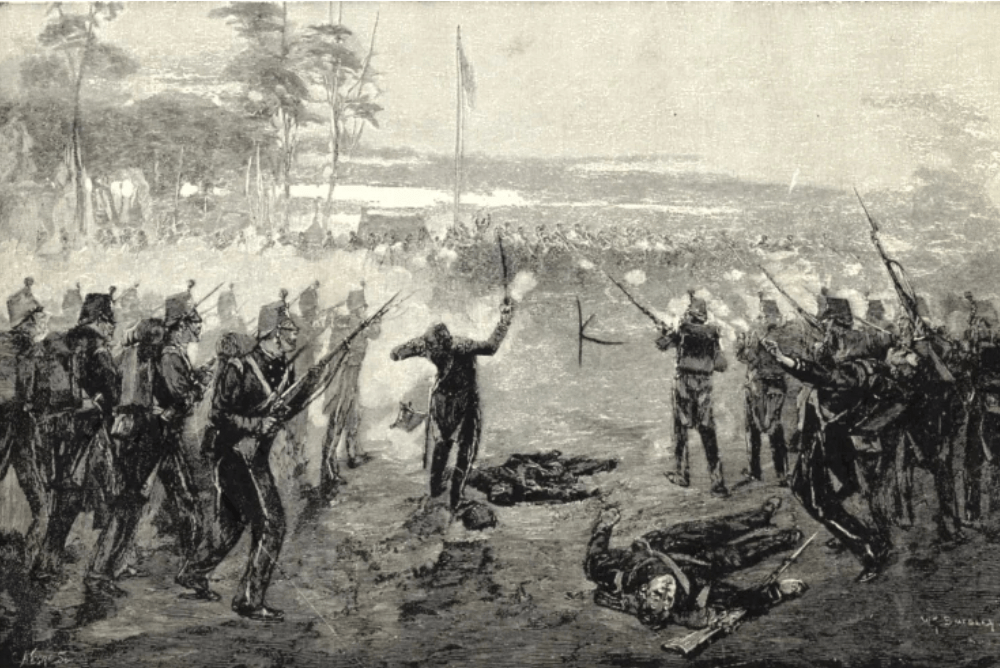
We do not want to indulge in petty workerism – glorifying the Eureka because it’s popular amongst a few bureaucratised unions and the worst type of teenage history fan is as pathetic as it is useless to the movement for a communist party.
We do not have any reason to uphold this rebellion as the standard – it is the standard for nothing but the extremely low bar we must overcome, as Marxists, as workers, as revolutionaries. Comrades should look towards expressions of working class power that capture our present moment, that capture to direct
history of our movement – only through the forging of a new future, of a mass party, can we expect to achieve anything beyond a re-enactment of the tragedy of the 3rd of December, 1854.
 PARTISAN!
You must be logged in to post a comment.