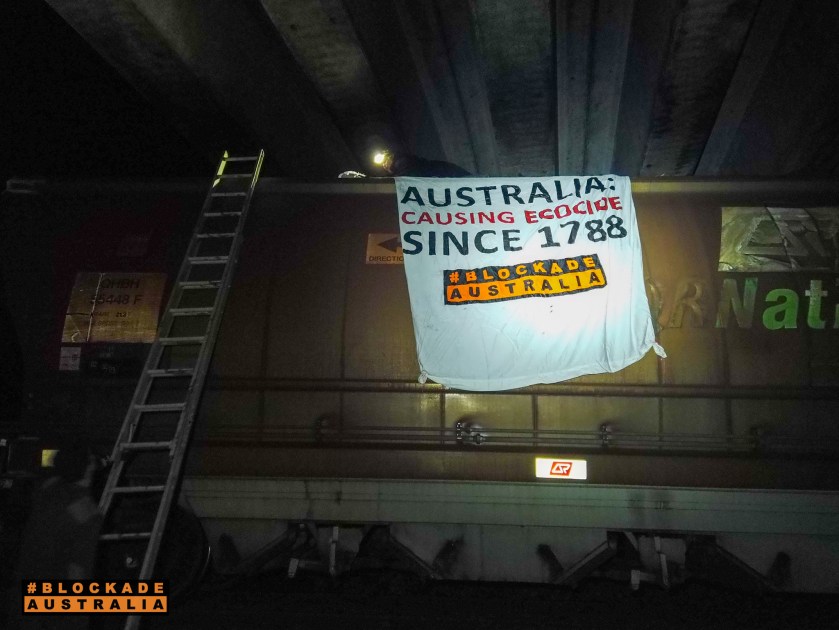
An anonymous contributor sends an open letter in addressing political issues with Blockade Australia.
Dear Blockaders and comrades,
I hope this letter finds all of you very well. I politely ask that you read this letter. It contains in it the sum of my experiences working alongside you and I hope that the lessons I have learned from that time can be imparted to you also. Although this letter may be lacking in praise, this does not mean that I do not praise you. I admire all you, your courage and wit, immensely and I hope that this letter is seen for what it is: an attempt to better our movement out of respect for our goals and strategies, and not to an attempt at a takedown or snide critique. To sum it up, your important mission, to turn the reformist climate movement into a workshop for Anarchism, suffers from a fear of rejecting reformism. Many of BA’s most staunch members reject reformism in discussions with one another. However, in practice, struggle against the state is not in and of itself sufficient to radicalise reformists coming over from the non-violent direct-action climate movement. Bunny messaging was more likely to be reformist than revolutionary, and little effort is taken to educate bunnies on proper revolutionary messaging.
The politics of consensus democracy must not be applied to BA. Practically, a group that explicitly aims to incorporate reformists into its revolutionary ranks cannot achieve any kind of meaningful consensus other than appeal to the lowest-common-denominator. I argue that, from these issues, numerous other issues have emerged in BA which continue to haunt us: misogyny and predatory behaviour within our ranks and the failure to adopt a truly intersectional politics.
Consensus Politics
Firstly, we must address the flaws of consensus decision-making within BA. I saw numerous problems emerge from this practice within BA, which re-asserted the pressure of capitalist power dynamics because of this prefiguration. Blockaders, in conversation, were aware of the need to manufacture compromise rather than for it to emerge organically. This resulted in less-experienced and more reformist elements within the organisation blocking revolutionary messaging (such as on Israel). Furthermore, anticipating the need for consensus led to members in the organisation remaining silent so as not to invigorate the more opinionated and senior, and often male, members who, as a result, effectively controlled the decision-making on larger scale strategy and messaging.
A totally prefigurative politics is impossible under the yoke of capitalism, which divides us into classes, genders, and races. It hides revolutionary politics away from us, confusing us with these divisions. Because of these divisions, an immediate basis for solidarity on any single issue between disparate groups of people is hidden from us. Without explicitly revolutionary politics to unite us, consensus politics stealthily reproduces wider social hierarchies and limits capacity for the only politics that will save us (revolutionary politics). There is a huge variety of disparate politics within BA because it is united only by a desire to take dramatic action. The only “consensus” that can be formed on anything then is, in reality, accepting the weakest anti-revolutionary view.
Reformism in Our Ranks
Underlying this is a misapplication of a core Anarchist principle – that struggle radicalises people. Core Blockaders have explicitly used this principle to justify their strategy to me: we do not need to have anything more than a subtly revolutionary message, because anyone who works with us will be radicalised after subjugation by the police, court system, and after seeing no progress made by reformist institutions.
It has not played out this way. Many bunnies were Greens party activists trying to earn “activist cred” before returning to electoral politics. Even veteran bunnies rarely called for anything resembling revolutionary transformative politics, instead reiterating increasingly desperate demands for attention and validation by the state.
Few attempts are made towards constructing a consistent revolutionary internal politics, and these attempts suffer from the flaw that the messaging itself suffers from, which is a lack of positive content. It provides no vision of an alternate society and is instead a simple, vague negation of reformist politics (but not of the society itself). This allows radical reformist politics, which simply use radical means to achieve state validation, to sneak into the cracks. There is no method for ensuring bunnies stick to the messaging anyway, on the basis that this would be exclusionary or authoritarian.
This fear of “authoritarian” or “exclusionary” action has numerous other consequences. Lacking the ability to collectively discipline Blockaders, information security is impossible to maintain to a high standard. Without a positive agenda of transformation and the articulation of revolutionary politics, sexually predatory men are attracted to the movement and unable to be effectively removed. Similarly, the biologically essentialist politics of the “divine feminine”, that many women Blockaders implicitly believe in, leads to BA often being a transphobic organising space. Furthermore, it has been the mission of feminists for 200 years to demystify and denaturalise femininity, pointing out its nature as a social construct, and the “divine feminine” ideology is completely anti-feminist.
Majority decision making, the only way to adopt revolutionary politics – the negation of current society – is abandoned in favour of consensus decision making, which, as I have seen, breeds conservatism.
The Politics of Trauma
The post-action debriefs are indeed the best opportunity for discussions that raise the consciousness of bunnies. Unfortunately, trauma politics have infected this practice. The principle in BA is that bunnies, sharing their trauma of being suppressed by the police, will be able to realise the connections between these experiences and build this into a common picture of solidarity, a strategy shared to some extent by the feminist movement in the 60s – 80s. Instead, however, what occurs is that Blockaders take turns sharing their experiences and being listened to and recognised for how difficult it must have been, with observers commenting on how hard it must have all been.
In practice, instead of a collective identity forming around these experiences, Blockaders oscillate between therapist and patient. Like therapy itself, this may be useful but is nonetheless limited to individual action and experiences rather than collective solidarity and social action.
This is representative of a wider issue within the activist scene in Australia. This culture regards intersectionality as the process of “recognising” or “centreing” the struggles of minority groups, practising this same swapping between therapist and patient, observer and observed, rather than building a common picture of solidarity and united struggle. This instinct is understandable – it comes out of experiences in the 20th century with white feminists espousing “sisterhood” between all women, which in reality meant subjugation of black women to the agenda of the white woman. However, it is also motivated primarily by a desire for validation, rather than liberation, and white guilt.
Towards Transformative Politics
Truly transformative politics does neither: it does not segment struggle into different parallel lines, linked together only by moral obligation, nor does it collapse the contexts of all forms of subjugation into the narrative of the most prominent exploited group. The prevailing logic is that, “well, workers can’t be liberated if women aren’t either, so I suppose we have to help the girls out,” or “it’s my duty as a white person to support the struggle of black people against racism.”. This is a mistake!
Systems of exploitation are not specific to the primary object of their exploitation, they affect everyone universally also! They are not separate but interlocking systems, they are the arms of the same octopus. As a man, you too are oppressed by patriarchy, which controls your sexuality and enforces standards of behaviour upon you, which mutilates your androgynous human soul.
Cisgenders, whenever you have felt ugly, too “mannish” or too “feminine”, that is gender dysphoria! It is not unique to transness, everyone is punished by the impossible gender standards that the ruling class enforces on us. Whites, us who have been raised to fear and loathe our fellow dark-skinned humans, we are humiliated by this fear which limits our capacity to love one another!
All this to say that there is only one struggle – the struggle for universal human liberation. And it unites every single one of us. There is a fear amongst the more genuinely Anarchistic Blockaders that, were we to adopt a revolutionary line and attempt to implement this internally, that we would limit our growth and exclude potential future revolutionaries. I have been told that, actually, our current messaging allows us to appeal to all kinds of people from all walks of life.
This is sacrificing long-term strength for short-term growth. History, in the form of the Occupy movement, demonstrates that this sort of loose coalition is a recipe for eventual disillusionment and defeatism.
History has also proven that revolutions are a product of leadership from the front. By adopting transformative politics, which is revolutionary, which attacks all aspects of oppressive society, which takes the hard road and from day one makes the proud claim that one day we will tear it all down – this is the only way to actually appeal to all kinds of people from all walks of life. Rather than appealing to their reformist sensibilities now, and instead by arguing staunchly for their liberation at every turn and in every circumstance, we will win them over.
While we must not enforce a dominant white perspective on other Blockaders, we must abandon this fear of unity and forge ahead to a transformative revolutionary politics.
Where to Go From Here
To this end, I make the recommendations that BA:
● Abandon consensus politics. Form assemblies to debate strategy and ideas. Make use of affirmative-action processes to ensure all are given a voice. Exclude Blockaders who fail to treat others with respect.
● Adopt an openly transformative and revolutionary line that envisions a better society. Ensure bunnies stick to this messaging and do not reuse bunnies if they demonstrate they cannot.
● Patiently raise the revolutionary political consciousness of Blockaders through accessible means, whether this be reading groups, workshops, or collective discussions.
● Ensure core activists who lead strategic decision-making are accountable to the collective without compromising security culture.
● Create democratic non-authoritarian procedures for actually ensuring security discipline.
Thank you for reading.
In solidarity,
Anonymous

 PARTISAN!
You must be logged in to post a comment.