Max J advocates for communists to take a more serious, strategic approach to the oft-maligned realm of student politics.
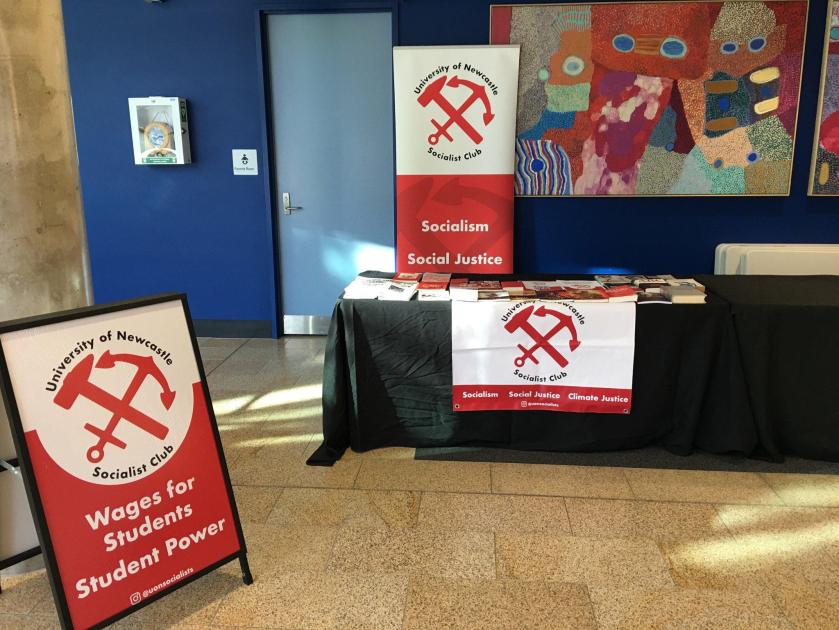
Student politics is a total mess. To many, it is a circus where wannabe bureaucrats cut their teeth in petty campus fights. If communists want to organise students and other young people in serious mobilisations, we need to have a real strategy for engaging politically on campuses. We need to take student politics as seriously as we take all other political engagements.
Students and other young people historically have been and remain a deeply politicised, politically engaged demographic. However, this engagement has not always translated into advances in the class struggle or positive developments for the communist movement. I myself pointed this out when commenting on the relative decline of the Palestine solidarity student occupation wave (Direct Action #14: “Is there a future for the Student movement?”), a wave which has since died out. In that article, I state that communists should engage with students as workers and not just as students.
We should view campuses as just another avenue of struggle, no different to one’s workplace. The issue with the dominant ‘strategy’ of the organised Left, it seems, is that there is no strategy at all. Groups such as Socialist Alternative (SAlt), Solidarity, and others appear to orbit campuses for the sake of orbiting campuses, soaking up student members that they tend to lose fairly quickly. If not these groups, they are absorbed by Labor or the Greens. These are student activist groups that, like activist groups in general, exist just to exist.
In engaging on campus, what should communists aim to do? We should aim to supplant the NGO-ified ‘student associations’ (many of which were built out of the husks of the old student unions) with genuine, democratic bodies of representation: real student unions. On campuses where student unions still exist, and haven’t been completely turned into NGOs, we should intervene in them and aim to have communists within them, same as any other union.
Many groups fail in their campus strategy as they aim only to mobilise students to do repetitive, tunnel-visioned activist campaigns, as opposed to building long-lasting and strong alternative institutions. We shouldn’t reject these groups entirely, but we should be clear in our critique and be clear in what we want. Their ‘strategy’ of permanent activism has failed, it has not produced a viable alternative to the NGO-ified student association or the deeply bureaucratic student union.
At the University of Newcastle (UoN), there is an attempt by certain students of a vaguely left-wing political persuasion to ‘fix’ the Student Representative Council (SRC). I will use this as an example of what we should be going against and avoiding. Running under the name ‘Students for Palestine’ (unrelated to the SAlt-run Students 4 Palestine groups), they previously held a protest encampment at the Callaghan campus for under three months, before they were defeated by the administration.
After their camp was defeated, only then did they decide to call for a Student General Meeting (SGM). Was this SGM called, like at other universities, to get the student association to support the demands of the encampment? No, it was called to pick sides in an internecine fight between sections of the SRC (Student Representative Council) and the UoN Student Association (UNSA). Their call for an SGM, made in early August, carries with it four demands:
- That UNSA remunerates SRC members as casual employees.
- That UNSA ensures that no member of the SRC can be removed, suspended, replaced, etc by UNSA.
- That international students have no barrier to sitting on the SRC.
- That UNSA adopts the previous student association’s funding model and provides clubs with $2000 up front for the year and that club funding increases with inflation.
- That UNSA supports BDS.
Of the 5 demands, only 3 and 5 have any merit. Demands 1, 2 and 4 are not only petty demands made for self-benefit, but are either undemocratic (Demand 2) or financially nonviable (Demands 1 and 4). This is an example of what we as student communists should be against: the co-option of our movement by petty bureaucrats who use the motivation of well-meaning people to fight out their corporate battles. Since there has been very little talk of an SGM from the UoN Students for Palestine crowd since their announcement in early August, it is safe to assume that they did not have the clout they thought they did and were unable to scrounge enough people to force UNSA to call one.
Such battles are dime a dozen in the student politics realm. However, as communists, we should endeavour to intervene in all areas of struggle, including the campus. There are many areas in which students are suffering: in the classroom, on the job, at home, the list goes on. By stepping away from the campuses and not taking student politics seriously, we leave students at the mercy of regressive activists who are effective at wasting people’s time, burning them out, demoralising them, and leaving them unwilling to continue any kind of political engagement. They are an industrial acid on radical politics.
For this reason, I make the argument that the Revolutionary Communist Organisation (RCO), and the communist movement in general needs an on-campus strategy. If it is true that communists need a strategy in the broad sense (it is, they do), then it is also true that they need a strategy for engaging with campuses and students. It seems that for the most part, none with any seriousness exist today. With much of the RCO being comprised of young people (most of whom are students), it is vital that it develops a strategy for engaging with the campuses.



 PARTISAN!
You must be logged in to post a comment.