Nathan Kats reports on the 2024 Queensland LNP conference and what it means for the ailing bourgeois monstrosity.
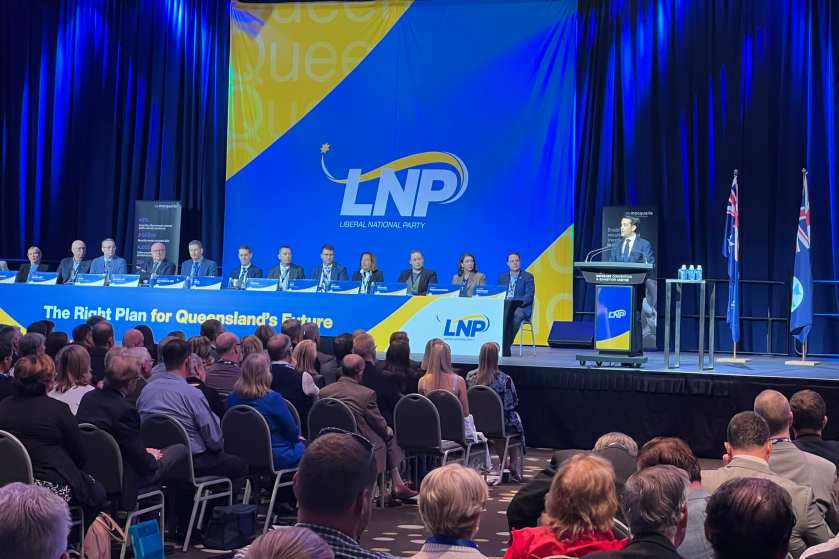
The recent Queensland State Convention of the Liberal National Party (LNP) revealed the party’s internal dynamics and ongoing challenges. Despite the three-day duration from the 5th to the 7th of July, the convention was marked by a scarcity of significant achievements and a notable absence of innovative solutions. Rather than presenting a compelling alternative vision, this lack of forward-thinking and fresh ideas raises concerns about the LNP’s future direction and ability to adapt to changing political landscapes.
Various observers attended the event; including party members, donors, lobby groups, media representatives, delegates, and politicians. However, the restrictions on observer participation, particularly the evident fear of media scrutiny, cast a shadow of doubt on the party’s transparency. The contentious relationship between the LNP and the media, with fact-checking and accountability being significant concerns, further fuels distrust in a party riddled with accusations of dishonesty.
The LNP’s paranoia about infiltrators and information leaks is evident, yet there seem to be few innovative ideas circulating within the party. Much of the rhetoric remains unchanged, albeit with a slightly more fanatical tone. The usual calls for unity and tough stances on crime were reiterated, and the claim that they are not simply a conservative or moderate party but the Liberal party was a recurring theme, often surfacing during intense factional infighting.
Going into the event, I fully expected as much that the LNP would be a disappointment. The LNP is weak internally. It is a dead and dying entity filled with rats seeking to take as much as possible while the entity remains salvageable. The talk of the dangers of a hung parliament seemed ironic given the LNP’s internal divisions, which leave it in a state of limbo. These divisions not only hinder the party’s ability to present new and working ideas but also create a reluctance to challenge the interests of powerful donors and foreign entities, particularly from the U.S. This, in turn, raises concerns about the party’s ability to govern effectively. The resulting hesitation stifles meaningful reform and innovation, leaving the party in a precarious position.
Infighting between the Moderates and the Conservatives further incapacitates the party. This internal power struggle prioritizes factional dynamics over public welfare, leaving the party ineffective in addressing immediate and long-term issues. Thus, the party becomes nothing more than an excuse for donors and lobby groups to get their way while everyone else in the state gets left behind. The inability of the two sides to work together should cause the people of Queensland to feel a mix of relief and frustration. Australians should be wary; nothing good will come from the potential incoming state and federal governments. The Australian people saw what factional fighting led to when it came to the Rudd-Morrison era.
The LNP is sabotaged from within; they need no infiltration from outside. Both factions fear the other will shut them out if one gets more power. It is a Game of Thrones, a disappointing reality for the people of Queensland. Additionally, the LNP’s reluctance to crack down on market manipulation and the resulting renter economy reflects a future where the property-owning class wields political power, disenfranchising the renter class. This situation underscores the broader reality within the LNP: it is less a battle of political ideologies and more a contest between factions of the ruling class vying for power, with solutions rarely addressing the needs of the working class.
A particularly intriguing aspect of the convention was the mention of an individual working in the shadows to influence the party’s direction. This Individual, who operates outside the party room and is not officially associated with the LNP, has managed to wield considerable power within the party through various agents. This Individual is a significant annoyance to the party executives, who are focused on keeping lobbyists and donors happy. Their focus on these third parties’ investments and business opportunities raises concerns about the party’s priorities and commitment to serving the public interest. No name was given as the party executives didn’t wish to give the individual any unwarranted attention.
There were also significant concerns from within the party that, with changes to laws concerning political donations, the ‘average person’ would find it more challenging to elect their favored candidates. The fear was that the election would instead be gerrymandered in favor of Unions. ‘Average person’ was code for donors and lobbyists, who were worried about losing their influence in the party’s decision-making process.
Support for Israel passed at the convention, yet there is a noticeable shift within the party toward growing disillusionment with Israel. This is partly due to the actions of the Israeli government during October 7th and the influence of the Israel Lobby. Within the Christian Lobby, there appears to be a divide when it comes to supporting Israel, with half in favor of Israel and the other half against it. This growing disillusionment is a clear indicator of the party’s evolving attitudes towards international relations and the influence of lobbying groups. Additionally, there was talk that Muslim disillusionment towards Labor could potentially increase the Liberals’ chances of forming a government. There is also talk that the Federal Liberal Party will likely regain the seats lost to Independents.
The convention also included discussions reflecting extreme views, such as considering the Greens party as communist and emphasising that “friends don’t let their friends vote Greens” and “should not allow their children to vote Greens.” An auction featuring a portrait of Joh Bjelke-Petersen, an emblem of an era characterised by suppressed workers’ rights and unchecked police power, highlighted a troubling nostalgia admired by both factions within the party. This event, which symbolises a return to a more authoritarian era, underscores the party’s internal dynamics and its potential implications for governance and public interest.
Overall, the LNP’s internal strife and lack of innovative solutions suggest a party more preoccupied with internal power struggles than serving the public interest. This internal discord, often overshadowing the party’s policy making and governance, raises questions about the LNP’s overall competance as a party of capital.
 PARTISAN!
You must be logged in to post a comment.