Sylvia Ruhl reviews the 1980 film Breaker Morant, lambasting it for its poor attempt at “anti-war” messaging coated in Australian nationalist mythos.

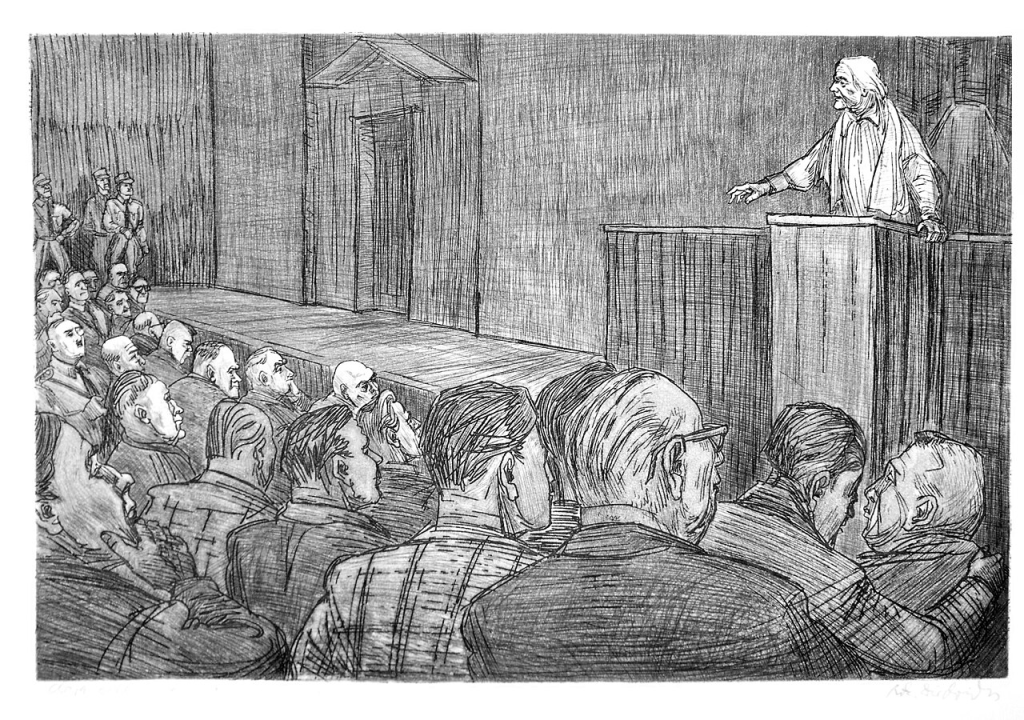
The film Breaker Morant (1980) directed by Bruce Beresford is a highly acclaimed courtroom film of questionable historical accuracy (which this review will only address as relevant) that depicts the court-martial of three Australian soldiers serving in the British Army charged with the revenge killings of civilian prisoners during the Second Boer War. The individuals on trial were lieutenants Harry “Breaker” Morant, Peter Handcock, and George Witton of the Bushveldt Carbineers.
The defence asserted that they should be acquitted on the basis that they were following orders to not take prisoners. Whether such orders existed was the focus of the film. Such orders were not proven to have been issued, and all three were found guilty of murder, with Morant and Handcock being executed. The trial’s proceedings were interspersed with flashbacks depicting what was being discussed, including combat and the executions of prisoners of war. The film deserves praise for its stellar cinematography. However, one cannot ignore the problems with its attempt to, according to the director himself, convey a pacifist message that repudiates war and the Nuremberg Defence. The film’s narrative, as well as the medium of film itself, inevitably caused it to take on an Australian chauvinistic and pro-war character.
The film clearly depicted the men as guilty as charged and having carried out murders against civilians and POWs on their own accord. However, it explicitly propagated the myth used historically that there were standing orders issued to kill all Boer POWs, which would have exonerated the accused for at least some of the murders. It also depicted the trial as motivated by the British to scapegoat the murders on three soldiers to bring about peace talks with the Boer republics. These claims are used to this day by those who claim that Morant was innocent; however no evidence has been produced to substantiate them.
Regardless of the question of the existence of such orders, the point of the film is that even if the soldiers’ Nuremberg Defence was true, this would not change the nature of their acts, nor of the war. The intended point is not that they happened because the soldiers went out of line, nor because the high command was overzealous, but simply because of the overarching context of the actions: that they were in a war.
The film centered around the soldiers’ own experiences and put forward their views to the audience, in all the emotional detail that one would expect them to hold. This includes their justifications of their actions that they historically used in court, and their disillusionment with Empire. A most pointed example of this is the depiction of Morant and Handcock in the final scenes of the film after they are sentenced to death, in which their Australian nationalism, and feelings of betrayal and mourning for their own death was the focus. By centering Morant and Handcock’s personal views on the verdict, it should come as no surprise that many viewers see Morant as a victim of injustice.
Despite this, the depiction of both the accused as guilty, and the military brass as scheming and brutal, even within their own rules of engagement, clearly shows that viewers are not meant to side with one or the other. Pacifistic and reductionist to the point of simply expressing the idea that “all wars are bad”, it is completely detached from a materialist analysis of war. Confused as to why viewers continue to walk away from viewing the film sympathising with Morant, Beresford himself stated in a 1999 interview that its intended message was pacifistic: “But what was interesting about it was that it analysed why men in this situation would behave as they had never behaved before in their lives. It’s the pressures that are put to bear on people in war time. Look at the atrocities in Yugoslavia. Look at all the things that happen in these countries committed by people who appear to be quite normal. That was what I was interested in examining. I always get amazed when people say to me that this is a film about poor Australians who were framed by the Brits”.
It was once stated by the director François Truffaut that “There is no such thing as an anti-war movie”. This is due to the nature of the medium; film can only appeal to audiences through visuals and sound, and therefore cannot ever convey its reality. It inevitably draws attention to what it can convey to its audiences, that being camaraderie, and a sense of adventure. The effect of this is to reduce any on-screen depiction of war into an epic of pro-war propaganda, regardless of its intentions.
I do not know what it would take for a film to be unmistakably interpreted as an anti-war film, if that is even possible. But given the reasoning outlined earlier that visual media will make whatever depictions of combat it portrays appealing to pro-war audiences (though almost all would never use that label), it would be required to show absolutely no depictions of combat, nor of uniformed soldiers. It would also need to forgo the idealistic notion of being anti-war for its own sake and adopt a materialist and Marxist analysis of war. That is, that in the context of the contemporary capitalist era, it is waged as a means of reconstituting trade relations after they expand to a point where doing so otherwise is no longer possible. Perhaps most importantly, is that such a true anti-war film would need to advance an unapologetically internationalist outlook that states that the only way to end war, is to bring the working class to power through international revolution. This would show to audiences the world-historic way that war will end, and that this is something that the working class must strive for.

 PARTISAN!
You must be logged in to post a comment.