Anthony Furia questions the political direction (or lack thereof) of the Palestine solidarity movement in Melbourne.
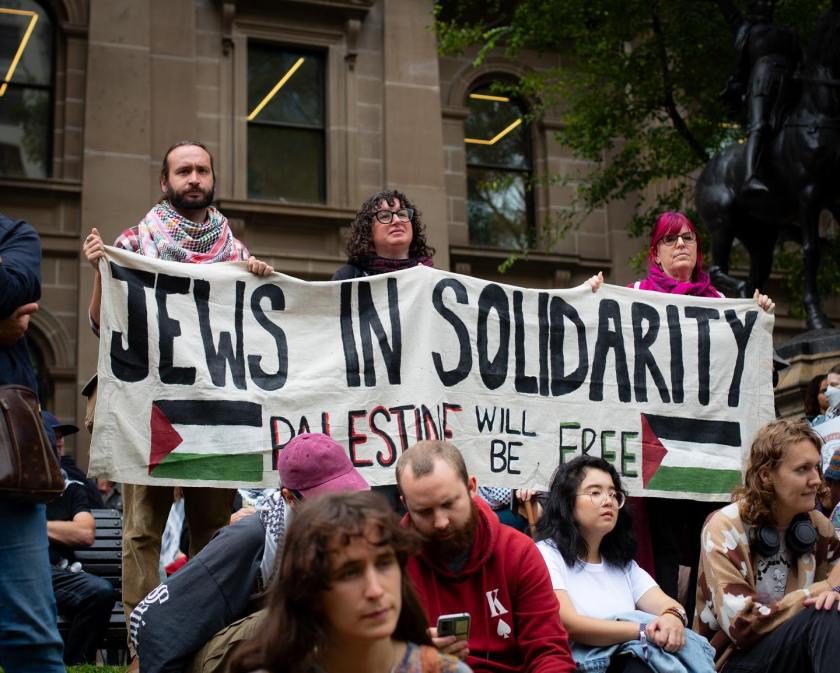
In attending the weekly rallies here in Melbourne for Palestine, involving oneself in aspects of organising for Palestine on campus and in activist spaces, one may have an increasing sense of despair surrounding the movement itself. In the face of undeniable, abject political failure, the movement itself has floundered.
It has maintained its broad appeal, marshalled constant rallies, and coordinated dozens of protests in a variety of workplaces and places of education. It has done all of this, and has come to nought. There are a myriad of reasons for this continued failure, yet one that both perpetuates this failure and grows in response to it, like a cancerous tumour benefits from the decline of the body until its collapse, is the shedding of political character.
In other words, the movement unbecomes itself as a movement. Instead, the mainstream of the Palestinian Liberation struggle careens ever forward towards a totalising pit of self-pity and social grief. The struggle ceases to struggle, and becomes instead an observation. In practice, this is demonstrated most clearly in the Sunday rallies of fame in Melbourne. Here, thousands gather weekly to hear the latest death tolls. The weekly batch of civilians massacred, the most recent war crimes committed by a bloodthirsty IDF, the current total of Palestinians dead to an endless onslaught with no end in sight.
Intermingled with this are the affirmations of solidarity from various speakers – unions, activists, Indigenous peoples from across the globe. We gather there, in the centre of Melbourne, to remind ourselves of an ongoing attempt at genocide. We gather there to affirm our own support to resistance, to observe the unending horror ignored by bourgeois politics, media, and society.
In place of the shared grief and shock that would typically be the product of wider society in general, the Palestinian movement – the politically mobilised – take it upon themselves to observe. To grieve and mourn, publicly, routinely, and without fail, the deaths of Palestinians and the atrocities committed by Israel. Mixed with this grief is a constant performance of anger and outrage – a shock, a fury and rage, at what is occurring. This too is a product of observance, of that very process of public grief, and indeed public guilt.
Let it not be said that this observance is entirely unimportant, or, more accurately, that its components are politically unnecessary. Reminding oneself of the very reason for why we fight is just as important as the fight itself – keeping in mind the current situation is crucial, and affirming solidarity is an affirmation of commitment to struggle.
Yet here we encounter the growing problem of the movement – there appears, less and less, to be the fight itself. An act such as the weekly protests is not a battle – it is a ritual. A symbolic routine of observation, a public demonstration of one’s grief and often guilt in the failure of the struggle thus far. When comrades gather to hear the death tolls, to hear the speeches describing killed children and maimed civilians, they are gathering not to battle, but to mourn.
To mourn both what has been lost, Palestinian lives, and in this instance to mourn a struggle that has not yet failed – the movement not yet entirely lost. This is the case not merely for these rallies, but for protests and events across the nation. Even the Student General Meetings (SGMs) are an expression of observance over protest. These are events designed not to achieve political goals or aims, nor define these goals or aims, but to gesture at the very symbolic act being performed (the meeting, the protest, the discussion group) as political enough, and gather in observance.
The truth is, any political movement needs political direction. Currently, there is none for the Palestinian struggle. It is a self-perpetuating cycle of pity. There are pickets, such as those in Melbourne over Electromold, and those previously at the docks (my thoughts on which were made clear in an earlier article for Direct Action), but these lack a unified vision, goal, or anything resembling a mass base.
Rather, the pure numerical majority of the struggle is losing itself as a struggle at all. It is becoming a despairing acceptance of reality, a ritualised display of outrage. To speak in a political direction – to address the thousands who attend these rallies and protests, and present them with an actual political vision, an actual approach, would be a monumental step forward.
Rather than the cry “come back next week and every week”, the call should be towards sustained organisation, towards the building of centres of power in unions, campuses, and society, towards genuine ultimatums and escalating action as the struggle itself escalates.
To truly win – to have even the remotest hope of victory in any sense of the word, we must break from a deadlock of grief and despair. We must move forward, with our outrage, with our fury and anger, yet clear-eyed and politically minded. What must be done is the extension of resistance to every facet – the organisation of struggle through sustained mass organisations, able to cohere forces for consistent struggle.
Communists, of course, argue for this through the argument for a mass party – the communist party. We strive to organise the struggle for Palestinian liberation upon its class lines and character – to maintain independence from, yet organise with, those forces who support the struggle for national liberation along differing lines. To do this the movement must have political character. We must push for this character in the same breath as we push for the mass party itself; unrelentingly, confidently, and with passion.
To liberate ourselves is to struggle – patiently, passionately, and sincerely. We cannot do this through ritual and observation, through a pacified demonstration of resistance. Why struggle at all if we do not struggle to win?
 PARTISAN!
You must be logged in to post a comment.