Brunhilda Olding reviews the themes in the play “Scenes from the Climate Era”.
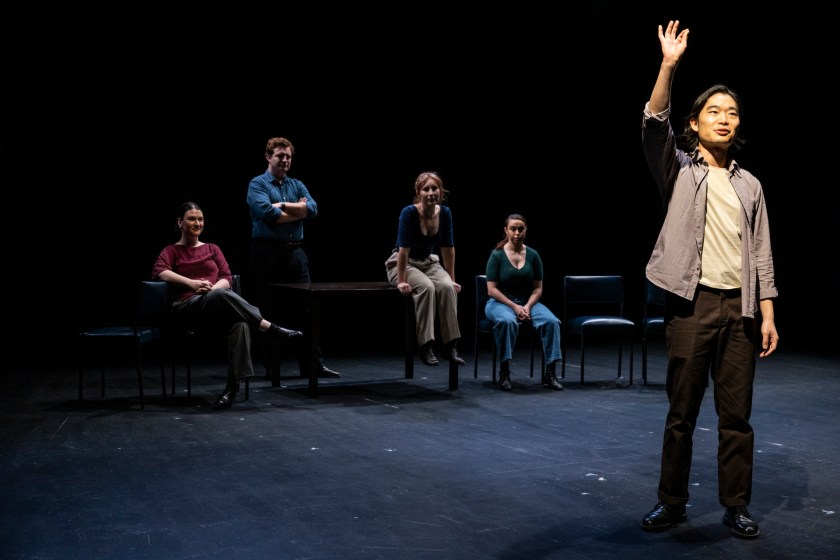
The new play “Scenes from the Climate Era” by David Finnigan is a fascinating insight into the left-liberal mindset on the growing horror of the Climate Crisis. The performance by Saint Micheal’s Grammar School was masterful as per tradition, the current 10-12 cohort holding a strong acting current. The performance of Lizzie Cassidy, Jim Harris, and others deserves outstanding notes, and the novelty of a Brechtian style performance utilising the advances in theatrical technology of the 21st century was a novel development, the works of the sound team despite brief glitches deserve a round of applause.Yet what is more interesting about this play is the political and philosophical insight it provides into the current crop of bourgeois liberal understanding around responses to the Climate Crisis and an insight into the weakness of the Whig capitalist view of history that so dominates their historiography. The two core theses of the play are firstly that we live are living in the ‘Climate Era’ much as there was the Renaissance, or Medieval Era so too there will be a Climate Era, secondly that the mechanism of relating to the Climate is the arc of Denial, Acceptance, Grief, and finally Hope.
This arc is reiterated several times through the play, an initial position of rejecting the scientific consensus on Climate Change, accepting it’s happening and trying to take some actions against it, conceptualising that there is no hope, that the planet is doomed no matter what, and finally hope that something can happen. This concept requires an honest intellectual engagement, from a principled Communist position. I hope to provide part of that engagement throughout this review. However, the titular concept provides a much more interesting engagement with the liberal bourgeois understanding of both the objective crisis that is striking the climate, and the broader understanding of historiography from the capitalist ‘left’. The elucidation of the theory by a Climate scientist portrayed by Max Miller argues that since this generation was born in the midst of the climate crisis, and so too will it die with it being unsolved, it is more accurate to refer to it as the Climate Era. The statement that ends this segment is that the end of the climate era will be when waves crash on beaches again, arguing that since at least a metre of sea rise is locked in all the beaches on the planet will be drowned. To temporarily play into the authors arena of academic expertise of history, this is a fundamentally capitalist approach to history. The Climate Era if it is remembered will be remembered as the bridge between the dying days of the capitalist epoch, and the rising dawn of the socialist revolution. The lack of historical materialism stunts Finnigan’s ability to accurately provide insight into this shifting epoch. In the words of Mark Fischer ‘It is easier to imagine the end of the world then the end of capitalism’ this is stunningly displayed in the conclusion of the piece. As an actor portrays blackouts in a Melbourne with 50+ degrees Celsius days, there is no attempt to portray a new social order, merely the blanket assumption that we will continue to march forwards under the liberal capitalist bourgeois order. An assumption that the readers of this magazine would probably reject.
This assertion ties into the earlier stated secondary thrust of the play. The arc of denial, acceptance, grief, and finally hope. In some ways perhaps a stirring idea, hope springs eternal mankind will rise to the challenges that face us and emerge triumphant. Yet what does this hope look like? It is the fetishisation of the act of protest, viewing wild adventurism as the height of political action that can be taken on Climate Change. One of the penultimate monologues is from a protester at COP26 ranting about how for a split second it seemed like they were about to make a successful final push, and then the protest ends, and they all disperse. That more than anything else reveals the dead-end nature of capitalist protest politics. If the marchers in February 1917 had simply dispersed the Tsar would never have fallen, in Mai 1968 under the falsified leadership of the PCF the marchers did disperse, transforming an opportunity to strike a thundering blow into the heart of capitalism into nothing more than another shibboleth for the decaying remains of the New Left. This ultimately stems from the capitalist relation to politics and reveals a clear message to Communists. A crucial strategy lies in the power of ‘good news socialism’, the ability to transform the struggle against capitalism, into the struggle for socialism. A march against something may draw people in initially but as a long-term project it cannot really rally people, but a march for something can have a snowball effect drawing in more and more to a single banner. Mike McNair’s article in the Weekly Worker ‘Communist Unity and it’s Refuseniks’ (WW1475) outlines a strong position on this issue.
Ultimately the working class have a world to win, and they must struggle to win it. For all of Finnigan’s political faults the message running through his play does point towards this image even if in the most wishy-washy liberal way. Nonetheless it is inevitable that Justice will thunder condemnation, and a better world will be born from the ashes of the old. To return to the play itself, while the short run time limits from reaching a mass audience, the performance deserves applause. If a performance does pop up near the reader it is a worthwhile way to spend the evening.
 PARTISAN!
You must be logged in to post a comment.