Brunhilda Olding criticises the limited scope and vision of the New French Popular Front.
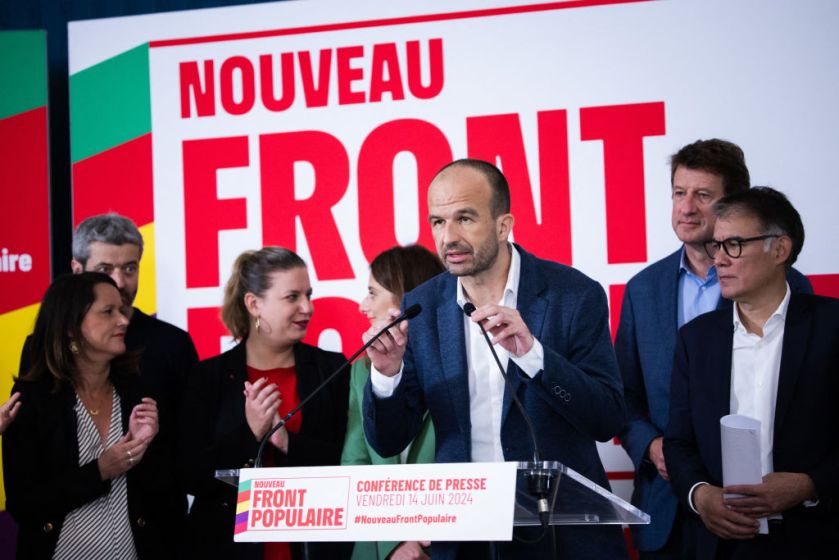
Leftwing pundits the world over have applauded the victory of the New French Popular Front in the recent French elections, who won a plurality of seats in French parliament (7,039,429 or 25.80% of the votes). The task of communists now is a sober analysis of these results, the programme that unified this popular front, and the legacy and tactics of Popular Fronts.
Popular Fronts evolved following the victory of the NSDAP (the Nazis) in the 1933 German elections. The electoral results served as a wake-up call to the Comintern leadership whose ‘Third Period’ had developed the theory of Social Fascism. Popular Fronts called for as broad a coalition as possible to fight fascism, and would have two very distinct tactical phases. In Spain and France, they evolved to be dominated by social democratic and ‘centre left’ parties, though in Spain’s case the geopolitical realities of the Civil War pushed the PCE to hegemony.
It is important to note that even in this case the struggle was never pushed into transforming into a class conflict. In Eastern Europe they emerged as the Soviet Red Army pushed west, with such stellar examples as the National Democratic Block in Romania, or the Democratic Block in East Germany. These in practise served as the fig leaf of bourgeois democracies that the post-war People’s Democracies relied on to maintain legitimacy. On a practical level this legacy of Popular Fronts does not influence the discussion on the French electoral results. When analysing Popular Fronts as an electoral tactic, or the general position of socialists we find that they are a fundamentally reactive tactic. They rely on fighting to defend the bourgeois order.
United Fronts on a practical level in the west derives from the Trotskyist tradition, as outlined by the 4th Congress of the Comintern: ‘The united front tactic is simply an initiative whereby the communists propose to join with all workers belonging to other parties and groups and all unaligned workers in a common struggle to defend the immediate, basic interests of the working class against the bourgeoisie’. The crucial difference between the two is that Popular Fronts are open to the bourgeois if they stand against fascism. What then is the programme of France’s newest Popular Front (NFP)?
For a force that has seen so much of the left crowing about the importance of left unity, and how working together we can defeat the fascists and create a new world, the programme is severely lacking. Perhaps the most revolutionary demands are within the section ‘Towards the 6th Republic’, these proto-demands for a democratic republic are to be honoured as a step in the right direction. But they are just steps. As Marx outlined, the fight for socialism is the battle for democracy, and yet when we analyse these demands we them lacking once again. Let us compare the demands of the RCO’s programme and the demands presented by this Popular Front.
‘For the creation of an assembly of popular representatives! For the abolition of the Senate, and the creation of a single-chamber National Assembly with proportional representation, annual elections, and MPs’ salaries set at the level of a skilled worker. Lowering of the voting age to 15.’ (The Road to Workers’ Power, Section 3).
These are the minimum demands of the RCO, the absolute least that the working class will accept.
Compared to the demands raised by the NFP:
- Abolish the monarchical president in the practice of institutions
- Establish proportional representation
- Revitalise the parliament
- the Repeal of 49.3
- Defend effective decentralisation by strengthening the local democracy in the unity of the Republic.
- Implement the citizen referendum initiative (RIC) and strengthen the referendum’
While if implemented these would be massive steps forward, as demands raised they are fundamentally reformist at best, and in practical terms the demands of rightist radical liberals. The task of Communists is stand unerringly against this deviation. Yet it is no surprise that the Communist Party of France (PCF) has entered this coalition. The Eurocommunist deviancy was long held its roots in Paris, though of course their influence spread across the world, most notably in the Australian context to the Communist Party of Australia, which was dissolved in 1991 on dubious grounds by the Eurocommunists.
The other demands raised throughout the programme of the NFP are primarily for a defence and minor expansion of the French welfare state. Nothing of particular note, until one reaches their foreign policy section, where the growing crisis over Françafrique has resulted in rhetoric towards at least warming relations with the region, this alongside the demands raised on relations with Israel namely the stopping of the arms trade and the recognition of Palestine as a state. Perhaps this represents the development of a serious anti-imperialist tendency within the French left, but a more cynical viewpoint points towards the NFP’s electoral decision to try and win over Muslim, and migrant voters with polices simply beyond being ‘we are not the literal fascists, or fascist enablers.’
The exact form that the new French government will take has not been clarified at the time of writing, though the most recent news points towards a minority government focused on locking out the RN. If the NFP does enter into bourgeois government, they make perhaps the greatest mistake any socialist force can make. Nonetheless we will see how this turns out, and as the age old saying goes c’est la vie.
 PARTISAN!
You must be logged in to post a comment.