Eliza MacDonald discusses the various contradictions behind politics in the states of the Sahel.

In June 2024, the Alliance of Sahel States (AES) was formed. During the first conference of the AES Burkina Faso’s President Ibrahim Traore stated, “Africa is a continent that has suffered due to imperialists. These imperialists have but one cliché in their head, Africa is an empire of slaves, that’s how they view Africa. For them, Africans belong to them, our land belongs to them. They’ve never been able to change their ways.”
On 6th of July 2024, the leaders of Mali, Niger and Burkina Faso announced the formation of the Alliance of Sahel States (AES) as a confederation. The immediate political context for this event has been described as a long-running series of Islamist insurgencies that led to a series of coups led by generals frustrated by the lack of victory. There is a much deeper context which must be addressed in the following intertwined contradictions.
Pastoralists vs Agriculturalists
At the base of political economy in the Sahel are two modes of production as old as the family and older than class society. Pastoralism is a mode of production involving the herding of livestock to disparate pastures based on rainfall patterns. Across the Sahel, 20 million people rely on this mode of production. They include societies where all individuals are always nomadic with no fixed abode and communities that have a home village where the young, the old and their carers reside. The livestock is kept for sustenance with the surplus enabling trade and commerce. Agricultural societies on the other hand, are sedentary in the form of villages that usually grow crops alongside livestock ranching. Both these modes of production require land and water which is at the basis of the contradiction.
There are certain advantages inherent in sedentary agriculture that lead to dissonance between the modes. Surplus produce sold can be used to reinvest in capital expenditure on farms which can revolutionise the means of production. Within the Sahel, the replacement of the hand hoe with the ox driven plough, the improvement of land and other such innovations have increased harvests and fostered population growth amongst agriculturalists. Short of vaccinating the herd, pastoralism lacks options for capital reinvestment beyond buying more livestock and hence productivity increases are rare. More farmers demand more land and water turned over to farming which conflicts with the needs of the pastoralists.
Ethnic and religious identities in the Sahel tend to map on to Pastoralism and Agriculturalism. Within the Sahel, groups such as Tuaregs and Fulani tend to be Pastoralists while the Dogon tendto be sedentary agriculturalists. Pastoralists tend to be Muslim whereas agriculturalists tend to be a mix of Christian, Muslim or followers of traditional indigenous religious practices. These factors shape the form of the conflict between pastoralists and agriculturalists. An example within Mali is the conflict between the Fulani and Dogon peoples.
Traditional Leaders vs Peasants
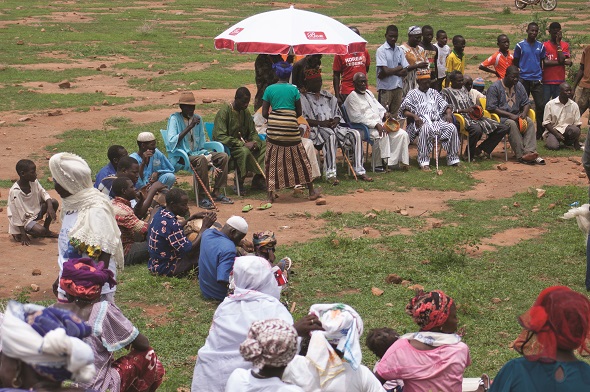
The ownership and control of the land is a question of concern for pastoralists and agriculturists who will be collectively referred to as the peasants. Historically the land was controlled and owned by ethnic based traditional leadership in association with the clergy. Under this regime, relations between pastoralists and agriculturists are not always antagonistic. Pastoralists can provide a valuable source of manure, meat and milk to agricultural villages in return for grazing, water and food. The relations have often been characterised by negotiation, mediation and commerce through which the traditional leadership and clergy play a role. Both agriculturalists and pastoralists have a united class interest as peasants against traditional feudal leaders. Both groups have an investment in land reform carried out at the expense of traditional leaders whether they be secular chiefs or Islamic clergy.
Such conflict can be triggered by traditional leaders’ poor governance and inability to control intergroup conflict. This conflict takes place at the local level of village raids, murders and reprisal attacks, but can also bleed into organised insurgencies. This was seen when some traditional Fulani leaders in Mali were supporting the Tuareg rebels and not protecting Fulani pastoralists from attacks by armed Dogon agriculturalist groups. This led to Fulani pastoralists turning against their traditional leadership and aligning with Islamists affiliated with Al Qaida in the Maghreb. Pastoralist groups have also broken from their traditional leadership in places and aligned with Islamist and ethnic militia groups. Some of these groups have adopted progressive measures to win the support of the peasantry such as land reform and abolishing rents. The groups have increased the intensity of pastoralist vs agriculturalist conflict in addition to implementing extreme sectarianism and social conservatism in the case of the Islamists.
Bourgeoisie vs Peasants
The main avenue through which peasants in the Sahel struggle with the bourgeoisie is through the struggle with the bourgeois state. The bourgeois state was founded in the form of a French invasion and subjugation of the overwhelmingly peasant society with the cooperation of some sections of the traditional leadership. Within the agrarian-dominated regions, the pre-invasion structure was partially kept intact however the extensive lands mostly used by the pastoralists were brought into State control. The colonial state undertook a program of expanding agricultural land at the expense of pastoralism which the neocolonial states continued after independence. Not only did this reduce the total land and water rights that could be utilised by the pastoralists, it also destroyed corridors of pasture used to move herds, further entrenching the conflict between the peasants.
French interests, later joined by American and then also Chinese and Russian companies are engaging in an ongoing process of oil drilling, cash cropping and mining of gold and uranium to this day. These interests competed with the peasantry for land and water. To extract the resources, the French colonial authorities and later the neocolonial governments needed to secure the frontiers that were disproportionately inhabited by pastoralists. This led to the beginning of government oppression of the pastoralists and the resulting insurgency.
The French and later Western bourgeois intellectuals also brought ideas of Malthusianism and imperialist environmentalism to the Sahel. Based on racist pseudoscience and a lack of understanding of ecology they considered pre-colonial society, especially the peasants, as irresponsible stewards of natural resources who could not be trusted to preserve water, wildlife, forests and soils. Based on the incorrect demographic writings of Malthus, they also believed that the growing population of the Sahel could not be supported by the current carrying capacity of the land and hence the colonial state would have to strictly control the utilisation of natural resources by the peasantry. This resulted in a proliferation of forestry and water authorities which consisted of militias tasked with preventing the peasants from using land locked up in preserves. State foresters prevented pastoralists from using branches of trees as protective corrals or livestock feed which was among a host of indignities fostered upon the peasants. This regime continued in the neo-colonies after they declared independence in the 1950s and 60s. Unsurprisingly, state foresters are the first targets of the Islamist insurgencies.
Bourgeois discourses around environmentalism have focused on the visceral effects of climate change and desertification on the conflicts among the peasants of the Sahel. While the effects of these put massive pressure on the people of the Sahel it is a secondary factor compared to the pairing of the clash of the modes of production with capitalist exploitation and state formation. This can be proven by the fact that the political economy of the conflict remains even in years of plentiful rainfall. Through this, the Western bourgeoisie and their national compatriots in the Sahel mystify the primary social causes of this conflict.
As the areas frequented by the pastoralists tended to be on the edge of the zones of control of the colony, agriculturalists were generally concentrated closer to towns and cities. Pastoralists to this day tend to be found in the more remote areas close to the Sahara desert, within vast forests and borderlands. Geographically agriculturalists are at an advantage when accessing urban markets, and services and influencing state policy around issues such as land distribution and anti-insurgency. As a result pastoralists face the brunt of the attack on the peasantry by the bourgeois.
Bourgeois vs Working class
There is a rapidly growing urban proletariat and rural working class within the nations of the Sahel. In some cases, the bourgeois are even hiring workers to drive livestock in a manner similar to the pastoralists. Most of the working class, especially women, are employed in the informal sector, largely working for a multitude of petit bourgeoisie enterprises. Within rural areas, armed local capitalists and mercenaries such as the Wagner Company profit from the work of mining and other extractive industries.
Industrial militancy throughout the Sahel is on the rise. In Niger, union membership has been rapidly increasing and the national union federation threatened a general strike before the coup. Since the coup militancy has continued as the Juntas of the Sahel stand with capitalists against the working class. Workers of the British company Endeavour Mining in Burkina Faso began industrial action in January which judges banned. In early June, Aguibou Bouare who is the trade union secretary general of the National Union of Banks, Insurance Companies, Financial Institutions and Business of Mali was arrested on charges of malpractice within the union. The union then took an extended strike pressing for his release.
In terms of the working-class movement in the streets, the relationship with the Juntas has been mixed. While working-class people participated in the anti-French and US military protests, however, some movements of working-class people have been directly antagonistic to the Juntas. Protests against inflation and blackouts have been met with political repression and the jailing of organisers.
Nationalism vs Imperialism
When the French granted the nations of the Sahel formal independence, it maintained its imperial control through neo-colonialism. The French state continued to train and exert much influence on the armed forces, police and intelligence services in countries such as Mali, Guinea and Burkina Faso. Major economic resources such as uranium mines remained in the hands of French companies. It collaborated with reactionary generals to carry out coups and assassinations against political leaders opposed to this policy. Most countries in the region still use the CFA French Franc which the French directly controlled till 1978. To this day, France forces all CFA Franc users to deposit 50% of their foreign currency reserves in the French Central Bank in an act of naked exploitation preventing the development of these economies.
The ideological background of the nationalisms present in the Sahel are Pan-Africanism, African Nationalism and African Socialism. These ideologies were formed in a united opposition to European colonialism. Post-independence they represented non-aligned tendencies that aimed to overcome neocolonialism. It was in part a project of modernity aiming for the development and unification of the post-colonial states in Africa. They were also projects of state formation begun by the colonisers. It also harkened back to a past traditional African society, allegedly free of class divide. These projects failed due to both a campaign by the former colonial powers and an internal failure to achieve their program and a strengthening of the neocolonial state. These ideologies continue today as a form of nationalism in various African countries and the diaspora.
The Islamist insurgency and government anti-insurgency have taken a great toll on the peasants of the Sahel. The French and American forces assisted these neocolonial states including the deployment of their respective troops. This allowed the continued extraction of imperial profits by safeguarding the uranium, gold and oil industries. Despite the atrocities and human rights abuses committed by the counterinsurgency aligned with imperialism they met an impasse and were unable to bring the wars to a conclusion. Mass movements emerged in urban areas such as the leftist Pan-Africanist M62 movement in Niger calling for the expulsion of US and French troops, and the ending of French neocolonial control of the economies. These movements took the form of militant protest and civil disobedience including surrounding a French barracks. Dissatisfaction with the war effort and continued poverty laid the subjective conditions for political strife. The weakness of the United States and French-led counterinsurgency alongside increased economic and political relations with Russia and China laid the objective conditions for the coups in Mali, Burkina Faso and Niger.
The new military governments responded to popular demands by expelling the French and American forces in 2024. Instead, cooperation with the Russian armed forces and the Wagner private military company increased. In some cases, gold mining concessions were granted to the Wagner group in exchange for counterinsurgency. In responding to allegations of being pro-Russian, Mali’s Foreign minister, Abdoulaye Diop, was quoted as saying, “We will no longer justify our choice of partner. Russia is here on demand by Mali and responds efficiently to our strategic needs.” The Malian army and Russian mercenaries in the Wagner group face allegations of human rights abuses by the Western press and human rights organisations. This includes mass summary execution, rape and pillaging which United Nations human rights experts have called to be investigated.
The new military Juntas have a degree of support from urban working people but still rely heavily on local capitalists and traditional leaders. The compliance with the popular demand of expelling the French and pausing uranium exports to France is progressive however more conservative sectors of the Juntas bases have led to increased reaction. An example is the family code proclaimed by Burkina Faso’s parliament with the blessing of the Junta. The code erodes the rights of women, legalises child marriage lists and criminalises homosexuality with imprisonment. Reactionary nationalists erroneously point to homosexuality and feminism being a ploy by imperialists to control the country and not the progressive outcome of changes to the family form with modern industry and popular struggle.

Islamism vs Imperialism
The Islamist organisations of the Sahel have had to make concessions to win the support of sections of the peasants, especially the pastoralists. This has included fighting against the neocolonial states’ rule and authority in certain peripheral areas of the Sahel. They are fighting aspects of imperialism to do with the imposition of a bourgeois neocolonial state that the nationalist forces enable. The Islamists have fought against the armed forces of the Sahel states when in alliance with France and the US. The Islamists have also fought against the various Juntas forces which are currently allied with Russia which the majority of RCO members regard as a semi-peripheral imperialist power.
Nationalism vs Islamism
The Pan-Africanist nationalisms of the Sahel and Islamism are both positions of partial opposition to imperialism and neocolonialism. While nationalism takes a modernist road, Islamism is in large a reaction against this modernism behind imperialism and its neocolonialist state. Many of the Islamist movements in the Sahel have their origins in certain dissident tendencies formally within the Algerian National Liberation Front (FLN) during its successful war of independence against France culminating in 1962. Despite the victory, some members were dissatisfied with the governing FLN inability to finish the anti-colonial revolution and their secularism. This movement combined with Algerian mujahideen returning from fighting the Soviets in Afghanistan to create a strong Islamist movement. The Islamists won the first round of the legislative in 1992 which was followed by a military coup by generals to preserve secular nationalism against the popular will. The civil war that ensured was lost by the Islamists however their cadres and arms sparked the Islamist conflict to the south in the Sahel. Islamism is a bourgeois reaction against the failures of bourgeois secular nationalism.
The Islamists stand in opposition to liberal ideology. While this can result in acquiescing to the peasant’s progressive demands against the neo-colonial state it also results in a stark rejection of progressive causes associated by the Islamists with Western thought. Women’s and Queer liberation are violently rejected. Fundamentally in defending the rights of Pastoralists, the Islamists are fighting for a mode of production that is dying and hence is standing against progress as opposed to the development of agriculture and later the abolishment of the division of town and country.
Communism vs Imperialism
At the basis of the conflicts in the Sahel is the conflict between the pastoralist and the agrarian modes of production. The proletariat is different from all other classes in that the destruction of class societies and the abolition of unevenness of development are its interests. The abolition of the difference between country and town is core to the communist programme. The Islamists and Nationalists can sometimes support progressive demands but will not carry out the agrarian revolution to its conclusion and will at times oppose this.
Their strongest heritage of proletarian revolution in the region is the movement around Marxist soldier, Thomas Sankara, in Burkina Faso who took power in an officer-led coup in 1983. The French economic interests were nationalised and there was the project of rapid industrialisation, improvement of agriculture and extension of public services. At the same time, Thomas Sankara fought for the unity of African states against the colonial powers albeit in a manner more akin to bourgeoisie anti-imperialism rather than proletarian internationalism. In 1987 he was assassinated in a French-backed military coup.
The active Communists in the region are mostly from the Sankarist tradition. While so far there seems to be a tailing of the pro-junta nationalism, it remains to be seen if this will continue. It is of great importance to understand the relationship of these Sankarists to the workers’ militancy and the mass protests against inflation. Developing a correct position on the political economy of the Islamist insurgencies will also be vital in the struggle for organising the rural workers and waging a united struggle in cities and rural areas against capitalism.

 PARTISAN!
You must be logged in to post a comment.