Anthony Furia provides a first-hand account of the University of Melbourne Gaza Solidarity occupation.

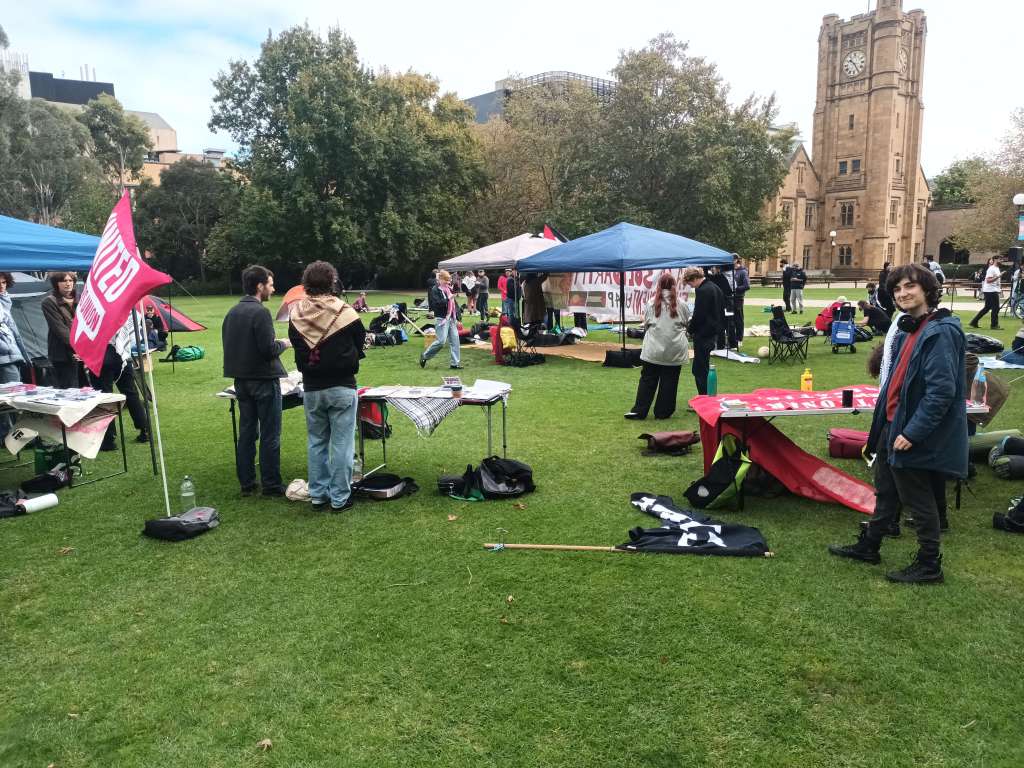
The encampment maintains a steady supply of food and water, provided by individual donors and community groups. Often meals are cooked in semi-bulk quantities and delivered to the encampment. Other than food and water, various designated waste bags function as rubbish disposal, and there are numerous tents and sleeping supplies that are “free” (temporarily provided by community members). Most of these tents are set up, and sit empty. Attempts have been made to establish communal “studying spaces” for students, in addition to a large prayer space.
The activities being run are limited in scope and sparse in attendance. There are multiple basic “police training” courses (for those who are willing to engage in potential escalation), in addition to a routine teach-in on how the University of Melbourne (UniMelb) aids Israel and the defence contractors. Other teach-ins seem to have been proposed and subsequently abandoned, or simply not communicated well enough for any of our comrades to be aware of them. Notably absent is education on historical occupations/encampments, or long term strategic and tactical methods for encampments.
The camp structure currently sustains a little over 100 people consistently throughout the day, with numbers dropping to 50-60 during the evening and overnight. The structure itself is confusing, vague, and lacks clear authority or guidance – multiple passers-by and casual visitors have approached comrades from the RCO under the assumption that we were in charge or a position of authority. Most meetings are called and guided by three central members of UM4P – an unelected committee which works to maintain the encampment as is and holds some semblance of authority due to their role in calling the encampment. Requests by RCO members for a security liaison between the group and the RCO/others have reportedly been rebuffed. Rather, information travels by word of mouth, with major events and meetings announced on the Signal channel. Meetings that are called are often delayed, or simply don’t happen at all (as was the case this morning), and there has been a total absence of direct communication about the escalation with organised groups at the encampment (RCO, SAlt, and U4P).
What the camp is “planning” is thus up in the air. Monday (today) will reportedly involve a march, and the announcement of a deadline for escalation (likely Tuesday), followed by vague plans for an escalation (of some sort) by Wednesday morning.
We don’t know the details due precisely to the lack of formal communication. In the medium term there are two major risks to the continuation of the camp; the failure of any act of escalation, given the current lack of details and level of disorganised communication, and the potential for the camp to settle into a status quo in which it is rendered entirely ineffective and non-disruptive. These dangers are largely the result of the lack of democratic structure or clear lines of communication.
 PARTISAN!
You must be logged in to post a comment.