Sylvia Ruhl discusses recent mass coral bleaching on the Great Barrier Reef.
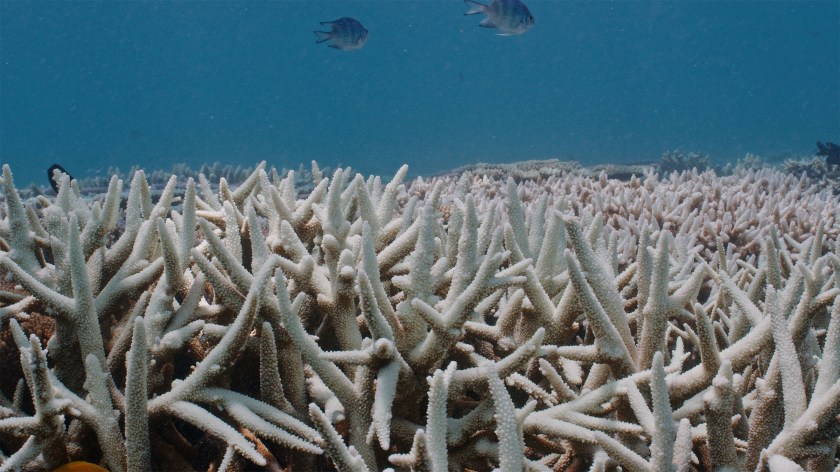
The Great Barrier Reef (GBR, also henceforth referred to as “the Reef”) has been afflicted with its fifth coral bleaching event in eight years, as confirmed by the commonwealth government’s Great Barrier Reef Marine Park Authority (GBRMPA) on the eighth of March, 2024. Mass bleaching in the Reef was first observed in 1998, and has been followed by subsequent bleaching events in 2002, 2016, 2017, 2020, and 2020. Aerial surveys of two thirds of the reef conducted by the Authority in conjunction with the Australian Institute for Marine Science (AIMS) have confirmed concerns among researchers that a widespread coral bleaching event is currently occurring across much of the Reef. The current bleaching event is consistent with the observed buildup of heat-induced stress resulting from sea surface temperatures remaining above the long-term average across the Reef (GBRMPA, 2024). The current bleaching event is most widespread and severe in southern sections of the Reef, with preliminary results indicating bleaching to be of mostly minor to moderate in severity on surveyed reefs in the central and northern regions of the GBR.
Further heat stress-induced bleaching is also once again underway further south in Quandamooka-Moreton Bay (CoralWatch, 2024), and on the reefs of Norfolk and Lord Howe Islands (Leggat, 2024; The Guardian, 2024). It should be noted that the Lord Howe Island reefs are the southernmost in the world, and their repeated bleaching in recent years has cast doubt on long-held hopes among coral reef researchers of high-latitude reefs serving as refuges for tropical species of coral (Moriarty et al, 2023).
Coral bleaching has occurred with increasing global frequency over the last thirty years as a result of an increased frequency of anomalously high water temperatures (Suggett and Smith, 2019). Although corals are capable of regaining their health and associated colouration following bleaching events, projected increases in the magnitude and frequency of these events are occurring at a pace far beyond which corals have evolved to cope with (Pandolfi, 2011).
Coral bleaching and death is but one, very publicly facing and visible aspect of the ongoing ecological crisis under capitalism. Mitigation of future global warming will require massive reductions in greenhouse gas output, which necessarily entails the elimination of wasteful and socially unnecessary production. Such a shift cannot occur under the dictatorship of capital due to the capitalists’ push towards the constant expansion of production and accumulation.
This highlights the necessity of a workers’ movement that, whilst maintaining a long-term aim of the establishment of a proletarian dictatorship, is able to be rallied against ecologically harmful developments, and in favour of environmental preservation and restoration.



 PARTISAN!
You must be logged in to post a comment.