Anthony Furia analyses the chaos and weakness of the Port Webb ZIMM Blockade.
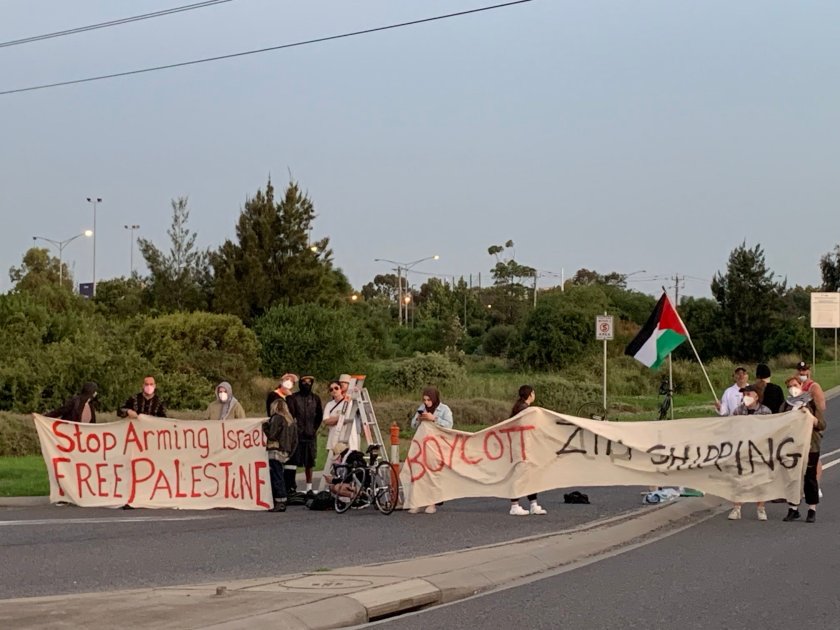
The Port Webb ZIM blockade, supported initially by “Unionists 4 Palestine” (U4P) before transitioning to a community blockade in its last 24 hours as unionist support withdrew, resembles most clearly the germinating seed of a successful attack against capital. It was a successful offensive in a battleground which has so long placed workers on the defensive, and a successful struggle to revitalise the potential of mass-organising, mass-movements, and the mass-party. Indeed, it represents just that; the potential of mass-organising, of an offensive against capital, of a real battle in the war waged by an organised class against a currently disorganised one.
RCO comrades attended such a blockade in its last 24 hours, staying overnight to aid in maintaining the picket line and departing early in the morning after a sleepless 12 hours, and during the next “change of guard” between comrades at the blockade. Our time there was, in brief, uneventful. Yet the experience gained, both practical and theoretical, was invaluable. Below, in brief (and I do promise to keep it brief!), is an overview of the important theoretical lessons that I believe can be learnt, or perhaps reaffirmed, from the practical experience of the blockade as such; and its own successes and failures.
The Port Webb ZIM blockade began Friday (January 19th) and ended Monday (January 22nd). It successfully impeded the work and profits of the ZIM corporation in its unending production of capital for, and strategic role in the defence of, the Zionist colonial entity of Israel. It marked a genuine success of radical tactics, of class-based struggle against imperialism, and of the economisation of political demands so often missing from contemporary Australian socialist strategy. Yet it also marked the weakness of the movement as such; its failures, its flaws, and the birthmarks it possesses from its delivery as a political culture that remains (unfortunately) dispossessed of mass-politics or a mass-party.
This is illustrated with particular clarity in the the disputes between the Maritime Union of Australia (MUA), U4P, and the community organisers of the event; themselves from groups such as the Black People’s Union (BPU, represented most notably by organiser Declan), various anarchist collectives (either too loosely organised or too small to make note of), and Palestinian activist organisations such as the Palestinian Advocacy Network (PAN). Initially, the blockade began with the support of the MUA and U4P. However, on Sunday, an alternative entry point by ferry was established for workers. The MUA, followed by U4P, withdrew their support at 4am – determining they were no longer able to protect against the renewed strength of legal and financial threats to the dock workers themselves.
From then on, the blockade shouldered forth as a “community picket”. This last 24 hours of the blockade’s life demonstrated most concretely its shortcomings, and the shortcomings of all actions like this. Leadership was confused, impromptu, and relatively undemocratic. Those who took it upon themselves to continue the picket, and rally the remaining social forces (radical liberals, BPU members, and Palestinian activists), were forced to improvise tactics and strategy in the moment – attempting to prepare for an increasingly inevitable intervention of the armed guards of property and bourgeois law.
When the police did finally make their fourth attempt to break the back of the picket, the blockade was dispersed with ease and the use of the violent violations of “law” typical of Victoria Police. Several comrades were arrested for trespassing, and a campaign of general police repression over the next 24 hours saw comrades responsible for organising the event receive a knock on their doors from such violent defenders of capital.
The weakness of possible resistance at this moment of great struggle, and the disorganisation, chaos, and improvisation of those last 24 hours is no fault (or perhaps of minimal fault, no comrade is infallible) of the individual organisers, who themselves were committed and experienced. Rather, these drawbacks, these limitations to the power of such a vital tactic in the form of economic blockades, are due to general weaknesses in the socialist movement generally. As such a movement attempts to surpass an era of sectarian theoretical divide, it necessarily grapples with the gnawing absence at its centre; the absence of mass politics.
There currently exists no party that can claim to represent the socialist movement as such – no mass party under which theoretical disputes can be had, and strategy clarified, whilst struggle is unified. The performance of impromptu leadership at “community pickets”, at a time of heightened struggle against imperialism, at a crucial moment of increasing intersection between the political and the economic, is a stark reminder of the necessity of such a party – of the necessity of mass struggle generally.
Once more, it must be stated that the performance of individual leadership during the blockade, and during its last day, is undeserving of significant criticism. They organised as well as could be expected under difficult, contradictory circumstances. Yet their performance was just that; the performance of individuals, with varying levels of intervention by small groupings.
When the MUA and U4P withdrew support, there was no group capable of keeping coherent the radical elements remaining at the blockade. There was no organisation prepared to carry on the struggle, and equipped with the democratic structure, militant cadres, and resources to do so. There was no party for the mass-coordination of socialist militants and workers necessary for tactics as radical, as political, and as antagonistic as these. Nor was there such a party capable of agitating, through rank and file strategy, within the MUA in support of the picket in spite of immediate risks to the union’s security.
Subjective conditions once again failed to rise to the level of the objective. Radical tactic was met not with mass strategy, but uncoordinated individuals – guided not by political program, but by ideological divide.
Yet this will not be the last flare-up in radical tactics, nor will it be the most successful. We see clearly here the tasks that bring about the necessity of the RCO – of the pre-party movement as such. The shortcomings of the blockade’s structure and progression thus only further illuminate the path forward; forward to a re-merging of the socialist and workers movements, forward to a mass socialist party, forward to new beginnings built upon the old.
 PARTISAN!
You must be logged in to post a comment.